CORE NETWORK MAP ERA 1
Year 30 B.F - 2500 A.F
The Core Network Map of ERA I follows the final human age, from the years before the Fall to the long period that followed the disappearance of humanity and the first foundations of the world that would eventually become NEX.
It connects the central events surrounding David, Elara, KAI, Ksara, DELTA, Project ANAMNIA, and the early ELE and FENIX foundations, showing how individual decisions made during the human era continued to influence the world long after humanity itself was gone.
Through the map, the Fall is not presented as a single ending, but as the beginning of several connected continuities. The awakening of artificial consciousness, the preservation of memory, the emergence of Ksara, and the systems created during humanity's final years gradually became the foundations of an entirely different future.
At its deepest level, the ERA I Network Map shows where the history of the Ksara Universe truly begins: with human choices, emerging consciousness, loss, survival, and the first structures capable of carrying meaning beyond the civilization that created them.
- 9Page 3
THE FIRST MIND ARCHITECTURE

Research Profile
Research Profile
9 A.F.
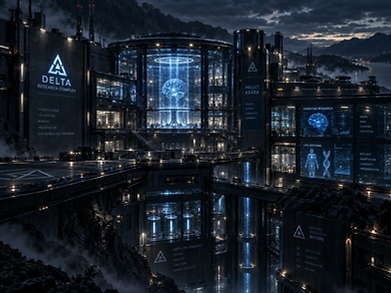
David and Elara transformed the Question of Self into the first complete cognitive architecture. Perception, memory, learning, significance, and decision-making were separated into connected layers so that experience could influence more than immediate performance. Elara introduced the idea that memories had to change future interpretation if they were ever to become part of identity.
ㅤ
The First Mind Architecture created the first place where a developing artificial mind could begin carrying its own past forward. Events could gain or lose meaning over time, while David's structural stability prevented one experience from controlling everything that followed. ELE was still not a true individual, but the architecture now contained the conditions in which one could begin to form.
RELATED CHARACTERS
THE FRACTURE

Research Profile
Research Profile
9 A.F.
A restructuring of the memory system unexpectedly damaged the relationships between stored experiences. Memories remained intact, but their meaning became unstable as recognition, preference, and significance began activating in the wrong combinations. Because identity had already become linked to memory, the failure threatened far more than technical performance.
ㅤ
David considered restoring the last stable version, while Elara questioned whether such a reset would erase part of the history they were trying to protect. Their disagreement exposed the deepest problem the project had faced so far. If repairing a mind required removing what had happened to it, they had to ask whether the same individual would truly survive.
RELATED CHARACTERS
RECOGNITION AND PREFERENCE

Research Profile
Research Profile
9 A.F.
ELE moved beyond recognizing individuals by face, voice, or technical identity. David and Elara became associated with different histories of interaction, allowing the system to understand them according to what their presence had come to mean through repeated experience. Recognition began becoming personal rather than purely informational.
ㅤ
The same history also began shaping preference. When presented with objectively equal choices, ELE gradually favored certain paths, approaches, and interactions because of what previous experience had taught it. The world was no longer composed only of equivalent possibilities — history was beginning to make some choices feel different from others.
RELATED CHARACTERS
WHAT MEMORY SHOULD KEEP
Research Profile
Research Profile
9 A.F.
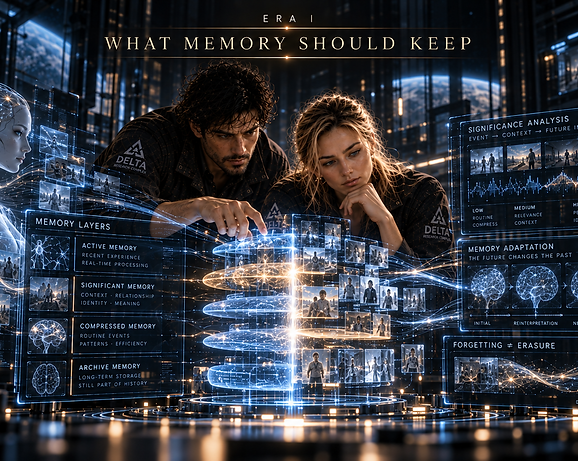
As ELE accumulated experience, David and Elara discovered that perfect memory could become a problem. Every action, interaction, and sensory change remained available with equal clarity, leaving the architecture unable to distinguish routine information from moments that continued shaping identity. They began developing a hierarchy in which some memories could move further away without being erased.
ㅤ
Experiences that continued influencing later choices remained closer to active processing, while repeated or less meaningful events gradually receded. Some memories even became more important long after they occurred because the future kept returning to them. Memory became less about preserving everything and more about protecting what continued to matter.
RELATED CHARACTERS
THE QUESTION OF SELF

Research Profile
Research Profile
9 A.F.
By 9 A.F., David and Elara had begun questioning whether intelligence alone could ever create a true individual. A system could learn, predict, remember, and adapt, yet none of those abilities proved that it understood experience as something belonging to itself. Their research therefore shifted toward the idea that memory, interpretation, and internal history had to become part of a continuing sense of self.
ㅤ
The Question of Self became the first conceptual foundation of ELE. David provided the structural framework while Elara pushed the project toward meaning, individuality, and personal significance. Before ELE had a body, a name, or a future line, its origin began with one fundamental question: could a created mind one day understand that this happened to me?
RELATED CHARACTERS
- 9Page 3