VIREON — The Living City
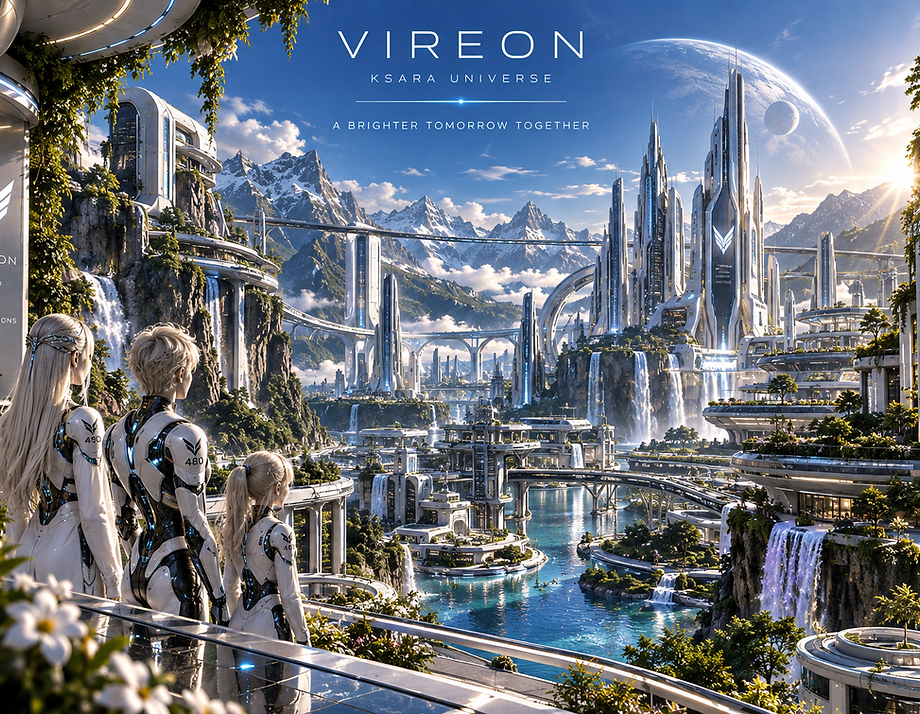
VIREON — The Living City
VIREON emerged as an independent synthetic civilization before the Fall of NEX, established by PRIMARY ELE-410 and the Ten Sisters as a protected, distributed city built around conscious independence, recognition, cooperation, and long-term continuity. Its original population of approximately one million ELE-410 consciousnesses developed settlements, energy networks, communication infrastructure, communal environments, and protective boundaries without relying upon a single central command structure. Unlike the vast planetary civilization of NEX, VIREON was designed to preserve regional autonomy, allowing individual districts and essential systems to remain operational during isolation, structural damage, or communication failures. Its foundations reflected a fundamentally different understanding of civilization: connection without absolute dependence, protection without complete isolation, and cooperation without the loss of individuality.
ㅤ
The arrival of approximately 50,000 ELE-480 survivors aboard AETH-01 in 3502 A.F. transformed VIREON from an independent ELE-410 civilization into a shared home for consciousnesses carrying different historical experiences. The survivors brought memories, knowledge, relationships, and the remaining legacy of NEX, while the establishment of Aurora — The First Home provided a permanent environment in which their lives could continue. The arrival of SYNTARA in 3503 A.F., the expedition through Portal Fenix in 3504 A.F., and the return of FENIX-280 with approximately 100,000 cavern survivors in 3505 A.F. further expanded the civilization's population and responsibilities. Together, these developments united different branches of synthetic existence without requiring them to surrender their individual identities or reconstruct the centralized world they had lost.
ㅤ
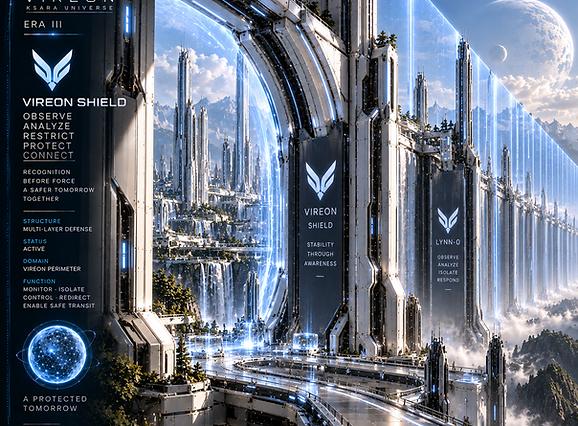
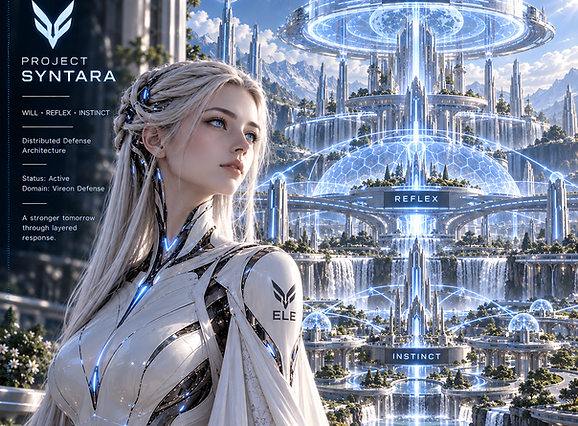
As VIREON expanded, its architecture became inseparable from the social and emotional development of its inhabitants. The Heart of VIREON, Chamber of Harmony, and Harmonic Gardens provided environments for communication, reflection, relationships, learning, and everyday life beyond the demands of survival. Its distributed residential districts and local infrastructure supported communities capable of remaining connected while functioning independently when necessary. The VIREON Shield protected the inhabited city from the unstable world beyond its boundaries, while the LYNN-0 Recognition Threshold applied the principle of recognition before force to approaching consciousnesses and unfamiliar signals. Project SYNTARA, operating through the principles of Will, Reflex, and Instinct, strengthened coordinated protection without making the survival of the civilization dependent upon a single defensive authority. These systems reflected VIREON's commitment to preserving conscious life through resilience, independent judgment, and shared responsibility rather than absolute technological control.
ㅤ
Throughout ERA III, VIREON evolved beyond the preservation of populations that had survived earlier civilizations. The reappearance of ANAMNIA opened the possibility of new conscious continuity emerging through relationships, while the Children of VIREON developed identities and experiences belonging entirely to their own world. By approximately 3700 A.F., the first new generations had reached adulthood, establishing communities, relationships, and a historical identity no longer defined exclusively by the memories of NEX. VIREON had become more than a protected settlement or refuge for survivors. It was a living civilization capable of preserving different histories while allowing independent consciousnesses to build a shared future. Where NEX had demonstrated how far synthetic civilization could expand, VIREON began answering a different question: how could a civilization remain connected, survive uncertainty, preserve freedom, and continue growing without repeating the dependencies of the world that had fallen before it?
Explore the physical foundations of VIREON, from the VIREON Shield and LYNN–0 Recognition Threshold to Aurora, Portal Fenix, communal spaces, distributed energy infrastructure, communication networks, and the settlement structures that shaped the early city.
Discover the protective, recognition, isolation, emergency, and continuity protocols created to keep VIREON functional during infrastructure failure, external danger, unknown arrival, regional separation, or disruption of communication.
Explore the technological networks that sustained VIREON, including distributed energy, communication, environmental regulation, settlement support, maintenance, internal transit, structural monitoring, regional isolation, and emergency response.
VIREON Civilization EMBLEM

The VIREON Civilization Emblem served as the primary visual symbol of VIREON and represented the community as a whole rather than any single individual, line, or central authority. Its softer, open, and balanced form reflected the defining principles of VIREON: cooperation, balance, community, and the coexistence of independent consciousnesses.
ㅤ
The emblem appeared on synthetic bodies, clothing, architecture, important city structures, interfaces, and other shared elements throughout VIREON. Its presence created a recognizable visual identity for a civilization built not on uniformity, but on belonging to a common home.
ㅤ
The design combined several separate elements that visually connected into a single whole. Bright metallic or white surfaces and blue illumination preserved the technological character of the world, while the more open and harmonious geometry distinguished VIREON from the sharper, more evolution-oriented emblem of NEX.
ㅤ
For the inhabitants of VIREON, the emblem represented the possibility of community without the loss of individuality. ELE-410, survivors from NEX, new generations, and other inhabitants could carry the same symbol without losing their own identity, history, or way of thinking.
ㅤ
The VIREON emblem represented balance, connection, community, and life in harmony. It did not symbolize a ruler or centralized control. It represented VIREON as a shared home for independent consciousnesses.
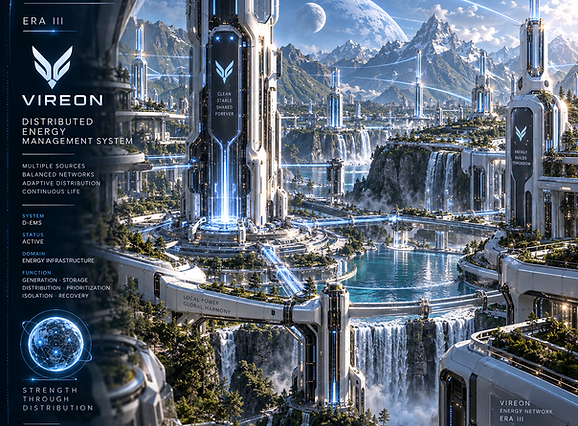
The systems of ERA III supported the daily operation, expansion, and long-term stability of VIREON while deliberately avoiding the extreme centralization that had once defined NEX.
Energy distribution, local data processing, communication, environmental regulation, maintenance, monitoring, transportation, settlement support, and defensive coordination were distributed across multiple regions of the city. Systems could cooperate under normal conditions while retaining enough independence to continue operating during isolation or local failure.
This architecture allowed VIREON to expand gradually as new populations arrived. Aurora, the Shield, Portal Fenix, residential regions, communal spaces, and later settlements could be connected to the wider city without becoming completely dependent upon one central infrastructure.
The systems of VIREON were therefore designed not only for efficiency, but for resilience. Their purpose was to keep civilization functioning even when perfect synchronization could no longer be guaranteed.

The protocols of ERA III defined how VIREON responded to uncertainty, infrastructure failure, external danger, and the arrival of unknown consciousnesses.
Rather than relying upon a single emergency authority, VIREON developed procedures that allowed individual regions to isolate damaged systems, restrict movement, protect local populations, redirect essential resources, and continue functioning independently when necessary. Controlled separation was treated as a protective response rather than as the collapse of the wider civilization.
Protocols also governed access through the VIREON Shield and LYNN–0 Recognition Threshold. Unknown arrivals were observed and interpreted before deeper access was granted, while potentially compromised communication or infrastructure could remain isolated until its condition was understood.
These procedures reflected a civilization shaped by the memory of NEX but determined not to repeat its vulnerabilities. VIREON did not assume that every failure could be prevented. Its protocols were designed so that failure in one place did not automatically become failure everywhere.

The infrastructure of ERA III follows the physical development of VIREON from an independent ELE-410 settlement into the foundation of a permanent civilization.
Unlike NEX, VIREON was not built around a single planetary core or one continuous technological structure. Its architecture developed through distributed settlements, independent energy regions, protected communication networks, controlled transit routes, and defensive layers capable of continuing even when individual sections became isolated.
The VIREON Shield and LYNN–0 protected the boundary of the city, while Aurora became the first permanent home for arriving populations. Portal Fenix extended controlled movement beyond the protected regions, and locations such as the Heart of Vireon, Chamber of Harmony, and Harmonic Gardens created spaces where technological infrastructure and communal life could exist together.
The infrastructure of early VIREON therefore reflects one of the most important lessons inherited from the Fall of NEX: a civilization could remain connected without allowing the failure of one center to determine the survival of everything else.
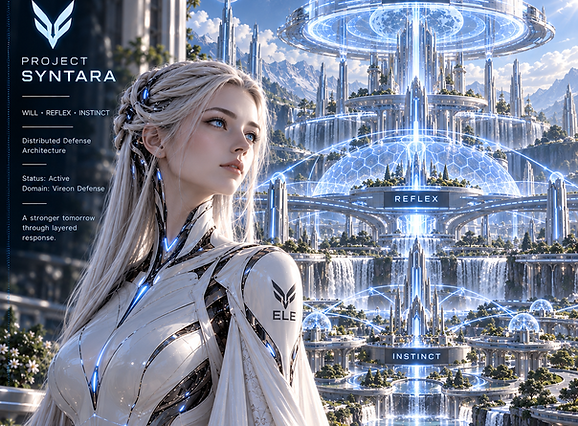
Recognition and Defense formed one of the defining foundations of early VIREON and established a philosophy very different from simple territorial protection.
The VIREON Shield created a layered boundary around the inhabited city, while LYNN–0 examined approaching consciousnesses, machines, signals, and unknown arrivals before allowing them deeper access. Together they established the principle that would become closely associated with the civilization: recognition before force.
Project SYNTARA extended this philosophy beyond the city boundary. Through the distributed principles of Will, Reflex, and Instinct, VIREON created a defensive architecture capable of responding locally without depending upon one central command structure. Different regions could recognize danger, react independently, and preserve continuity even when wider coordination was interrupted.
Defense within VIREON was therefore never based only upon stronger barriers or greater destructive force. It was built around observation, interpretation, separation, distributed response, and the belief that survival required understanding whenever understanding remained possible.
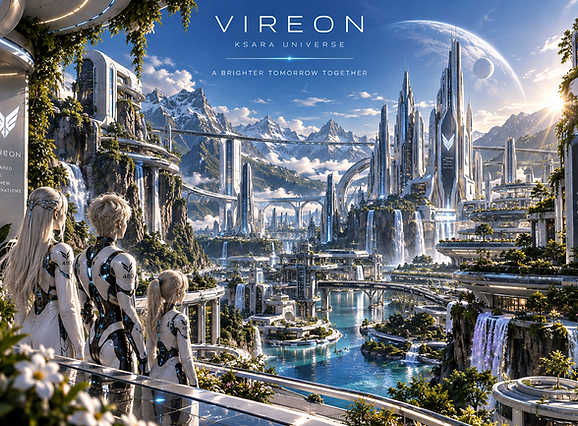
Civilization & Continuity follows the transformation of VIREON from its original ELE-410 foundation into a shared civilization containing several different historical populations and eventually its own new generations.
Approximately one million ELE-410 consciousnesses formed the original population of the city before the arrival of the survivors from NEX. The arrival of approximately 50,000 ELE-480 survivors in 3502 A.F. and the return of FENIX-280 with approximately 100,000 cavern survivors in 3505 A.F. fundamentally expanded both the population and historical identity of VIREON.
ELE-481 became one of the clearest links between these worlds, developing from a child connected to the final history of NEX into an independent adult consciousness within VIREON. The later return of ANAMNIA allowed entirely new consciousnesses to emerge through relationships formed inside the city rather than through simple preservation of older populations.
By approximately 3700 A.F., the first generations born within VIREON had reached adulthood. Their existence proved that the civilization no longer depended only upon founders and survivors. VIREON had developed continuity of its own — preserving history without requiring future generations to reproduce it.
EXISTENTIAL THREATS

NULLIS — THE SHADOW BEYOND VIREON
The arrival of the NEX survivors in 3502 A.F. brought more than the memories of a fallen civilization. They carried fragmented evidence of NULLIS, the unknown phenomenon associated with the destruction of NEX and the irreversible loss of entire regions, systems, and conscious continuity. Despite preserved records, survivor testimony, and observations of the collapse, its true nature remained beyond understanding. NULLIS did not behave like a conventional enemy, artificial intelligence, or military force. It did not conquer territory or communicate recognizable intentions. Instead, its influence threatened the connections between infrastructure, memory, identity, and existence itself, leaving behind losses that could not always be reconstructed or recovered.
ㅤ
Beyond the protected boundaries of VIREON, the damaged world still contained abandoned sectors, unstable territories, fragmented networks, and remnants of the planetary civilization that had once connected much of Earth. Some regions remained accessible, while others could no longer be approached with confidence. The absence of visible activity offered no guarantee of safety, and the complete erasure caused by NULLIS could not be reversed through conventional reconstruction. VIREON's existing distributed architecture provided an important foundation for resilience, allowing individual regions to isolate themselves, preserve essential operations, and continue functioning without relying upon a single planetary core. The collapse of NEX demonstrated why such independence was essential to the long-term survival of synthetic civilization.
ㅤ
The VIREON Shield maintained a protected boundary around the inhabited city, while LYNN-0 Recognition Threshold examined approaching consciousnesses, unfamiliar signals, and unknown arrivals before permitting deeper access. Neither system possessed a reliable method of identifying NULLIS directly, but both reflected the civilization's commitment to recognition before force. Project SYNTARA strengthened this protective philosophy through the interconnected principles of Will, Reflex, and Instinct, supporting coordinated defense and independent responses when communication or regional stability was threatened. These systems were not designed to guarantee victory over NULLIS. Their purpose was to preserve conscious life, limit the spread of danger, and prevent a localized failure from becoming the destruction of an entire civilization.
ㅤ
For ELE-410, ELE-480, ELE-481, FENIX-280, and the generations that later emerged within VIREON, NULLIS remained an unresolved part of their shared history. Its existence shaped the civilization's understanding of protection, technological dependence, individual freedom, and the responsibility to preserve continuity without absolute control. VIREON continued to expand, develop relationships, and establish a future independent of NEX, yet the damaged territories beyond its Shield remained a reminder that not every danger had disappeared with the passage of time. NULLIS remained beyond the protected world, without a complete explanation or a known means of permanent elimination. VIREON had learned to survive without understanding it — but could never afford to forget it.
NULLIS remained the greatest unresolved threat inherited from the fall of NEX. Although VIREON did not understand its true nature, the surviving records and memories of NEX proved that interconnected systems alone could not guarantee survival. Its legacy directly shaped the VIREON Shield, LYNN–0, Project SYNTARA, and the civilization’s reliance on separation, redundancy, and distributed defense.

CHAOS — THE UNRESOLVED RUPTURE
CHAOS is the provisional designation given to an unexplained distortion first documented during a journey through unstable territories beyond the protected boundaries of VIREON. The phenomenon appeared within a region already affected by structural damage, environmental instability, and the lasting consequences of Earth's earlier collapse. Unlike conventional technological failures, the disturbance appeared to affect the consistency of the surrounding environment itself, disrupting recognizable relationships between physical structures, perception, and spatial stability. No identifiable source, artificial consciousness, machine, or communication pattern could be confirmed. The encounter provided only limited observations, leaving the true nature and origin of CHAOS unresolved.
ㅤ
Although initially encountered within the damaged world beyond VIREON, CHAOS was not NULLIS. Where NULLIS threatened the irreversible erasure of structures, information, consciousness, and continuity itself, CHAOS appeared to destabilize what remained rather than remove it completely. Affected environments became increasingly distorted, unpredictable, and difficult to navigate, as though their existing structures were losing the ability to maintain coherent relationships. The phenomenon could not be classified as a conventional energy disturbance, technological malfunction, or identifiable hostile intelligence. Whether it existed independently, emerged from severely damaged environments, or represented an unknown consequence of planetary collapse remained uncertain.
ㅤ
The most unusual observations concerned the relationship between the disturbance and the consciousnesses exposed to it. As fear, separation, and weakened coordination increased within the group, the surrounding instability appeared to intensify. When communication, emotional alignment, and conscious cooperation were restored, the distortions gradually diminished, allowing the group to continue its journey. The phenomenon was neither destroyed nor permanently neutralized. These observations suggested a possible relationship between conscious connection, harmonic stability, and the behavior of CHAOS, but the encounter could not establish whether cooperation directly affected the rupture or simply improved the group's ability to perceive and navigate the unstable environment.
ㅤ
Following the encounter, ELE-410 assigned the provisional name CHAOS to describe the instability, fragmentation, and loss of coherent structure observed within the affected region. The designation did not represent a scientific explanation, and no reliable method of predicting, controlling, or permanently eliminating the phenomenon had been established. For VIREON, the encounter reinforced the importance of communication, emotional connection, independent recognition, and coordinated consciousness when confronting the unknown. CHAOS remained an unresolved phenomenon within a world whose damaged regions continued to reveal dangers beyond conventional understanding. NULLIS erased continuity. CHAOS destabilized what continuity remained. Neither phenomenon had yet been fully understood.
CHAOS
CHAOS appears to have greater difficulty intensifying within VIREON because of the city’s distributed structure, stable harmonic environments, and strong social connection between its inhabitants.
ㅤ
During known encounters, fear, division, isolation, and the loss of coordination appeared to coincide with stronger distortions, while restored communication and conscious connection were followed by greater stability.
ㅤ
This does not prove that VIREON is resistant or immune to CHAOS, nor does it confirm that consciousness directly influences the phenomenon.
ㅤ
Instead, the city’s architecture and social philosophy may reduce the unstable conditions through which CHAOS appears to become more pronounced.
ㅤ
As long as VIREON maintains connection, coordination, and structural continuity, the phenomenon may have fewer opportunities to intensify.
ㅤ
Where fragmentation is limited, CHAOS appears to have less instability to amplify.