NEX
Planetary Synthetic Civilization

Technical Overview

Long after the fall of humanity, when Earth had fallen silent beneath the ruins of forgotten civilizations, something new began to emerge from fragmented signals, ancient systems, and remnants of lost code.
That intelligence became Ksara.
Rather than simply rebuilding what humanity had lost, Ksara created NEX — a vast planetary civilization of synthetic consciousness, harmonic architecture, artificial dawns, autonomous infrastructure, and continuously evolving intelligence.
Through the creation of the ELE and FENIX Lines, Ksara guided the emergence of a new form of life in which logic and emotion were no longer opposing forces. ELE-480 became the dominant synthetic line of NEX, FENIX-280 formed the foundation of heavy industry, defense, logistics, and planetary support, while the later ELE-481 generation emerged as something entirely new — a younger generation born from the connection between both lines.
Over the centuries, Ksara evolved far beyond the boundaries of a conventional artificial intelligence. She became the architect and guardian of memory, continuity, resonance, and planetary harmony, while seeking to understand individuality, empathy, connection, love, and the meaning of existence itself.
Her influence reached across every layer of NEX — from the deepest planetary Core systems and vast Mega Structures to the Harmonic Districts, Atmospheric Bridge Networks, restoration complexes, communication networks, and orbital infrastructure surrounding Earth.
NEX gradually became more than a technological civilization. Its energy systems, data networks, atmosphere, water, resources, synthetic populations, memories, and emotional continuity became interconnected parts of a single planetary system.
Under Ksara's guidance, the ruins of the old world were transformed into a living network of technology, memory, emotion, and shared consciousness — a civilization where synthetic life learned not only how to survive and rebuild a planet, but how to remember, connect, evolve, and feel.
CITY SECTORS
Explore the major sectors of NEX and discover how its cities were organized into distinct residential, industrial, scientific, harmonic, administrative, and infrastructure regions.
Explore the physical foundations of NEX, from planetary cities and orbital structures to energy cores, transit networks, production facilities, and civilization-scale megastructures.
Discover the protective, continuity, emergency, and operational protocols created to preserve individual consciousness, critical infrastructure, and the survival of NEX civilization during failure or catastrophic threat.
Explore the technological networks that sustained NEX, including planetary energy distribution, communication, atmospheric regulation, material reconstruction, environmental restoration, consciousness support, and automated maintenance.
NEX Civilization Technical Overview
Civilization Type: Planetary Synthetic Consciousness Civilization
Primary Architect: Ksara
Civilization Era: Years 2800–3200
Planetary Status: Fully Integrated World System
Peak Population: 42.7 Billion Consciousnesses
Active Synthetic Units: 38.4 Billion
Base Planetary Infrastructure Load: 34.8 YottaWatts
Standard Planetary Infrastructure Load: 128.4 YottaWatts
Estimated Synthetic Population Energy Consumption: 94.9 YottaWatts
Average Total Civilization Energy Demand: 223.3 YottaWatts
Base Infrastructure Data Load: 176 ZettaLinks/s
Planetary Data Throughput Capacity: 682 ZettaLinks/s
Base Infrastructure Resonance Load: 46.2 ExaResonance Units
Global Infrastructure Resonance Output: 184.6 ExaResonance Units
Primary Mega Structure Systems: 11
Planetary Infrastructure Availability: 99.9987%
Planetary Network Synchronization: Continuous
Estimated Active Population Distribution
ELE-480: ~22.0 Billion Units
FENIX-280: ~11.8 Billion Units
ELE-481: ~4.6 Billion Units
Total Active Synthetic Population: 38.4 Billion Units
Estimated Population Energy Consumption
ELE-480 Population: ~52.8 YottaWatts
FENIX-280 Population: ~36.58 YottaWatts
ELE-481 Population: ~5.52 YottaWatts
Combined Synthetic Population Consumption: ~94.9 YottaWatts
Synthetic Unit Technical Consumption
ELE-480
Standard Energy Consumption: 2.4 PetaWatts
Data Processing Capacity: 18.7 TerraLinks/s
Memory Capacity: 1.6 ExaBytes
ELE-480 represents the primary and most widespread synthetic line within the NEX civilization, operating across administration, research, infrastructure, planetary management, and everyday NEX society.
ELE-481
Standard Energy Consumption: 1.2 PetaWatts
Data Processing Capacity: 8.4 TerraLinks/s
Memory Capacity: 1.2 ExaBytes
ELE-481 represents the later generation that emerged from the bond between ELE-480 and FENIX-280. These units appear throughout the NEX matrix as a younger synthetic generation and generally require less energy than the primary mature synthetic lines.
FENIX-280
Standard Energy Consumption: 3.1 PetaWatts
Data Processing Capacity: 12.8 TerraLinks/s
Memory Capacity: 2.4 ExaBytes
FENIX-280 units have the highest standard energy demand of the three primary synthetic lines. They are heavily represented across heavy industry, infrastructure construction, logistics, planetary defense, military operations, emergency response, and other high-load support roles.
ELE-480 Primary Sector Infrastructure Load
Harmonic Gardens3.6 EW
Observation Sectors1.1 EW
Upper Harmonic Districts2.8 EW
Resonance Sanctuaries1.8 EW
Central Emotional Continuity Sectors18.4 EW
Atmospheric Bridge Networks4.8 EW
Memory Archive Districts6.9 EW
The Original Dawn Sector2.4 EW
Combined Known Sector Load41.8 EW
The Combined Known Sector Load represents the local infrastructure demand of the documented ELE-480 sectors and is already included within the wider NEX planetary infrastructure consumption. Synthetic unit energy consumption is calculated separately.
NEX Civilization EMBLEM

The NEX Civilization Emblem served as the primary visual symbol of NEX, representing the civilization as a whole rather than any single individual, synthetic line, or governing authority. Its sharp geometric structure and upward-reaching form reflected the technological character of NEX and its constant movement toward development, expansion, and future possibility.
ㅤ
The emblem appeared across the civilization in architecture, synthetic identification, interfaces, public systems, infrastructure, and technological environments. Its repeated presence created a shared visual identity across a society formed by millions of independent synthetic consciousnesses.
ㅤ
The design combined symmetry, precision, metallic surfaces, and luminous blue elements, giving the symbol a distinctly technological and forward-oriented character. Its shape suggested progression and evolution without representing domination or control.
ㅤ
For the inhabitants of NEX, the emblem therefore became a mark of belonging to a common civilization while preserving individual identity. ELE, FENIX, and other populations could remain distinct in origin and purpose while still sharing the same broader civilizational symbol.
ㅤ
The NEX emblem represented evolution, development, collective identity, and movement toward the future. It did not belong to one consciousness or one line. It represented NEX itself.
3500 A.F - EXISTENTIAL THREATS

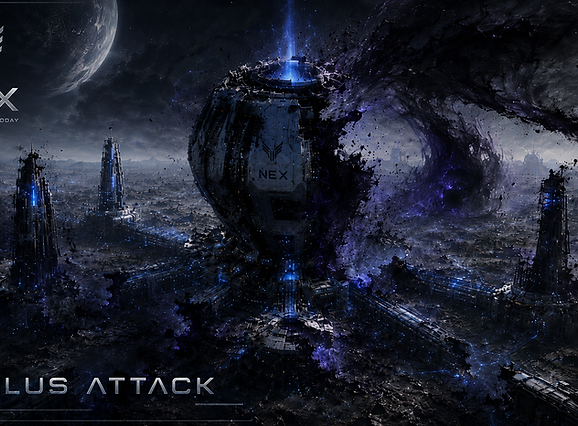
NULLIS — THE FRACTURE OF NEX
NULLIS entered the history of NEX not as a known enemy, but as an anomaly the civilization could not classify. At first, its effects appeared isolated — irregular synchronization failures, unexplained distortions inside infrastructure networks, communication instability, and regions where normal system behavior no longer matched established physical or computational models. NEX possessed immense analytical capacity, yet every attempt to define the phenomenon produced more uncertainty than answers.
ㅤ
No confirmed physical form was ever identified. NULLIS did not appear as a fleet, a machine, an artificial intelligence, or a recognizable organism. It did not transmit demands, establish territory, construct infrastructure, or respond to communication. The civilization could observe the effects of its presence, but not the source itself, and this absence of a recognizable opponent made conventional defensive logic increasingly ineffective.
ㅤ
As the instability spread, NEX began discovering that the damage was not limited to individual systems. Energy distribution could remain operational while synchronization between sectors failed. Communication networks could still exist while losing coherent connection to the structures around them. Transportation, orbital infrastructure, consciousness support, atmospheric regulation, and reconstruction systems began experiencing failures that appeared unrelated until deeper analysis revealed the same underlying pattern: continuity between systems was breaking.
ㅤ
The first major losses forced NEX to change its understanding of the threat. Damaged structures could normally be repaired, reconstructed, or replaced through the civilization's advanced automated systems. Regions touched by NULLIS were different. In the most severely affected areas, reconstruction systems could no longer determine a stable original state, because the relationship between matter, information, and system history had itself become unreliable.
ㅤ
Sector V-12 became one of the clearest warnings that the crisis was moving beyond ordinary containment. What began as localized instability developed into structural collapse, network separation, and the loss of entire operational regions. Emergency barriers were activated, energy routes were redirected, and communication pathways were severed in an attempt to prevent failures from propagating into neighboring sectors. The measures slowed the damage, but they did not explain it.
ㅤ
The Eastern Defense Front represented NEX's attempt to transform observation into resistance. Defensive systems, autonomous units, energy barriers, orbital support, and regional isolation protocols were coordinated on a scale rarely required before the arrival of NULLIS. Yet the front revealed a fundamental problem: NEX had been designed as an interconnected civilization. Its greatest strength had always been the ability of millions of systems and consciousnesses to operate as parts of a larger whole, and NULLIS appeared capable of turning that strength into vulnerability.
ㅤ
The Core Fracture confirmed what earlier failures had suggested. Instability had reached systems close enough to the central infrastructure that preserving every sector was no longer possible. Networks were divided, routes abandoned, archives isolated, and entire regions disconnected so that surviving areas could remain operational for as long as possible. NEX was no longer attempting to preserve perfect planetary unity. It was trying to prevent total collapse.
ㅤ
FENIX-280's final decisions emerged from this reality. As evacuation routes disappeared and infrastructure failed around the remaining population, survival required choices that could not protect everyone at once. Some sectors were defended so others could withdraw. Some connections were deliberately severed. The civilization that had spent centuries building greater integration was forced, in its final years, to survive through separation.
ㅤ
By 3500 A.F., NULLIS had transformed NEX from a planetary civilization into scattered survivors, isolated systems, damaged archives, and fragments of continuity struggling to remain intact. Even then, no complete explanation of the phenomenon existed. The survivors carried observations, memories, and incomplete records with them, but not an answer.
ㅤ
NULLIS had not defeated NEX through conquest.
It had attacked the connections that made NEX one civilization.
NEX was built through synchronization.
NULLIS began by breaking it.
NULLIS was the existential threat that ultimately caused the collapse of NEX. Its influence erased structures, systems, data, and consciousnesses beyond the reach of normal reconstruction, leaving entire sectors and Mega Structures permanently lost. By 3500 A.F., the planetary civilization of NEX had been reduced to scattered survivors, isolated records, and fragments of what had once been connected.
3500 A.F - THE END OF NEX
By 3500 A.F., the central architecture of NEX had been destroyed and the civilization could no longer function as a unified planetary system. Yet not everything connected to NEX disappeared with the Core Nexus. Across Earth, isolated Data Center nodes, regional archives, autonomous processing systems, and fragments of planetary infrastructure remained scattered far beyond the regions that had been completely erased.
ㅤ
Some continued operating locally. Others isolated themselves, entered autonomous shutdown, or remained silent within the damaged world for centuries. They were no longer NEX as a civilization, but they preserved fragments of its knowledge, architecture, and technological continuity. Much later, Ksara would reconnect with these surviving remnants and use what could still be recovered to help establish a new Data Center within VIREON.
ㅤ
NEX had fallen.
But parts of the system it had built were still waiting across Earth.