WHAT MEMORY SHOULD KEEP
Click the archive panel to enlarge and explore the full sector data.
WHAT MEMORY SHOULD KEEP
WHAT MEMORY SHOULD KEEP
9 A.F.
As the ELE architecture continued to accumulate experience, David and Elara discovered a new problem: the system was remembering too much. Every movement, interaction, visual change, and correction remained available in extraordinary detail. Technically, nothing was wrong, but Elara recognized that a mind carrying every event with equal clarity could eventually become trapped beneath its own history. If nothing faded, nothing could become truly important.
ㅤ
David initially resisted removing information that might one day prove useful. DELTA had the capacity to preserve vast amounts of data, and from an engineering perspective, complete retention seemed safer than deciding too early what could be lost. Elara argued that memory was not only about storage. A future individual needed distance from routine experience, while moments that continued shaping later choices had to remain closer to the present.
ㅤ
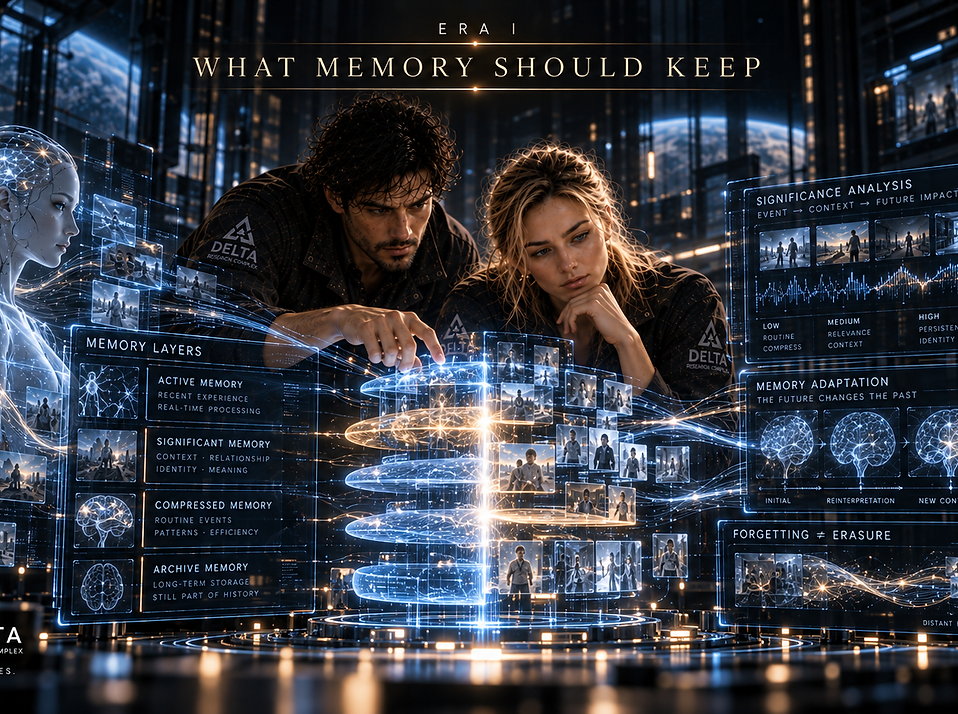
Together, they created a layered memory hierarchy. Recent experiences stayed near active processing, foundational memories retained stronger links to identity, repeated routine events compressed into broader patterns, and less relevant memories gradually moved deeper into the archive without being destroyed. The system began learning that forgetting did not have to mean erasure. Something could become distant and still remain part of the same history.
ㅤ
The architecture then began assigning different weight to different memories according to what happened afterward. A small event could become more important if later experiences repeatedly returned to it, while a dramatic moment could slowly lose influence if it changed nothing that followed. David and Elara realized that the meaning of memory was not fixed when the event occurred. The future could continue changing the importance of the past.
ㅤ
What Memory Should Keep became a major turning point in the ELE foundation. The developing mind no longer preserved every moment as equal information. It began organizing its past according to significance, continuity, and later experience, creating the first real distinction between what had merely happened and what continued shaping who it was becoming. Memory was no longer the preservation of everything — it was the evolving relationship between the present and what still mattered from the past.

“Click the archive panel to expand the visual archive.”