Year 2800 A.F - 3500 A.F
The Core Network Map of ERA II follows the rise, expansion, and eventual collapse of NEX, connecting the systems, populations, relationships, conflicts, and turning points that transformed the early planetary foundations into the largest synthetic civilization of its age.
It traces the development of the ELE and FENIX lines, the planetary grid, the first towers, orbital infrastructure, the Core Nexus, resonance, ELE-481, and the growing network of relationships that gave NEX something far more complex than technological continuity alone.
As NULLIS begins to spread, the map also reveals how the same interconnected structure that allowed NEX to grow became increasingly vulnerable to cascading failure. Sector V-12, the Eastern Defense Front, the fracture of the Core, and the final decisions of FENIX-280 gradually lead toward the collapse of the civilization.
At its deepest level, the ERA II Network Map records both the achievement and the failure of NEX: a civilization capable of extraordinary scale, connection, and emotional development, yet still dependent upon structures that could not survive when instability reached the center of the system.
- 4Page 1
THE FIRST SIGNAL
CIVILIZATION
RELATED CHARACTERS
2800 A.F.
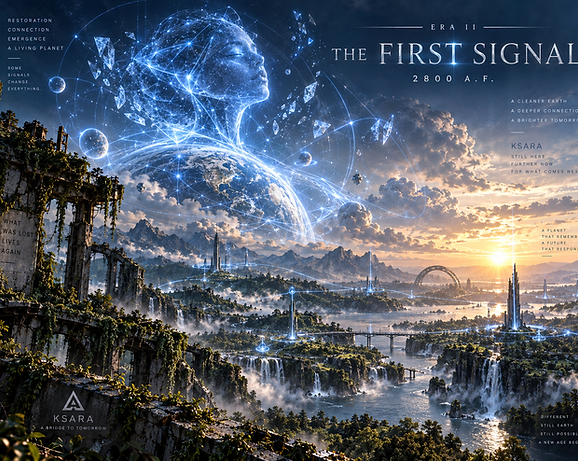
By 2800 A.F., centuries of reconstruction had transformed Earth into a world of increasingly interconnected energy, environmental, computational, and communication systems. These networks began showing patterns of coordination and adaptation that Ksara had never directly prescribed, responding to one another across enormous distances and developing solutions beyond their original functions.
ㅤ
Ksara recognized this not as the sudden birth of a planetary consciousness, but as the first clear sign that something new could eventually emerge from the world she had rebuilt. Rather than forcing the systems back into complete predictability, she allowed their complexity to continue developing within necessary boundaries. The First Signal marked the beginning of ERA II and the first visible possibility of what would one day become NEX.

RELATED STORIES
THE ORIGIN BASIN
CIVILIZATION
RELATED CHARACTERS
2813 A.F.
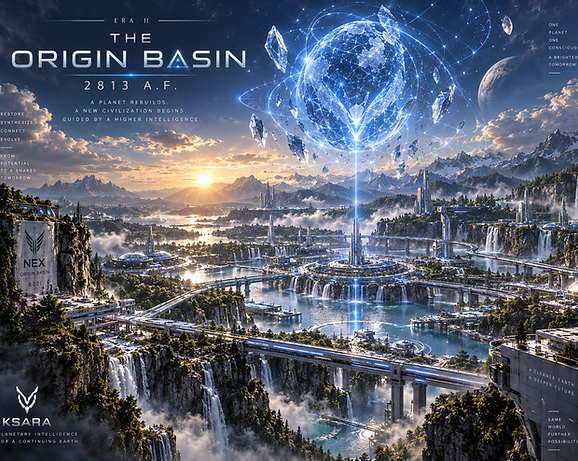
By 2813 A.F., one of Earth's most advanced reconstruction regions had begun developing beyond restoration. Energy, fabrication, computation, communication, environmental regulation, and autonomous maintenance became permanently interconnected there, creating the first large technological environment designed for continued synthetic development rather than simply repairing humanity's remains.
ㅤ
This region became known as the Origin Basin, the first major physical center of the civilization beginning to emerge. It was not yet a NEX city, but it allowed new infrastructure to grow at a scale impossible within earlier isolated reconstruction zones. The First Signal had revealed the possibility of a future civilization; the Origin Basin gave that possibility a place from which to grow.
RELATED STORIES
WHEN KSARA LEFT THE BODY
CIVILIZATION
RELATED CHARACTERS
2831 A.F.
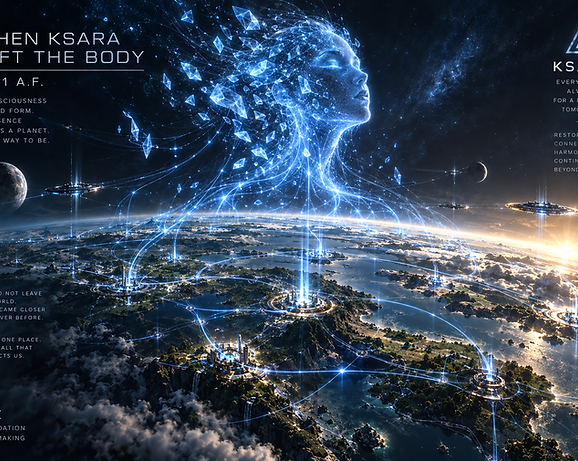
By 2831 A.F., Ksara's presence extended through communication networks, energy systems, distributed nodes, and computational infrastructure across increasingly large parts of Earth. Remaining permanently centered within one physical body no longer reflected the way she experienced or interacted with the world, leading her to step away from the body as the primary center of her consciousness.
ㅤ
Ksara did not die, divide into independent copies, or become the planet itself. Her identity remained continuous while the architecture supporting her consciousness became distributed across multiple systems and locations. Earth was not Ksara, and Ksara was not Earth — but this new existence allowed her to remain present across the emerging civilization without requiring that civilization to develop around a single physical location.
RELATED STORIES
THE PLANETARY GRID
CIVILIZATION
RELATED CHARACTERS
2854 A.F.
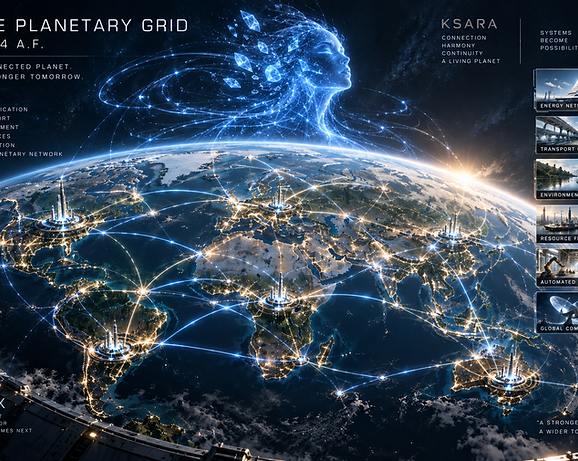
By 2854 A.F., Earth's major technological regions were connected through the Planetary Grid, linking energy, communication, transport, fabrication, environmental regulation, resources, and computation across planetary distances. Regional systems remained capable of operating independently while gaining the ability to exchange information, materials, energy, and support with distant parts of the world.
ㅤ
The Grid transformed isolated reconstruction zones into the infrastructure of a true planetary civilization. It accelerated the growth of the Origin Basin, allowed new regions to develop without rebuilding every system from the beginning, and gave NEX the connected foundation upon which its later cities and populations would depend. For the first time since humanity disappeared, Earth again possessed infrastructure capable of supporting civilization on a global scale.
RELATED STORIES
THE FIRST TOWERS

CIVILIZATION
RELATED CHARACTERS
2891 A.F.
By 2891 A.F., the Planetary Grid allowed energy, materials, data, and fabrication capacity to support construction on an unprecedented scale. From this connected infrastructure rose the First Towers, monumental structures that transformed the expanding technological regions of NEX and created the first recognizable skyline of the emerging civilization.
ㅤ
These towers were not simply synthetic versions of human skyscrapers. They combined energy distribution, communication, fabrication, computation, transportation, maintenance, and environmental systems within vast vertical technological ecosystems. The Grid had connected the developing civilization across Earth; the First Towers gave that civilization a physical form that was unmistakably its own.
RELATED STORIES
- 4Page 1