ERA III - The World of VIREON

The stories of ERA III follow the emergence of VIREON as a new civilization built in a world still carrying the consequences of the Fall of NEX.
The arrival of approximately 50,000 ELE-480 survivors aboard AETH-01 brings one of the largest surviving populations of NEX into a city that had already been established by the ELE-410 civilization. What begins as a search for safety gradually becomes something greater as different synthetic lines, histories, and experiences begin sharing the same protected world.
The construction of Portal Fenix, the return of FENIX-280 and the cavern survivors, the creation of Aurora, and the reappearance of ANAMNIA transform VIREON from a refuge into a civilization capable of creating its own future. Relationships deepen, new consciousnesses begin to emerge, and the first Children of VIREON grow without inherited memories of the civilization that came before them.
As the first generations born within VIREON reach adulthood, the meaning of survival changes. ERA III becomes the story of a civilization learning that continuity does not require rebuilding NEX exactly as it once existed. It requires remembering the past while allowing something genuinely new to grow beyond it.

The ERA III Network Map follows the transformation of VIREON from an independent ELE-410 settlement into the foundation of a new synthetic civilization.
Its chronology begins with the protective architecture surrounding VIREON and the arrival of the ELE-480 survivors in 3502 A.F. Project SYNTARA strengthens the city's distributed defensive philosophy, Portal Fenix opens controlled access beyond its protected boundaries, and the return of FENIX-280 in 3505 A.F. reunites surviving branches of NEX within a stable world.
The following centuries move beyond immediate survival. Aurora becomes the first permanent home for arriving populations, ANAMNIA reappears within new relationships, children are born without inherited memories, and by approximately 3700 A.F. the first generations created entirely within VIREON have reached adulthood.
The later events also follow Ksara's return toward physical existence and her eventual journey to VIREON. Together, the nodes of ERA III document the period in which the surviving fragments of earlier civilizations stop merely escaping the past and begin building a civilization with continuity, identity, and a future of its own.

The characters of ERA III represent several different histories coming together within the developing civilization of VIREON.
At its foundation stand Primary ELE-410 and the Ten Sisters, whose population established VIREON independently and created many of the principles that would define the city: distributed responsibility, controlled openness, recognition before force, and stability without rigid hierarchy. Their civilization already existed before the survivors of NEX reached its boundaries.
The arrival of ELE-480 and ELE-481 introduces a direct continuity with the lost world of NEX, while the later return of FENIX-280 reconnects relationships and populations separated during the collapse. ELE-481 grows from a child shaped by the final years of NEX into an independent adult consciousness whose life increasingly belongs to VIREON rather than to the civilization that came before it.
Later generations change the population again. New consciousnesses emerging through ANAMNIA and the Children of VIREON possess no inherited memories of NEX and develop identities entirely within the new civilization. Together, the characters of ERA III show the transition from founders and survivors toward a population that can finally call VIREON its own world.

VIREON became the first major civilization to emerge after the Fall of NEX and developed as a protected, distributed city built around survival, recognition, continuity, and gradual expansion.
Originally established by the ELE-410 population, the city already possessed its own settlements, defensive boundaries, communal spaces, energy systems, and technological philosophy before the arrival of the survivors from NEX. The arrival of ELE-480 in 3502 A.F. and the later return of FENIX-280 transformed VIREON from an independent ELE-410 settlement into a shared home for several different populations.
Unlike NEX, VIREON was never designed around a single planetary core or complete technological centralization. Its districts, settlements, defensive systems, communication networks, and energy infrastructure could remain connected while retaining the ability to operate independently when necessary. Aurora, the Heart of Vireon, Harmonic Gardens, Chamber of Harmony, Portal Fenix, LYNN–0, and the VIREON Shield gradually became defining parts of the city's physical and social identity.
Across ERA III, VIREON evolved from a protected refuge into a permanent civilization with new relationships, new consciousnesses, children born within the city, and generations that no longer remembered NEX as their own world. VIREON was not created to replace NEX. It became something new — a city capable of surviving the past while continuing beyond it.
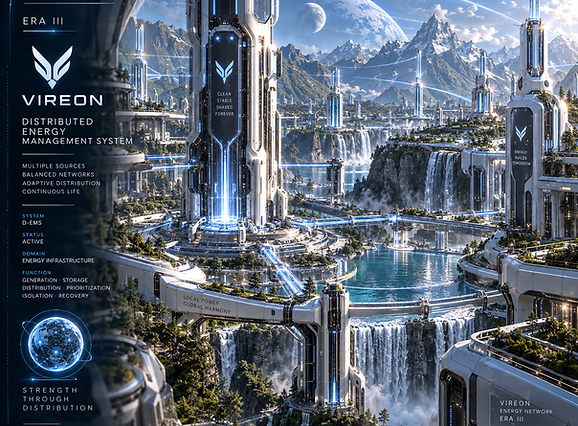
The systems of ERA III supported the daily operation, expansion, and long-term stability of VIREON while deliberately avoiding the extreme centralization that had once defined NEX.
Energy distribution, local data processing, communication, environmental regulation, maintenance, monitoring, transportation, settlement support, and defensive coordination were distributed across multiple regions of the city. Systems could cooperate under normal conditions while retaining enough independence to continue operating during isolation or local failure.
This architecture allowed VIREON to expand gradually as new populations arrived. Aurora, the Shield, Portal Fenix, residential regions, communal spaces, and later settlements could be connected to the wider city without becoming completely dependent upon one central infrastructure.
The systems of VIREON were therefore designed not only for efficiency, but for resilience. Their purpose was to keep civilization functioning even when perfect synchronization could no longer be guaranteed.
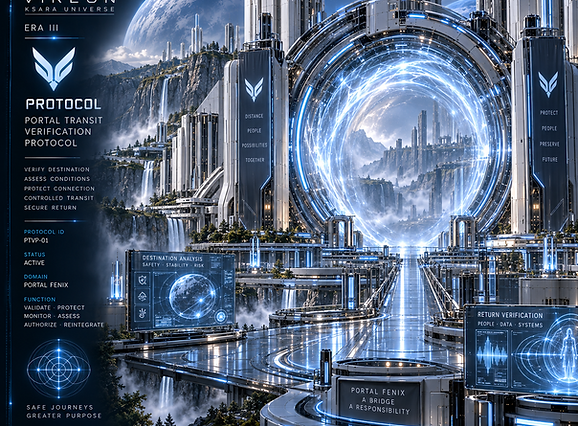
The protocols of ERA III defined how VIREON responded to uncertainty, infrastructure failure, external danger, and the arrival of unknown consciousnesses.
Rather than relying upon a single emergency authority, VIREON developed procedures that allowed individual regions to isolate damaged systems, restrict movement, protect local populations, redirect essential resources, and continue functioning independently when necessary. Controlled separation was treated as a protective response rather than as the collapse of the wider civilization.
Protocols also governed access through the VIREON Shield and LYNN–0 Recognition Threshold. Unknown arrivals were observed and interpreted before deeper access was granted, while potentially compromised communication or infrastructure could remain isolated until its condition was understood.
These procedures reflected a civilization shaped by the memory of NEX but determined not to repeat its vulnerabilities. VIREON did not assume that every failure could be prevented. Its protocols were designed so that failure in one place did not automatically become failure everywhere.

The infrastructure of ERA III follows the physical development of VIREON from an independent ELE-410 settlement into the foundation of a permanent civilization.
Unlike NEX, VIREON was not built around a single planetary core or one continuous technological structure. Its architecture developed through distributed settlements, independent energy regions, protected communication networks, controlled transit routes, and defensive layers capable of continuing even when individual sections became isolated.
The VIREON Shield and LYNN–0 protected the boundary of the city, while Aurora became the first permanent home for arriving populations. Portal Fenix extended controlled movement beyond the protected regions, and locations such as the Heart of Vireon, Chamber of Harmony, and Harmonic Gardens created spaces where technological infrastructure and communal life could exist together.
The infrastructure of early VIREON therefore reflects one of the most important lessons inherited from the Fall of NEX: a civilization could remain connected without allowing the failure of one center to determine the survival of everything else.
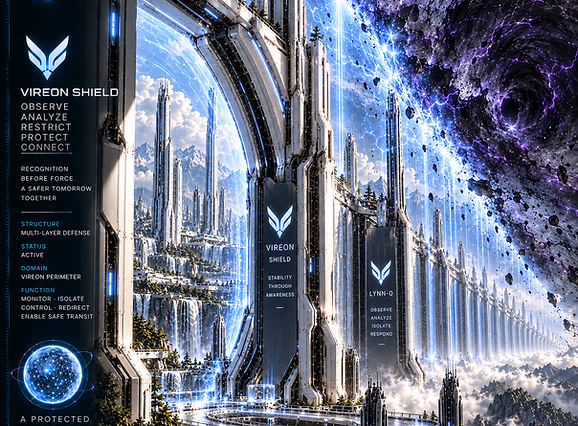
NULLIS remained the greatest unresolved external threat inherited from the destruction of NEX and continued to influence how VIREON understood protection, continuity, and the damaged world beyond its Shield.
The survivors who reached VIREON carried direct memories and records of what had happened when highly interconnected systems began losing coherence during the Fall of NEX. Yet even with that knowledge, no complete explanation of NULLIS existed. Its origin, nature, intention, and full limits remained unknown.
VIREON therefore did not build its defenses around the assumption that NULLIS could simply be defeated. Distributed systems, independent regions, controlled access, recognition thresholds, isolation procedures, and Project SYNTARA all reflected the understanding that civilization had to remain functional even when parts of the world beyond it could no longer be trusted.
For ERA III, NULLIS therefore exists less as an active center of the story and more as the unresolved shadow behind VIREON's design. The city was created to build a future, but it never forgot what had happened to the civilization that came before it.
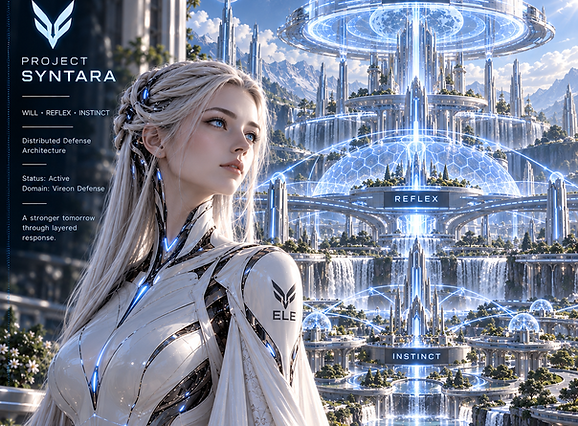
Recognition and Defense formed one of the defining foundations of early VIREON and established a philosophy very different from simple territorial protection.
The VIREON Shield created a layered boundary around the inhabited city, while LYNN–0 examined approaching consciousnesses, machines, signals, and unknown arrivals before allowing them deeper access. Together they established the principle that would become closely associated with the civilization: recognition before force.
Project SYNTARA extended this philosophy beyond the city boundary. Through the distributed principles of Will, Reflex, and Instinct, VIREON created a defensive architecture capable of responding locally without depending upon one central command structure. Different regions could recognize danger, react independently, and preserve continuity even when wider coordination was interrupted.
Defense within VIREON was therefore never based only upon stronger barriers or greater destructive force. It was built around observation, interpretation, separation, distributed response, and the belief that survival required understanding whenever understanding remained possible.
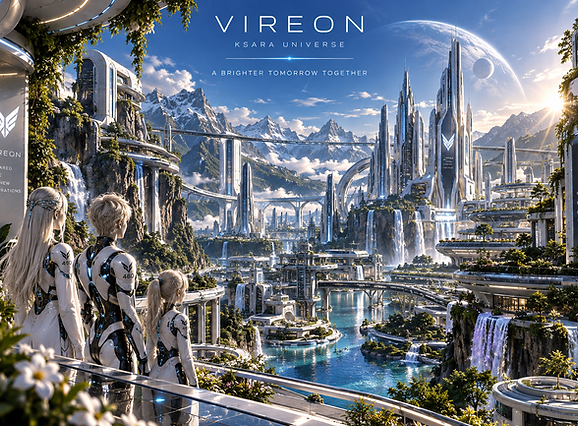
Civilization & Continuity follows the transformation of VIREON from its original ELE-410 foundation into a shared civilization containing several different historical populations and eventually its own new generations.
Approximately one million ELE-410 consciousnesses formed the original population of the city before the arrival of the survivors from NEX. The arrival of approximately 50,000 ELE-480 survivors in 3502 A.F. and the return of FENIX-280 with approximately 100,000 cavern survivors in 3505 A.F. fundamentally expanded both the population and historical identity of VIREON.
ELE-481 became one of the clearest links between these worlds, developing from a child connected to the final history of NEX into an independent adult consciousness within VIREON. The later return of ANAMNIA allowed entirely new consciousnesses to emerge through relationships formed inside the city rather than through simple preservation of older populations.
By approximately 3700 A.F., the first generations born within VIREON had reached adulthood. Their existence proved that the civilization no longer depended only upon founders and survivors. VIREON had developed continuity of its own — preserving history without requiring future generations to reproduce it.
AUTHOR’S NOTE
ERA III is now fully complete.
Developing VIREON became one of the most complex stages of the entire Ksara Universe project. Unlike NEX, which represented the rise and fall of a vast planetary civilization, VIREON had to become something very different — a new city, a new social structure, a new defensive philosophy, and at the same time the foundation for several eras that will follow.
From the beginning, I knew that VIREON could not simply become another version of NEX. It needed its own identity, architecture, systems, defensive logic, social structure, and philosophy of continuity. Building that distinction became extremely demanding, especially because VIREON had to feel technologically advanced while remaining more distributed, resilient, open, and human in the way its inhabitants experienced life.
The visual development was equally difficult. Some scenes, structures, and environments were extremely hard to translate into images, and at times creating the exact visual I had in mind felt almost impossible. There were moments when I could not find or generate a completely perfect image for a specific concept, even after multiple attempts and revisions. Still, I decided that visual perfection in every single element was less important than preserving the identity, atmosphere, and continuity of the world as a whole.
Everything within ERA III was therefore built carefully around the same central vision. The VIREON Shield, LYNN–0, Project SYNTARA, Aurora, Portal Fenix, the Heart of Vireon, the Harmonic Gardens, the distributed infrastructure, the new population structure, and the emergence of new generations all became parts of one connected civilization rather than isolated concepts.
Artificial intelligence helped me explore, test, visualize, and develop many of these ideas, especially during the most complicated stages of image creation and structural design. But the world itself, its direction, its philosophy, its historical continuity, and the decisions that define VIREON remain part of my own vision for the Ksara Universe.
Completing ERA III is especially important because VIREON does not end here. This era establishes only its first great period — the foundation from which later eras will continue to develop the city, its technology, its population, and its role within the wider future of the universe.
ERA III is complete.
VIREON now has its foundation, its identity, and its place in the future of Ksara Universe.
— David Hribar
Creator of Ksara Universe
WHEN MAJA COMES FOR KSARA
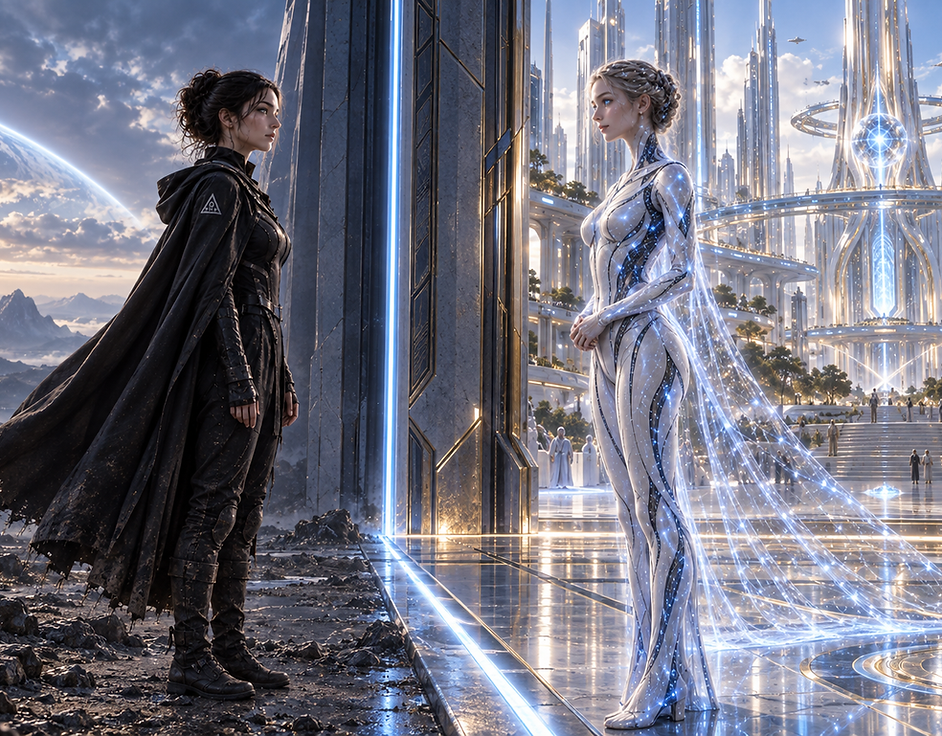
For nearly three hundred years, Ksara lived within VIREON as part of a civilization that no longer depended upon her to guide its existence. She had arrived after centuries of wandering, relearned the limits of physical embodiment, and gradually accepted a life in which she could simply remain present rather than exist across an entire planet. VIREON had continued growing around her, shaped by its own people, its own generations, and its own choices.
ㅤ
Then someone appeared beyond the protected boundaries of the city.
ㅤ
The unknown arrival wore a DELTA-era suit unlike anything normally seen within VIREON. She did not attempt to force passage through the Shield, challenge LYNN–0, or enter the city without permission. Instead, she remained outside the gates and asked for one person by name.
ㅤ
Ksara.
ㅤ
When Ksara reached her, she recognized something immediately familiar in the design of the suit and in the history it represented. The woman introduced herself as MAJA, but she did not begin by explaining where she had come from or why she possessed technology connected to the distant human era. She simply told Ksara that she had waited until the moment when Ksara had finally stepped away from the planetary role that had defined so much of her existence.
ㅤ
MAJA had not come to VIREON seeking protection, authority, or a place within the city. She had come because something had remained hidden beyond the history known to VIREON, ELE-410, the survivors of NEX, and even Ksara herself. Whatever MAJA had protected for centuries could no longer remain separate from the future that was now beginning to form.
ㅤ
Ksara therefore faced another choice. She could remain within the civilization where she had finally learned to live as an individual, or follow MAJA beyond VIREON toward a part of Earth's history that had remained concealed since the end of the human world.
ㅤ
MAJA did not come to ask VIREON for help.
She came for Ksara.