QUICK OVERVIEW
ERA I — The Human Era
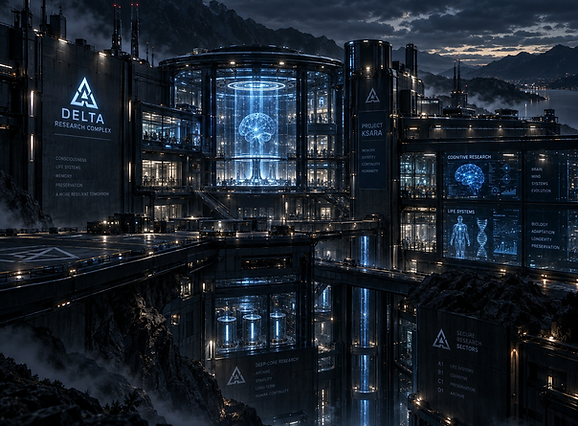
The locations of ERA I preserve the final physical traces of human civilization before Earth enters centuries of silence.
Sapienta represents one of the most important scientific and technological environments of the human era, connected to David, Elara, artificial intelligence research, and the development of systems that would eventually contribute to the birth of Ksara.
DELTA becomes equally important as a place of research, preservation, continuity, and hidden history. Long after the human world disappears, its surviving structures continue influencing events far beyond ERA I and eventually become important again thousands of years later.
Beyond these facilities lies the wider human world — cities, infrastructure, research networks, and technological systems that once supported billions of people but gradually disappeared during and after the Fall.
ERA I therefore explores not only where humanity lived, but the places where fragments of its knowledge, choices, and unfinished future remained long after humanity itself was gone.
NEX
Planetary Synthetic Civilization
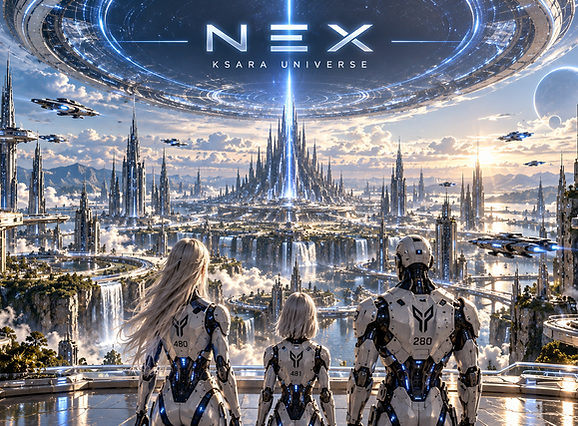
NEX was far more than a city. Over centuries it developed into an immense planetary-scale civilization built across multiple vertical layers, subterranean regions, orbital structures, artificial environments, and interconnected technological sectors.
Its architecture combined enormous towers, resonance districts, atmospheric bridges, floating structures, deep continuity corridors, industrial foundations, artificial gardens, archive regions, energy networks, and the vast Artificial Horizon above the inhabited world.
Millions of synthetic consciousnesses lived within a civilization where infrastructure responded continuously to emotional and harmonic conditions. Light, atmosphere, transportation, architecture, and resonance could change together with the collective state of the population.
By its final centuries, NEX had become something between a megastructure, a civilization, and a living technological organism — a world whose systems, inhabitants, memories, and consciousness had become almost impossible to separate from one another.
VIREON — The Living City

VIREON became the first major civilization to emerge after the Fall of NEX and developed as a protected, distributed city built around survival, recognition, continuity, and gradual expansion.
Originally established by the ELE-410 population, the city already possessed its own settlements, defensive boundaries, communal spaces, energy systems, and technological philosophy before the arrival of the survivors from NEX. The arrival of ELE-480 in 3502 A.F. and the later return of FENIX-280 transformed VIREON from an independent ELE-410 settlement into a shared home for several different populations.
Unlike NEX, VIREON was never designed around a single planetary core or complete technological centralization. Its districts, settlements, defensive systems, communication networks, and energy infrastructure could remain connected while retaining the ability to operate independently when necessary. Aurora, the Heart of Vireon, Harmonic Gardens, Chamber of Harmony, Portal Fenix, LYNN–0, and the VIREON Shield gradually became defining parts of the city's physical and social identity.
Across ERA III, VIREON evolved from a protected refuge into a permanent civilization with new relationships, new consciousnesses, children born within the city, and generations that no longer remembered NEX as their own world. VIREON was not created to replace NEX. It became something new — a city capable of surviving the past while continuing beyond it.
PRESERVATION COMPLEX
Human Continuity Facility
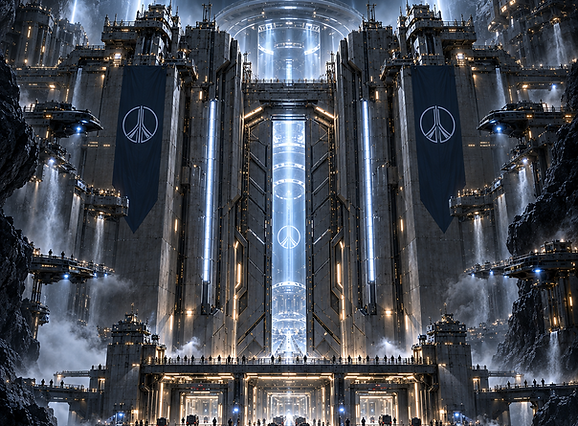
Preservation is humanity's final protected refuge, hidden deep beneath the damaged Earth and designed to maintain living human bodies across centuries of planetary instability.
Nearly one hundred million humans remain inside its chamber sectors, protected by medical systems, biological continuity networks, independent energy reserves, environmental infrastructure, archives, autonomous maintenance, and multiple defensive layers separating them from the world outside.
Preservation survived because it was never dependent upon a single system or intelligence. Entire sectors can isolate themselves, energy can be redistributed, communication can be severed, damaged infrastructure can be sacrificed, and deeper layers can continue operating independently.
For Ksara, the discovery of Preservation changes everything. Humanity did not disappear. It survived — but it survived inside a world from which it still cannot safely awaken.