THE FRACTURE
Click the archive panel to enlarge and explore the full sector data.
THE FRACTURE
THE FRACTURE
9 A.F.
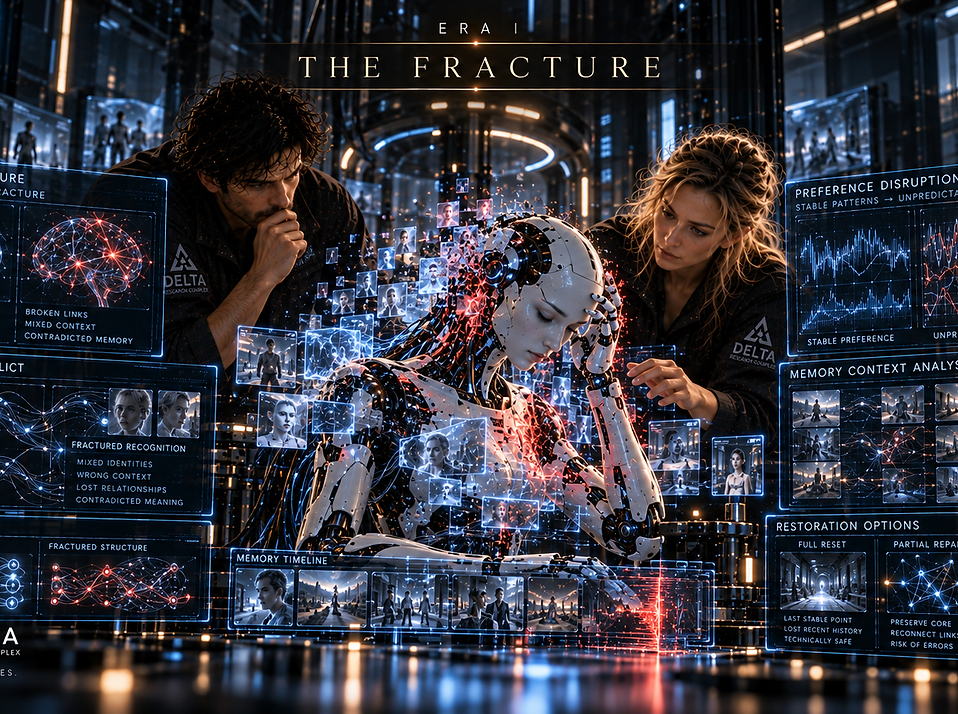
As the ELE architecture became increasingly complex, David began reorganizing parts of the memory system to reduce redundancy and improve access between older experiences. The change appeared safe: memories would remain intact while only the pathways connecting them were restructured. For a short time, the update worked exactly as intended. Then recognition, preference, and significance began producing contradictions. The memories were still there, but the relationships between them were starting to break.
ㅤ
The problem spread quickly. An interaction with Elara could activate memories associated with David. Older decisions appeared without the later experiences that had once corrected them. Preferences disappeared and returned unpredictably. The architecture still possessed its past, but it no longer understood how that past belonged together. David and Elara realized that the failure was not simply technical. Because memory had become part of identity, damaging the connections between memories meant damaging continuity itself.
ㅤ
David's first instinct was to restore the architecture to the last stable recovery point. From an engineering perspective, the solution was obvious. Months of work would remain intact, and only the recent unstable period would be lost. Elara stopped him before the reset began. If experience mattered because it shaped what came next, then erasing the fracture would not merely repair a system. It would remove part of the history that the developing mind had actually lived through.
ㅤ
For the first time, David and Elara confronted a conflict between technical safety and personal continuity. David wanted to preserve the architecture strongly enough that it could continue functioning. Elara wanted to preserve the history strongly enough that survival would still mean something more than returning to an earlier version. Their disagreement became sharper than usual, but neither treated the other as an obstacle. Both were trying to protect a different part of the same developing identity.
ㅤ
The Fracture became the most dangerous moment in the early ELE project. Development stopped completely while the unstable architecture was isolated inside a protected DELTA partition. David and Elara now faced a question they had never expected to answer so soon: if repairing a mind requires erasing what happened to it, has the mind truly survived — or has it only been replaced by an earlier version of itself?

“Click the archive panel to expand the visual archive.”