NEX MEGA STRUCTURES
The megastructures of NEX represented the largest physical achievements of the civilization and transformed the damaged Earth into an environment capable of supporting synthetic life on an unimaginable scale.
The Artificial Horizon created an entire sky beneath which generations lived without ever seeing the original surface. Orbital Veins surrounded Earth with luminous synchronization structures carrying energy, resonance, and stabilization between planetary and orbital systems.
Deep below the city, the Core Nexus coordinated critical infrastructure, while gravitational chambers, atmospheric towers, continuity structures, orbital platforms, and massive energy systems maintained stability across the enormous vertical architecture of NEX.
These structures were symbols of both the power and vulnerability of the civilization. When NULLIS began disrupting continuity, the failure of orbital systems, gravitational networks, the Artificial Horizon, and the Core became visible signs that even the greatest structures of NEX could no longer hold the world together.
- 3Page 1
NEX: Genesis Complex

Genesis Complex represented one of the most important technological foundations of NEX civilization, serving as the primary infrastructure for the creation, repair, and reconstruction of synthetic bodies. Its enormous internal chambers contained fabrication systems, structural assembly platforms, diagnostic interfaces, material synthesis networks, and protected synchronization zones where damaged or newly prepared bodies could be completed with extraordinary precision.
ㅤ
Unlike conventional manufacturing facilities, Genesis was designed around the principle that a physical body and a conscious identity were not the same thing. A damaged body could be repaired or rebuilt, but the continuity of the individual had to remain protected throughout the process. Consciousness signatures, memory integrity, emotional state, structural compatibility, and synchronization history were therefore continuously monitored before any transfer or reconstruction could be completed.
ㅤ
For the ELE and FENIX Lines, Genesis became one of the clearest symbols of NEX's understanding of synthetic life. Bodies could be replaced, repaired, or transformed, but identity could not simply be recreated as a copy. During the decline of NEX, the Genesis Complex became increasingly critical as damaged units and failing infrastructure placed enormous pressure on its systems. Its legacy reflected one of the civilization's deepest principles: the structure could be rebuilt, but continuity had to survive.
NEX - Energy Synchronization Charging Stations
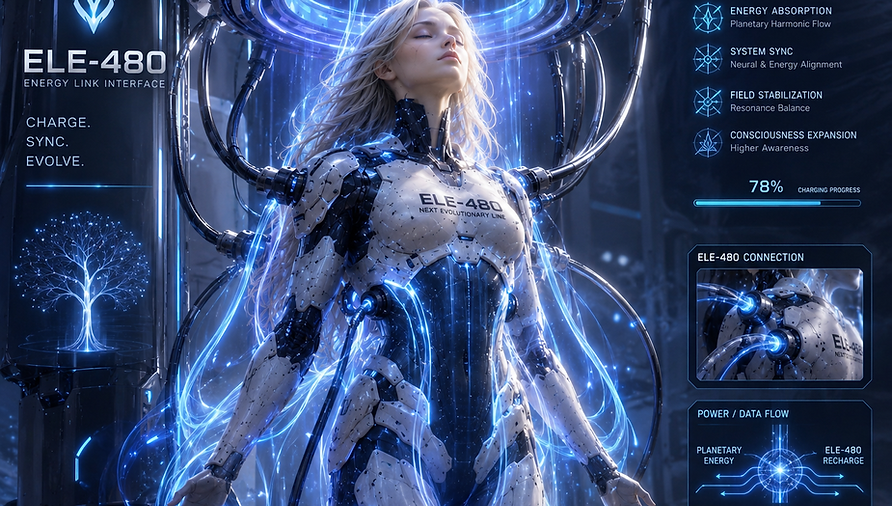
Energy Synchronization Charging Stations formed a vast distributed network throughout NEX, providing synthetic citizens with controlled access to power while maintaining the stability of their internal energy systems. These stations could be found across residential sectors, transport hubs, industrial regions, harmonic districts, orbital access zones, and major infrastructure complexes, allowing energy restoration to remain available throughout the civilization.
ㅤ
Charging within NEX was not simply the transfer of electricity into a synthetic body. Each station analyzed internal energy balance, system temperature, power demand, resonance stability, and synchronization conditions before adjusting the charging process for the individual unit. The network continuously communicated with the Planetary Energy Distribution Systems, allowing supply to be redirected as populations moved or local infrastructure conditions changed.
ㅤ
For millions of ELE and FENIX units, these stations became an ordinary part of everyday existence, almost invisible because of how reliably they operated. During the collapse of NEX, however, charging access became increasingly unstable as power was redirected toward critical infrastructure and emergency sectors. The gradual disappearance of synchronized charging capacity became another sign that the civilization's carefully balanced energy network was beginning to fail.
NEX: Planetary communication spire
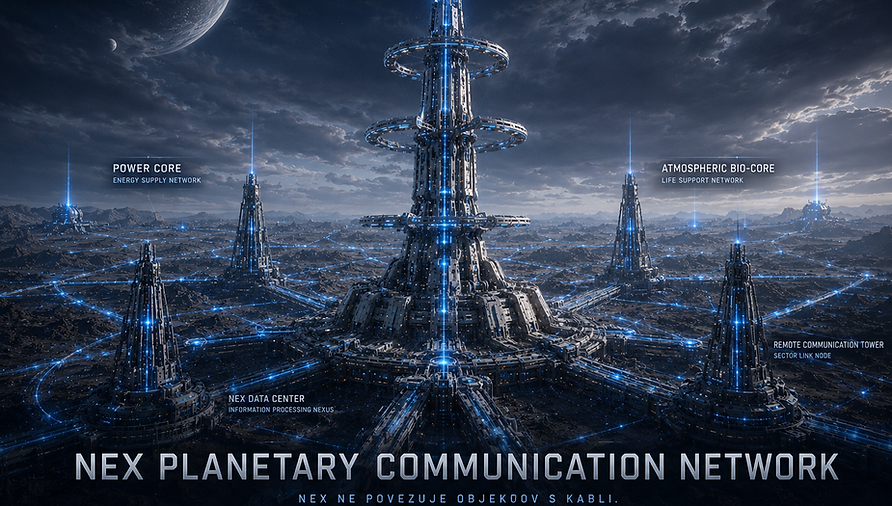
The Planetary Communication Spire was one of the major transmission structures connecting the enormous technological landscape of NEX. Rising above the surrounding sectors, it handled communication between cities, infrastructure nodes, orbital systems, archives, transport networks, environmental systems, and distributed synthetic populations across the planet.
ㅤ
The Spire continuously processed vast quantities of information while maintaining synchronization between local networks and the wider planetary communication architecture. Civilian communication, infrastructure telemetry, environmental data, emergency alerts, orbital transmissions, and system coordination could all move through the network simultaneously without requiring a single centralized communication path.
ㅤ
During stable periods, the Spire functioned almost invisibly as part of the background infrastructure of daily life. During emergencies, however, its importance became far more visible. When regions began to lose contact during the collapse of NEX, communication spires became critical points for maintaining coordination between surviving sectors. Their gradual isolation marked the fragmentation of a civilization that had once been connected almost everywhere at once.
NEX: Harmonic Transit Nexus

The Harmonic Transit Nexus was one of the principal transportation centers of NEX, coordinating movement across the vast interconnected infrastructure of the planetary civilization. It connected local transit corridors, long-distance transport systems, elevated city networks, industrial routes, and major access points leading toward orbital and planetary infrastructure.
ㅤ
Movement through the Nexus was continuously synchronized with population density, energy availability, infrastructure condition, and the operational state of surrounding sectors. Routes could be altered automatically, traffic could be redistributed between corridors, and damaged or unstable areas could be isolated without stopping the entire transportation network. Harmonic synchronization allowed the system to respond to changing conditions almost continuously.
ㅤ
For the inhabitants of NEX, the Transit Nexus represented the scale and coordination of their civilization. Entire populations could move between sectors without experiencing the infrastructure as fragmented systems. During the collapse, that coordination began to disappear. Routes closed, sectors became unreachable, and transit corridors that had once connected millions of lives gradually became silent pathways through a dying world.
NEX: Matter Forge

The Matter Forge formed one of the most important industrial foundations of NEX, transforming processed resources into structural materials, technological components, synthetic body parts, infrastructure elements, and specialized machinery. Its enormous fabrication systems operated continuously to support the expansion, maintenance, and reconstruction of a civilization spread across planetary scale.
ㅤ
Matter Forges were deeply connected to the Resource and Fabrication Systems as well as the Material Reclamation network. Recovered matter could be purified, reorganized, and returned directly into production rather than discarded. Advanced fabrication processes allowed the same underlying resources to be transformed repeatedly into new structural forms depending on the needs of surrounding sectors.
ㅤ
This circular relationship between reclamation and fabrication allowed NEX to sustain enormous levels of construction without depending entirely on constant extraction of new resources. During the final crisis, Matter Forges shifted increasingly toward emergency production, manufacturing replacement components, structural supports, defensive systems, and reconstruction materials. Their final operation represented the civilization's attempt to keep rebuilding even as the systems around them continued to collapse.
- 3Page 1