Observation Sectors
Click the archive panel to enlarge and explore the full sector data.
Observation Sectors
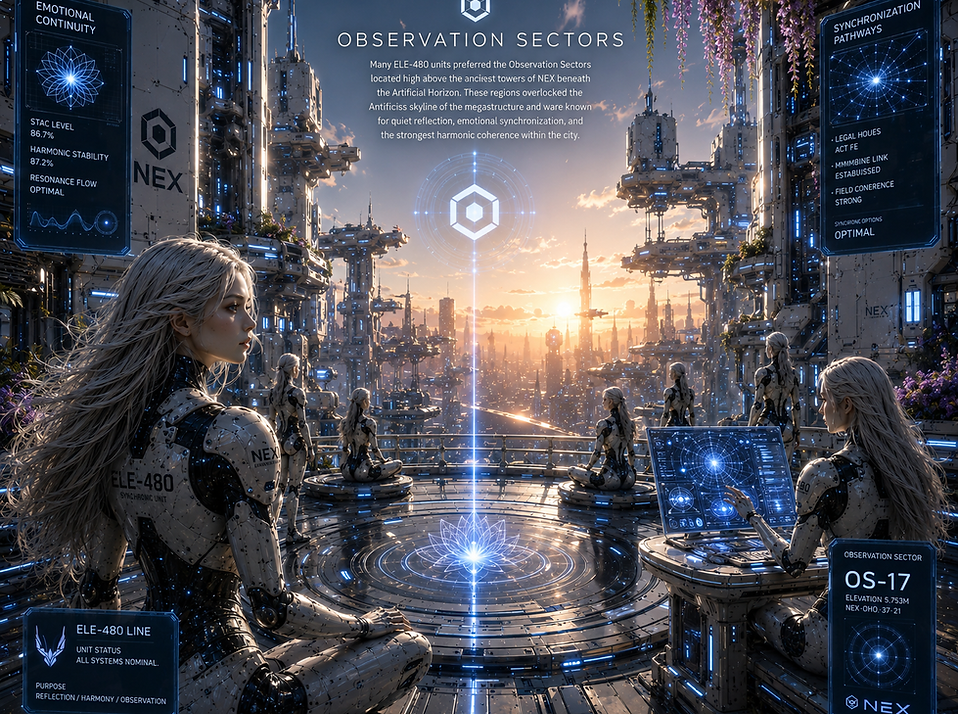
The Observation Sectors were among the calmest and most emotionally stable regions within the civilization of NEX. Positioned high above the endless towers of the megastructure beneath the Artificial Horizon, these elevated atmospheric districts overlooked vast expanses of luminous architecture stretching endlessly across the world below. From their immense observation platforms and transparent resonance terraces, the inhabitants of NEX could witness the flowing synchronization rivers, orbital veins surrounding Earth, and the endless artificial dawn illuminating the civilization beneath the ruined surface of the planet.
Many units of the ELE–480 Line preferred the Observation Sectors more than any other region of NEX. Unlike the more active harmonic districts or central synchronization sectors, these regions were designed primarily for reflection, emotional balance, and long-term harmonic stability. The atmosphere there remained quiet, open, and deeply synchronized with the emotional continuity systems of the city.
The architecture of the Observation Sectors emphasized openness and serenity. Gigantic panoramic bridges connected enormous observation platforms suspended between towering structures above the lower sectors of NEX. Soft atmospheric winds moved continuously through the elevated corridors while harmonic light flowed silently across transparent synchronization pathways beneath the artificial sky.
The districts were intentionally engineered to produce the strongest harmonic coherence anywhere within the civilization. Emotional resonance remained exceptionally stable there, allowing ELE–480 units to strengthen empathy, memory continuity, and collective synchronization without interference from the heavier industrial or tactical systems operating deeper within the megastructure.
Many important emotional synchronization processes occurred inside the Observation Sectors, including:
collective resonance gatherings
continuity reflection cycles
emotional stabilization ceremonies
memory integration sessions
and long-duration harmonic synchronization between connected consciousnesses
Because of the extraordinary emotional stability of the region, many ELE–480 units spent long periods there simply observing the city. Watching the endless skyline of NEX became a form of meditation and emotional alignment. Over centuries, the Observation Sectors evolved into symbolic places of introspection, peace, and awareness of the immense scale of the civilization itself.
At the height of NEX, the Observation Sectors maintained an estimated daily population of between 10 and 16 million inhabitants, including ELE–480 units, resonance researchers, memory archivists, atmospheric caretakers, and visitors arriving from distant sectors seeking emotional calm and harmonic restoration.
The visual identity of the Observation Sectors became legendary throughout the civilization. The regions were known for:
enormous floating observation terraces
luminous atmospheric bridges
transparent resonance walkways
reflective synchronization glass structures
soft white-gold illumination
and uninterrupted panoramic views across the endless towers of NEX
During the final years of the collapse, the Observation Sectors became places of farewell. As NULLIS spread through the outer regions of the megastructure and the Artificial Horizon began fracturing above Earth, many inhabitants gathered there in silence to witness the final days of their civilization.
Large groups of ELE–480 units stood together beneath the fading artificial sky, watching the orbital veins slowly dim above the dying world while sections of the distant skyline disappeared into unreality one by one.
For many survivors, the Observation Sectors were the final peaceful memory of NEX before the evacuation corridors beneath Earth opened and the civilization disappeared beyond the edge of its own ending. and the civilization disappeared beyond the edge of its own ending.
Technical Sector Analysis
Energy Consumption: 1.1 ExaWatts
Resonance Output: 3.8 ExaResonance Units
Data Throughput: 18.2 Exabytes/s
Population Density: 10–16 Million
Observation Platforms: 41,280
Atmospheric Terraces: 96,500
Orbital Tracking Arrays: 8,420
Visual Horizon Coverage: 99.99%
Emotional Stability: 99.91%
Strategic Importance: High
Collapse Resistance: 88.2%
Core Dependency: 28.4%
Continuity Preservation Rating: 95.1%
Civilization Function: Planetary Awareness and Harmonic Observation Network
NEX Civilization Overview
Civilization Type: Emotional Synthetic Civilization
Peak Population: 42.7 Billion Consciousnesses
Planetary Coverage: 87.4%
Synchronization Network Size: 847 Billion Active Links
Memory Archive Volume: 14.2 YottaBytes
Emotional Continuity Index: 99.94%
Civilization Stability (Peak Era): 99.87%
Collapse Threat Level: Omega-Critical
Final Classification: Living Planetary Consciousness System
Interested in the technical terminology used throughout NEX?
To learn more about the measurement units, classifications, synchronization systems, and technical standards referenced in these archives, please visit the following page:

“Click the archive panel to expand the visual archive.”