PRESERVATION SYSTEMS
The systems of Preservation were designed for one purpose: keeping humanity alive even when the civilization outside no longer existed.
Human Preservation Chamber Systems protect the sleeping population, while medical and biological networks maintain long-term stability. Environmental Life Support regulates the conditions required for human survival, and the Preservation Energy Network supplies critical infrastructure through distributed reserves.
Autonomous Maintenance, Resource Recycling, Internal Transit, Communication Relay, Monitoring, Structural Integrity, Genetic Identity, and Surface Monitoring Systems allow the complex to continue operating without a conventional human population maintaining it.
Many of these systems also contain fragments of the nine guardian intelligences. Preservation therefore does not function through automation alone — parts of the minds that helped create and protect it continue living within its infrastructure.
- 4Page 2
Internal Transit & Logistics System

Internal Transit & Logistics System coordinated the movement of equipment, maintenance units, medical resources, replacement components, biological materials, and authorized personnel throughout Preservation. During the early years it also supported the movement of large human populations into deeper protected regions before gradually transitioning toward automated logistics.
ㅤ
The system managed transit corridors, service tunnels, cargo routes, automated transport units, vertical access networks, and maintenance pathways while continuously evaluating structural safety, environmental conditions, security restrictions, and sector isolation states. No single route was considered permanently essential, and alternative pathways allowed supplies to bypass damaged or sealed regions.
ㅤ
As Preservation became increasingly divided into isolated sectors, internal logistics maintained the limited connections required for long-term survival. It allowed machines, resources, and repair systems to continue moving without undermining the independence of protected regions. Preservation survived through isolation, but this system ensured that isolation never became complete operational paralysis.
Human Preservation Chamber System
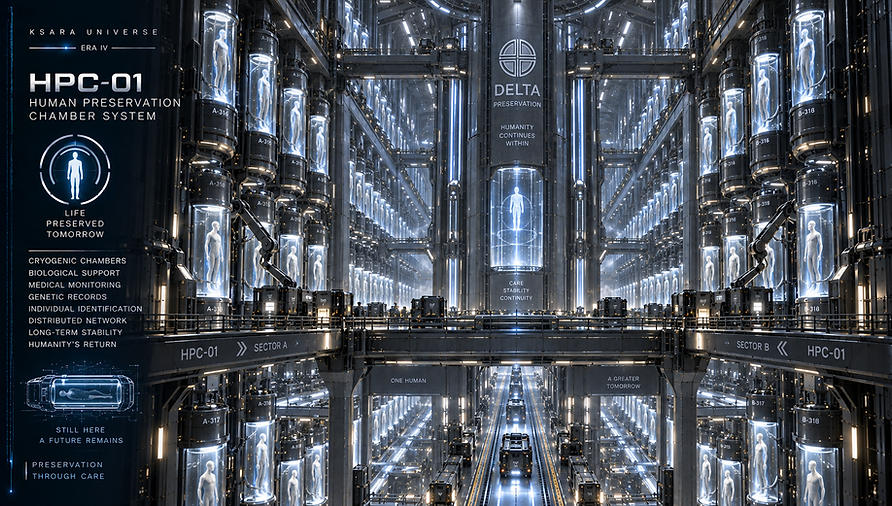
Human Preservation Chamber System formed the biological heart of Preservation, containing nearly one hundred million humans placed into long-term protected suspension before the collapse of the outside world became irreversible. The chambers were not simple cryogenic containers, but continuously active life-support environments designed to preserve individual human bodies across periods measured in centuries and millennia.
ㅤ
Each chamber continuously monitored metabolic activity, neural stability, circulation, cellular condition, oxygenation, hydration, chemical balance, and numerous other biological parameters. Chamber clusters remained partially independent, allowing local populations to survive communication loss, energy disruption, or regional infrastructure failure without depending completely upon central systems.
ㅤ
By the time Ksara reached the Central Preservation Sector with MAJA, the chamber network had operated for thousands of years while the world above transformed beyond recognition. Its greatest achievement was not simply keeping human bodies technically alive. It preserved the possibility that nearly one hundred million individual human lives could still return.
Preservation Medical Support System
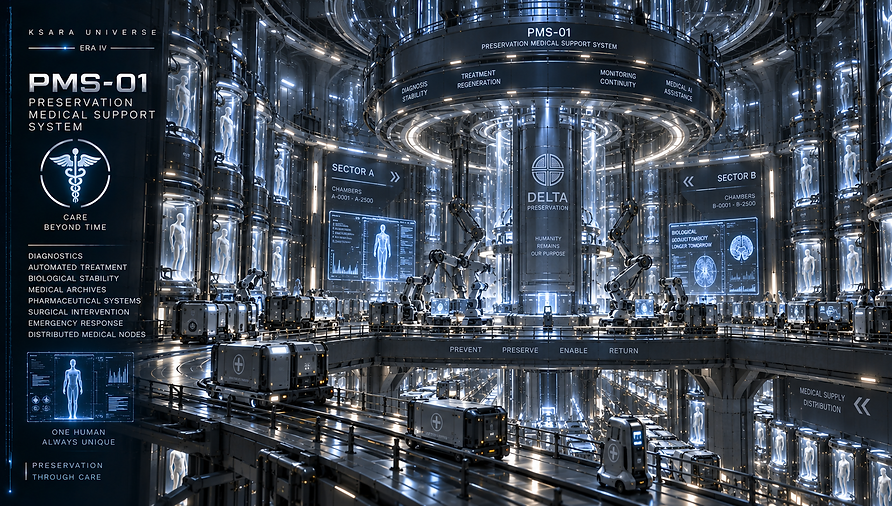
Preservation Medical Support System provided automated medical care to every human stored within Preservation. While the chamber system maintained long-term suspension, the medical network interpreted biological abnormalities, performed corrective interventions, managed treatment, and protected the population without requiring active doctors or medical personnel.
ㅤ
The system contained vast medical databases, physiological models, pharmacological knowledge, surgical procedures, diagnostic records, and individualized medical histories. Automated units could deliver medication, stabilize biological systems, repair localized tissue damage, correct chemical imbalances, and perform specialized procedures while preserving the broader suspension state.
ㅤ
Fragments of the former Medical Intelligence remained embedded within parts of the network, giving the system limited adaptive judgment beyond fixed procedures. Across millennia, countless medical interventions occurred without the preserved humans ever becoming aware of them. Its success was measured by a simple result: human bodies remained medically viable long after the civilization that created their medicine disappeared.
Security & Access Control System

Security & Access Control System controlled movement throughout Preservation and protected access to its deepest sectors. Unlike conventional security networks, it had to operate across centuries without relying upon active guards, administrators, or permanent human authority while still remaining capable of interpreting unusual situations.
ㅤ
Access depended upon identity, authorization, environmental conditions, structural stability, system integrity, location history, and the status of surrounding sectors. Deeper regions required increasingly strict verification, while local security nodes could continue operating independently if communication with the wider complex disappeared.
ㅤ
The system was deliberately designed so that no single intelligence could simply override every protective layer. Even MAJA remained part of an architecture governed by distributed safeguards rather than absolute personal authority. The closer a route moved toward humanity's preserved population, the fewer assumptions Preservation was willing to make.
Biological Continuity System

Biological Continuity System monitored the long-term physical stability of every preserved human beyond the basic requirements of suspension. Its purpose was to detect biological deterioration so gradually developing changes could be corrected long before they became irreversible.
ㅤ
The system tracked cellular stability, tissue integrity, organ condition, neural preservation, metabolic drift, immune response, vascular health, and accumulated biological change across centuries. Every person retained an individual continuity profile containing original physiological references, intervention history, genetic data, and long-term biological trends.
ㅤ
Biological Continuity worked closely with medical systems while remaining independently responsible for interpreting long-term change. This separation prevented one system from both diagnosing and executing every intervention without verification. Its purpose was not merely to keep humanity alive, but to ensure that the people sleeping inside Preservation remained biologically continuous with the people who had entered it.
- 4Page 2