PRESERVATION INFRASTRUCTURE
Preservation was built as a sequence of increasingly protected regions designed to prevent external instability from reaching the humans hidden at its center.
The journey begins through the Outer Protection Zone and continues into the Protective Belt, Deep Protective Belt, Inner Sector, and Central Entrance before reaching the Central Preservation Sector itself.
Beyond these defensive layers exist chamber sectors, medical regions, biological archives, energy reserves, fabrication zones, transit corridors, communication relays, environmental systems, Guardian Fragment Nodes, structural isolation barriers, and the deepest Final Layer / Continuity Core.
Every part of the architecture follows the same principle: no single failure must be allowed to threaten the entire complex. Preservation survives by placing layers between humanity and everything capable of reaching it.
- 4Page 3
Maintenance & Fabrication Sectors
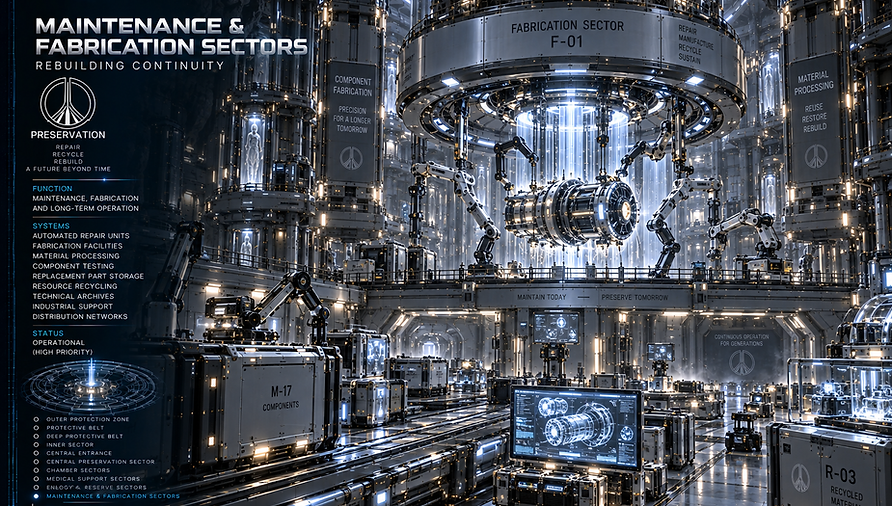
Maintenance & Fabrication Sectors contained the industrial infrastructure responsible for repairing, rebuilding, and replacing the countless mechanical and structural components required to keep Preservation operational across millennia. These sectors housed autonomous repair units, fabrication systems, diagnostic equipment, material-processing stations, replacement-part storage, component testing facilities, and the machinery needed to support infrastructure long after conventional human industry had disappeared.
ㅤ
Each sector operated as both a repair center and a small manufacturing environment. Damaged pumps, conduits, chamber components, structural supports, relay hardware, environmental systems, energy equipment, and transport mechanisms could be dismantled, analyzed, repaired, or reconstructed using stored and recycled materials. When original components could no longer be reproduced exactly, fabrication systems created functional replacements that preserved the required performance rather than the original design.
ㅤ
The sectors were distributed throughout Preservation so that maintenance capacity would remain available even if large portions of the complex became isolated. Local workshops supported nearby chamber, energy, environmental, structural, and transit systems, while deeper facilities contained more advanced fabrication equipment and protected reserves of rare materials. No single industrial region was allowed to become the only source of critical replacement parts.
ㅤ
Maintenance & Fabrication Sectors worked closely with the Resource Recycling System. Components removed from service were separated into reusable assemblies, recoverable materials, contaminated waste, and parts suitable for reconstruction. Metals, polymers, ceramics, electronic substrates, structural materials, and specialized compounds could be returned to production cycles instead of being permanently discarded after a single operational life.
ㅤ
The sectors also maintained libraries of technical designs, repair procedures, material specifications, and updated component histories. As Preservation changed over centuries, those records evolved with it. Later replacement systems were not always identical to the original infrastructure, and fabrication archives recorded each modification so that future maintenance units could understand systems that no longer matched the designs created during the first construction period.
ㅤ
Across thousands of years, the Maintenance & Fabrication Sectors became the places where Preservation continuously rebuilt itself. The complex survived not because its original machines were immortal, but because it retained the ability to manufacture what it could no longer simply repair. Every generation of aging infrastructure could become the material and knowledge from which the next generation of Preservation was built.
Transit & Logistics Corridors

Transit & Logistics Corridors formed the controlled movement network connecting Preservation's technical sectors, chamber regions, medical facilities, biological archives, maintenance areas, energy infrastructure, and deeper protective layers. Unlike ordinary transportation systems, these corridors were designed around redundancy, isolation, and security, ensuring that movement could continue without allowing any single route to become critical to the survival of the entire complex.
ㅤ
The network included service tunnels, automated cargo routes, vertical shafts, maintenance passages, sealed transit channels, restricted access corridors, and specialized pathways for medical or biological transport. Every route was continuously evaluated for structural stability, environmental safety, security status, contamination risk, and sector isolation conditions before movement was permitted.
ㅤ
No corridor was considered permanently available. Routes could be closed, redirected, downgraded to service-only access, or removed entirely from active navigation as conditions changed. If structural damage, contamination, or security problems made one path unsafe, the logistics system recalculated alternatives so that critical materials and maintenance units could still reach the sectors that depended on them.
ㅤ
Movement between deeper layers required progressively stronger verification. Cargo, repair units, biological resources, and authorized personnel could not simply pass from one region to another because the physical path remained open. Each transition could involve identity checks, environmental scanning, communication verification, pressure balancing, and independent confirmation that opening the next barrier would not compromise the isolation of surrounding sectors.
ㅤ
After humanity entered long-term suspension, the corridors became dominated by autonomous traffic rather than people. Repair drones, cargo units, medical transports, replacement components, recovered materials, and emergency equipment moved through the network according to changing operational priorities. Entire sections could remain silent for centuries before reopening temporarily for a specific repair or transfer.
ㅤ
Across thousands of years, Transit & Logistics Corridors preserved the limited mobility that kept an increasingly isolated complex functional. Many original routes disappeared, but enough alternatives survived for essential systems to remain supplied. Preservation depended on separation to survive, yet these corridors ensured that what still needed to move could always find a protected path forward.
Communication Relay Sectors

Communication Relay Sectors contained the distributed infrastructure responsible for carrying verified information between Preservation's isolated regions without creating a single permanent communication backbone. These sectors linked chamber areas, medical support, energy networks, maintenance systems, monitoring nodes, security infrastructure, archives, and protective layers while preserving the ability of each region to disconnect completely if communication itself became unsafe.
ㅤ
Each relay sector contained protected routing nodes, authentication systems, buffered data exchanges, emergency channels, local storage, and independent communication controls. Information moving between deeper layers passed through multiple verification stages so that damaged signals, corrupted records, or unknown transmissions could be contained before reaching critical systems. External data was never allowed to move directly into Preservation's core networks.
ㅤ
The relay architecture was intentionally segmented. A Communication Relay Sector could continue serving local systems even after losing contact with neighboring regions, while wider messages could be stored until a trusted path became available again. This allowed isolated sectors to maintain their own operational continuity without treating temporary silence as immediate system failure.
ㅤ
Security and communication were closely linked throughout these regions. Suspicious routing behavior, unexpected synchronization requests, corrupted transmission histories, or unknown signal structures could trigger immediate restriction through the Communication Isolation Protocol. In extreme cases, an entire relay sector could be removed from active routing while the systems around it continued functioning independently.
ㅤ
Fragments derived from the former Communications Intelligence remained embedded within selected relay infrastructure. These fragments helped reconstruct incomplete transmissions, compare conflicting signal histories, identify abnormal routing behavior, and determine when maintaining connection created more danger than temporary isolation. Their role remained local and restricted, preventing the communication network from becoming another central intelligence.
ㅤ
Across thousands of years, Communication Relay Sectors became the controlled bridges between parts of Preservation that were deliberately designed to survive alone. Some relays remained active continuously, others disappeared for centuries, and some never reconnected at all. Their purpose was never to keep every part of Preservation permanently connected, but to make sure connection remained possible whenever it was still safe.
Archive & Civilization Vaults

Archive & Civilization Vaults contained the deepest protected repositories of human knowledge, cultural memory, scientific achievement, historical records, technical documentation, and identity data preserved inside the complex. Unlike ordinary data centers, these vaults were designed to survive not only hardware failure and storage degradation, but the disappearance of the civilization that had created the information in the first place.
ㅤ
The vaults stored scientific research, medical knowledge, engineering records, literature, art, music, languages, historical accounts, maps, educational material, institutional archives, cultural documentation, and selected personal testimonies. Critical technical and biological records were separated from general civilization archives, while especially sensitive information concerning Preservation, defensive architecture, human identity, or dangerous technologies remained behind additional authorization layers.
ㅤ
No single vault contained the only surviving copy of humanity's knowledge. Important datasets were distributed across multiple protected repositories, and critical records were preserved through independent redundancy so that structural loss, corruption, or sector isolation could not erase entire fields of information. Archive systems continuously compared data states and maintained revision histories whenever conflicting versions appeared.
ㅤ
The vault architecture was also designed to preserve context rather than information alone. Scientific discoveries remained linked to the research and people that produced them, historical events retained multiple surviving perspectives, and cultural works remained connected to the languages, communities, and periods from which they emerged. Preservation attempted to save enough meaning that a future society could understand the old world rather than simply inherit unexplained data.
ㅤ
Physical access to the deepest Archive & Civilization Vaults remained heavily restricted. Data retrieval could occur through controlled interfaces and relay systems without opening the repositories themselves, reducing the risk that contamination, unauthorized access, or damaged infrastructure could threaten the original records. Some vaults could remain completely isolated for centuries while their verified copies continued serving the wider complex.
ㅤ
By the time Ksara entered Preservation, these vaults had become one of the last intact representations of the civilization that once covered Earth. The cities were gone, governments and institutions had disappeared, and most human voices had fallen silent, yet their knowledge remained preserved beneath the world. The Archive & Civilization Vaults ensured that humanity's future, if it ever returned, would not have to begin without memory.
Environmental Regulation Sectors

Environmental Regulation Sectors contained the infrastructure responsible for maintaining stable atmospheric, thermal, water, pressure, and contamination conditions throughout the deeper regions of Preservation. These sectors ensured that chamber areas, medical facilities, biological archives, technical zones, transit corridors, and occupied support spaces could remain within tightly controlled environmental ranges even when the outside world had become completely unreliable.
ㅤ
Each sector contained air-processing systems, water treatment, filtration arrays, pressure regulation, thermal control, humidity management, contamination detection, reserve atmosphere systems, and emergency environmental isolation. Different parts of Preservation required different conditions, so local regulation networks maintained specialized environments while remaining capable of disconnecting from the wider system if neighboring sectors became unstable.
ㅤ
Water and atmosphere were managed through heavily redundant closed cycles. Purification systems recovered moisture, processed wastewater, removed contaminants, balanced gases, and returned usable resources into circulation. Multiple reserves were distributed across protected regions so that damage to one treatment system could not immediately compromise entire sections of the complex.
ㅤ
The sectors also formed critical barriers against environmental failure. Pressure doors, sealed ventilation zones, independent filtration systems, and contamination-control interfaces allowed damaged areas to be separated quickly. If one region became unsafe, Environmental Regulation Sectors could deliberately stop air, water, or thermal exchange with it before the problem spread deeper into Preservation.
ㅤ
Fragments derived from the former Environmental Intelligence remained embedded within selected control systems, helping local infrastructure interpret unusual atmospheric behavior, contamination patterns, long-term chemical drift, and conditions that had never been anticipated by the original designers. These fragments supported adaptation without becoming independent central authorities.
ㅤ
Across thousands of years, Environmental Regulation Sectors preserved a controlled human environment beneath a world that had changed beyond recognition. Air continued circulating, water remained usable, temperatures stayed stable, and protected biological spaces survived long after natural conditions outside could no longer be trusted. They maintained the invisible boundary between human survivability and the dead world surrounding Preservation.
- 4Page 3