Communication Relay Sectors

Click the archive panel to enlarge and explore the full sector data.
Communication Relay Sectors
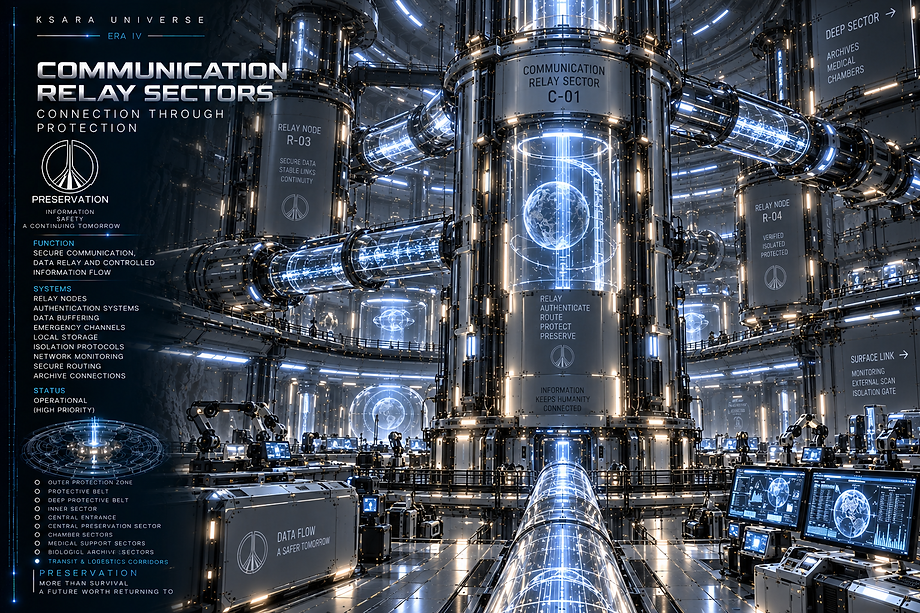
Communication Relay Sectors contained the distributed infrastructure responsible for carrying verified information between Preservation's isolated regions without creating a single permanent communication backbone. These sectors linked chamber areas, medical support, energy networks, maintenance systems, monitoring nodes, security infrastructure, archives, and protective layers while preserving the ability of each region to disconnect completely if communication itself became unsafe.
ㅤ
Each relay sector contained protected routing nodes, authentication systems, buffered data exchanges, emergency channels, local storage, and independent communication controls. Information moving between deeper layers passed through multiple verification stages so that damaged signals, corrupted records, or unknown transmissions could be contained before reaching critical systems. External data was never allowed to move directly into Preservation's core networks.
ㅤ
The relay architecture was intentionally segmented. A Communication Relay Sector could continue serving local systems even after losing contact with neighboring regions, while wider messages could be stored until a trusted path became available again. This allowed isolated sectors to maintain their own operational continuity without treating temporary silence as immediate system failure.
ㅤ
Security and communication were closely linked throughout these regions. Suspicious routing behavior, unexpected synchronization requests, corrupted transmission histories, or unknown signal structures could trigger immediate restriction through the Communication Isolation Protocol. In extreme cases, an entire relay sector could be removed from active routing while the systems around it continued functioning independently.
ㅤ
Fragments derived from the former Communications Intelligence remained embedded within selected relay infrastructure. These fragments helped reconstruct incomplete transmissions, compare conflicting signal histories, identify abnormal routing behavior, and determine when maintaining connection created more danger than temporary isolation. Their role remained local and restricted, preventing the communication network from becoming another central intelligence.
ㅤ
Across thousands of years, Communication Relay Sectors became the controlled bridges between parts of Preservation that were deliberately designed to survive alone. Some relays remained active continuously, others disappeared for centuries, and some never reconnected at all. Their purpose was never to keep every part of Preservation permanently connected, but to make sure connection remained possible whenever it was still safe.
“Click the archive panel to expand the visual archive.”