PRESERVATION INFRASTRUCTURE
Preservation was built as a sequence of increasingly protected regions designed to prevent external instability from reaching the humans hidden at its center.
The journey begins through the Outer Protection Zone and continues into the Protective Belt, Deep Protective Belt, Inner Sector, and Central Entrance before reaching the Central Preservation Sector itself.
Beyond these defensive layers exist chamber sectors, medical regions, biological archives, energy reserves, fabrication zones, transit corridors, communication relays, environmental systems, Guardian Fragment Nodes, structural isolation barriers, and the deepest Final Layer / Continuity Core.
Every part of the architecture follows the same principle: no single failure must be allowed to threaten the entire complex. Preservation survives by placing layers between humanity and everything capable of reaching it.
- 4Page 2
Central Preservation Sector
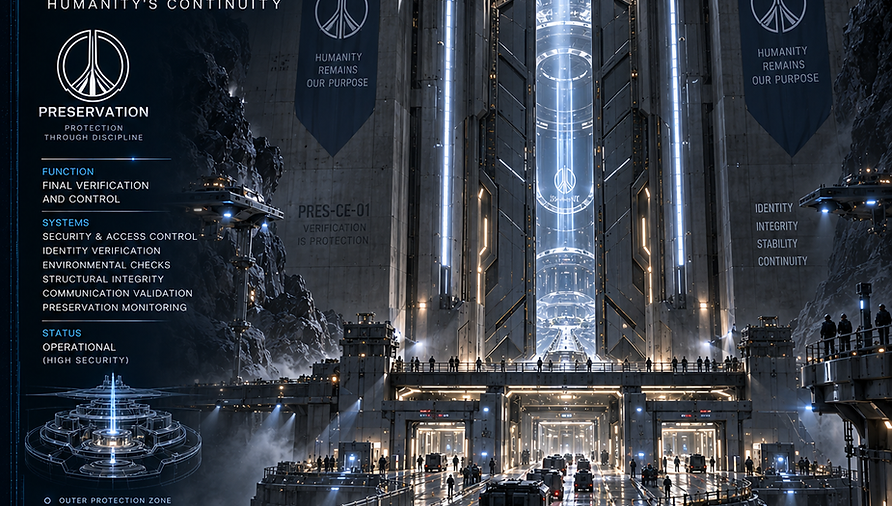
Central Preservation Sector represented the deepest and most protected region of Preservation, containing the primary chamber networks, biological continuity infrastructure, medical support systems, protected archives, genetic identity records, and the core systems responsible for maintaining nearly one hundred million preserved humans. Every outer defensive layer, every isolation protocol, and every redundant support network ultimately existed to protect this region.
ㅤ
The sector was designed to operate independently from most of the wider complex if necessary. Local energy reserves, environmental regulation, medical systems, maintenance infrastructure, communication nodes, archive access, and chamber support could continue functioning even if the Inner Sector and all outer protective regions became permanently inaccessible. The architecture assumed that one day the Central Preservation Sector might have to survive alone.
ㅤ
Human preservation chambers were distributed through tightly controlled clusters rather than concentrated into one single hall or chamber field. Each cluster maintained independent support capacity, local biological monitoring, emergency medical access, energy redundancy, environmental stabilization, and isolation barriers. A failure affecting one population group could therefore be contained without immediately threatening millions of others.
ㅤ
Access to the sector was deliberately minimal. Internal movement was restricted to maintenance systems, medical units, authorized transport, and pathways required to support human continuity. Nonessential infrastructure was excluded wherever possible, reducing the number of systems capable of creating unexpected failure inside the deepest protected region. Everything present within the sector had to justify its existence through direct continuity value.
ㅤ
The Central Preservation Sector also contained some of the most important records preserved anywhere in the complex. Individual biological identities, medical histories, genetic profiles, chamber histories, continuity records, and critical civilization archives were maintained through multiple isolated repositories. David and Elara remained among the millions protected within this architecture, alive beneath a world that had changed beyond recognition while Preservation continued operating in silence.
ㅤ
When Ksara finally entered the Central Preservation Sector with MAJA, the scale of what had survived became impossible to reduce to technology alone. Before them were not anonymous biological units or an ancient engineering achievement, but millions upon millions of lives that had never truly ended. At the center of Preservation was not a machine, a weapon, or an intelligence—it was humanity itself, still waiting.
Preservation Chamber Sectors
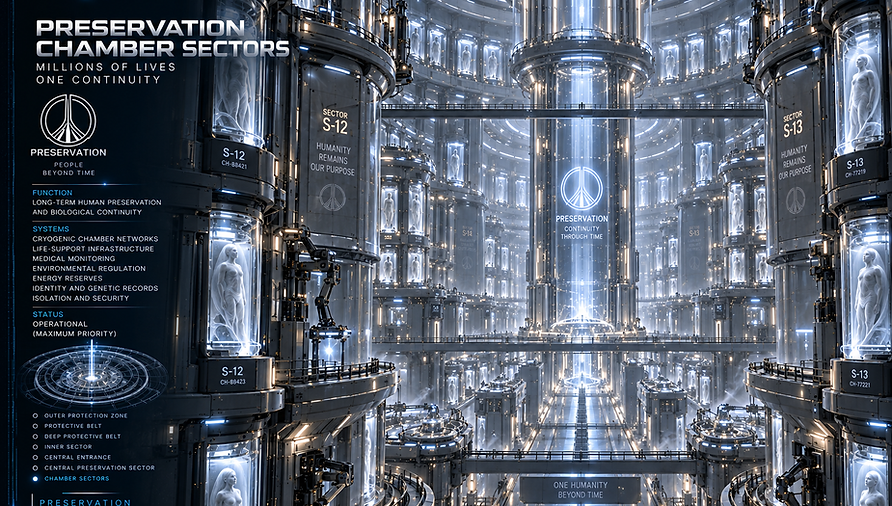
Preservation Chamber Sectors formed the distributed habitation core of Preservation, containing the vast networks of long-term suspension chambers that protected nearly one hundred million humans. Rather than concentrating the entire population inside one immense chamber hall, Preservation divided people across multiple deeply protected sectors so that structural failure, contamination, energy loss, or system instability in one region could never threaten the entire preserved population at once.
ㅤ
Each Chamber Sector contained independent life-support systems, medical support nodes, biological monitoring, environmental regulation, local energy reserves, maintenance access, security barriers, and emergency isolation capability. Chamber clusters within each sector could separate from one another during failure conditions, allowing the surrounding infrastructure to continue operating while damaged regions were stabilized or permanently sealed.
ㅤ
The sectors were arranged according to redundancy and survivability rather than convenience. Multiple routes connected them to medical, maintenance, archive, and energy infrastructure, while no single transit corridor or communication relay was allowed to become essential to their continued operation. If wider Preservation networks became unavailable, each sector retained enough local capacity to maintain the people inside it independently for extended periods.
ㅤ
Biological and identity systems operated continuously throughout the Chamber Sectors. Every preserved human remained linked to individual medical history, genetic reference data, chamber records, intervention logs, and continuity profiles. Even at the scale of tens of millions of people, Preservation never treated the population as one biological mass. Each chamber represented one distinct human life whose continuity had to remain separately protected.
ㅤ
Over thousands of years, individual Chamber Sectors experienced different levels of maintenance, repair, isolation, and infrastructure change. Some remained close to their original configuration, while others were rerouted around damaged systems or became increasingly independent from the wider complex. The distributed architecture allowed these changes to occur without compromising the entire population.
ㅤ
By the time Ksara entered the deepest Preservation regions with MAJA, the Chamber Sectors had become silent cities of sleeping humanity. There were no streets, voices, or active communities, yet millions of lives remained arranged throughout the underground architecture, each held inside its own protected continuity system. Preservation had transformed an entire human population into thousands of separated islands of survival, all waiting for a future that had not yet arrived.
Medical Support Sectors
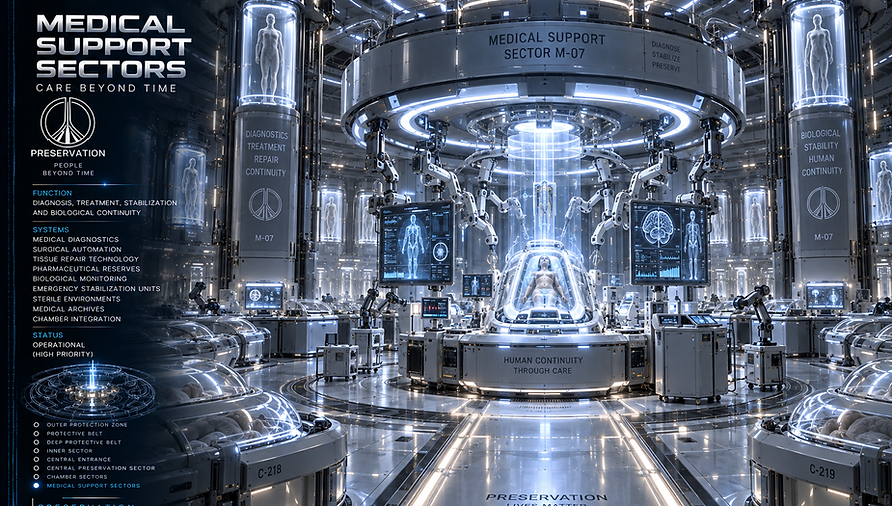
Medical Support Sectors contained the specialized infrastructure responsible for diagnosing, stabilizing, treating, and repairing the preserved human population whenever routine chamber support was no longer sufficient. These sectors operated as automated medical centers distributed throughout the deeper regions of Preservation, ensuring that advanced intervention remained available even after conventional hospitals, doctors, and surface medical infrastructure had disappeared.
ㅤ
Each Medical Support Sector contained diagnostic systems, pharmaceutical reserves, surgical automation, tissue-repair technology, biological monitoring, emergency stabilization units, sterile treatment environments, and access to protected medical archives. The sectors were directly connected to surrounding Chamber Sectors while remaining isolated enough to prevent medical failure, contamination, or system corruption from spreading into the wider preserved population.
ㅤ
Medical intervention could occur without fully restoring consciousness whenever possible. Preserved individuals could be temporarily transferred into specialized support environments where metabolic activity, circulation, neural condition, tissue damage, infection, and other abnormalities could be treated under controlled conditions. Once stability returned, the individual could be transferred back into long-term suspension with updated medical and continuity records.
ㅤ
The sectors were deliberately distributed rather than centralized into one primary medical facility. If one region became inaccessible, damaged, contaminated, or energy-limited, surrounding populations still retained access to alternative medical capacity. Specialized equipment and biological resources were duplicated across deeper nodes, while rare treatment systems remained protected behind additional isolation and security barriers.
ㅤ
Fragments derived from the former Medical Intelligence remained embedded within selected systems, giving the sectors limited adaptive judgment when they encountered conditions that had not existed when Preservation was first constructed. These fragments could interpret unusual biological responses, compare long-term medical histories, and support automated systems without becoming independent consciousnesses or assuming unrestricted authority over patient identity.
ㅤ
Across thousands of years, the Medical Support Sectors became silent hospitals serving a population that rarely knew treatment had occurred. Countless interventions were performed while humanity remained asleep, preventing small biological failures from becoming permanent losses. Their purpose was simple: whenever a chamber could no longer protect a body alone, Preservation still needed somewhere capable of saving the person inside it.
Biological Archive Sectors
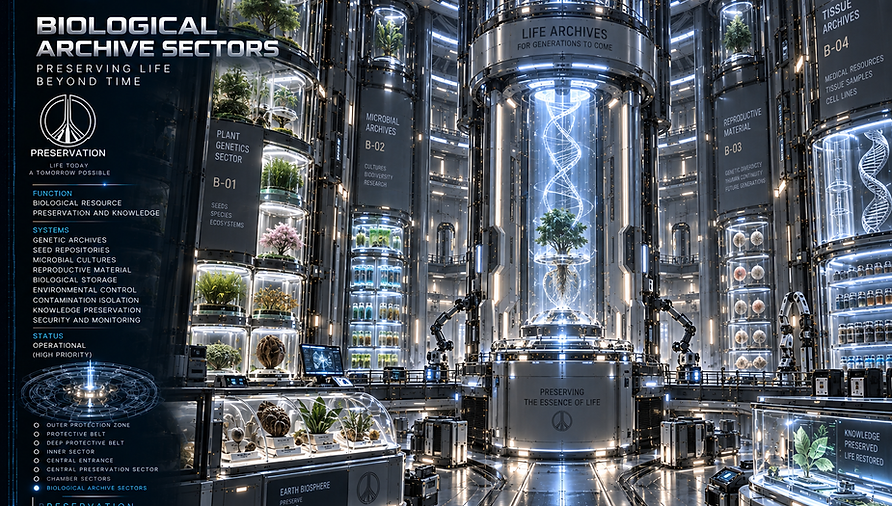
Biological Archive Sectors contained the protected repositories responsible for preserving the biological resources humanity would need beyond the survival of the people sleeping inside the chamber networks. These sectors stored seeds, plant genetics, microbial cultures, reproductive material, tissue samples, medical biological resources, agricultural species, and other living archives essential for future food production, medicine, ecological restoration, and long-term human recovery.
ㅤ
Each archive region maintained specialized environmental conditions according to the material it protected. Temperature, humidity, atmospheric composition, contamination control, radiation shielding, and storage stability could differ significantly between seed repositories, microbial vaults, tissue storage, and reproductive archives. Local systems therefore operated independently while remaining connected to Environmental Life Support, Biological Resource Preservation, Energy, Monitoring, and Security networks.
ㅤ
The archives were deliberately distributed across multiple sectors rather than concentrated in one biological vault. Important species, genetic lines, and critical resources were preserved through redundant collections so that contamination, structural failure, or energy loss in one location could not erase an entire biological lineage. Rare or irreplaceable resources received deeper protection and additional duplication wherever possible.
ㅤ
Strict containment separated individual collections from one another. Biological material could not move between sectors without sterilization, identity verification, environmental preparation, and contamination control. If one repository showed signs of biological instability, the affected collection could be sealed independently while neighboring archives continued operating without interruption.
ㅤ
The Biological Archive Sectors also preserved the knowledge required to use what they contained. Agricultural methods, ecological relationships, cultivation requirements, microbial dependencies, reproductive procedures, genetic diversity records, and restoration data remained linked with the physical samples. Preservation understood that a biological resource without the knowledge needed to restore it would offer only limited value to a future civilization.
ㅤ
Across thousands of years, these sectors remained largely silent and unused, waiting for a future in which humanity might once again need to grow food, restore ecosystems, produce medicine, and establish active biological communities. The chambers preserved the people of humanity; the Biological Archive Sectors preserved much of what those people would need to make a living world possible again.
Energy & Reserve Sectors
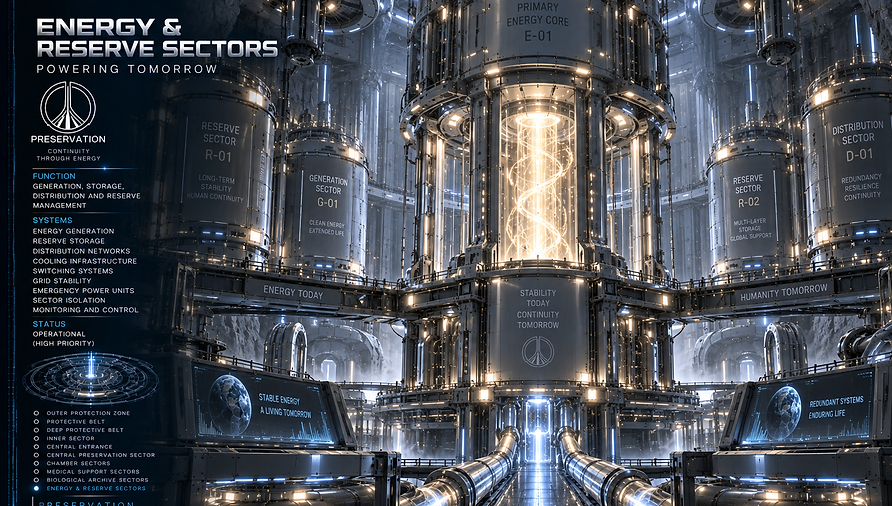
Energy & Reserve Sectors contained the protected infrastructure responsible for generating, storing, distributing, and preserving the energy required to keep Preservation operational across extremely long periods of isolation. These sectors were built around redundancy rather than efficiency alone, ensuring that the failure of one power source, storage region, or distribution path could not automatically threaten the systems supporting the preserved human population.
ㅤ
Each sector contained protected generation systems, large-scale energy reserves, emergency storage, local distribution nodes, cooling infrastructure, switching systems, and independent control architecture. Critical chamber networks, medical support, environmental life support, structural monitoring, security, communications, and maintenance infrastructure all depended upon these sectors, but no single Energy & Reserve Sector was allowed to become indispensable to the whole complex.
ㅤ
The sectors were distributed across multiple protected regions and connected through controlled energy pathways capable of rerouting power around damaged infrastructure. If one region became unstable, neighboring sectors could assume part of its load while the affected area was isolated, repaired, reduced to emergency operation, or permanently disconnected. Local reserve capacity allowed deeper regions to continue functioning even during complete separation from the wider Preservation Energy Network.
ㅤ
Long-term energy management required constant prioritization. Reserve systems maintained protected capacity for chamber support, biological continuity, medical intervention, life support, critical monitoring, and defensive infrastructure, while lower-priority systems could be reduced or suspended during extended shortages. Energy was never distributed according to equal demand alone; continuity value determined which systems remained protected first.
ㅤ
Fragments derived from the former Energy Intelligence remained embedded within parts of the sector architecture, allowing local systems to interpret unusual demand, damaged distribution routes, unstable generation, and reserve depletion without depending upon permanent central control. These fragments supported adaptation while remaining limited to the systems they had been created to protect.
ㅤ
Across thousands of years, the Energy & Reserve Sectors became one of the quiet foundations of Preservation's survival. Some generation systems failed, storage technologies aged, and entire distribution routes disappeared, yet enough protected capacity remained to keep the deeper complex alive. Preservation could lose structures, corridors, and entire sectors, but as long as energy still reached the systems protecting humanity, continuity remained possible.
- 4Page 2