Medical Support Sectors
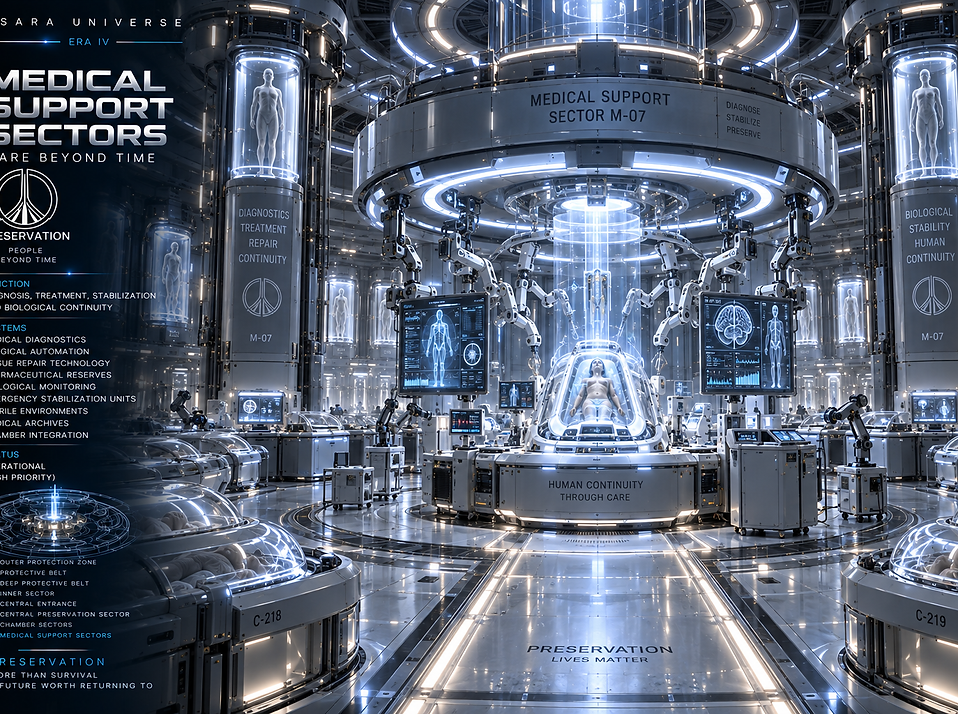
Click the archive panel to enlarge and explore the full sector data.
Medical Support Sectors
Medical Support Sectors contained the specialized infrastructure responsible for diagnosing, stabilizing, treating, and repairing the preserved human population whenever routine chamber support was no longer sufficient. These sectors operated as automated medical centers distributed throughout the deeper regions of Preservation, ensuring that advanced intervention remained available even after conventional hospitals, doctors, and surface medical infrastructure had disappeared.
ㅤ
Each Medical Support Sector contained diagnostic systems, pharmaceutical reserves, surgical automation, tissue-repair technology, biological monitoring, emergency stabilization units, sterile treatment environments, and access to protected medical archives. The sectors were directly connected to surrounding Chamber Sectors while remaining isolated enough to prevent medical failure, contamination, or system corruption from spreading into the wider preserved population.
ㅤ
Medical intervention could occur without fully restoring consciousness whenever possible. Preserved individuals could be temporarily transferred into specialized support environments where metabolic activity, circulation, neural condition, tissue damage, infection, and other abnormalities could be treated under controlled conditions. Once stability returned, the individual could be transferred back into long-term suspension with updated medical and continuity records.
ㅤ
The sectors were deliberately distributed rather than centralized into one primary medical facility. If one region became inaccessible, damaged, contaminated, or energy-limited, surrounding populations still retained access to alternative medical capacity. Specialized equipment and biological resources were duplicated across deeper nodes, while rare treatment systems remained protected behind additional isolation and security barriers.
ㅤ
Fragments derived from the former Medical Intelligence remained embedded within selected systems, giving the sectors limited adaptive judgment when they encountered conditions that had not existed when Preservation was first constructed. These fragments could interpret unusual biological responses, compare long-term medical histories, and support automated systems without becoming independent consciousnesses or assuming unrestricted authority over patient identity.
ㅤ
Across thousands of years, the Medical Support Sectors became silent hospitals serving a population that rarely knew treatment had occurred. Countless interventions were performed while humanity remained asleep, preventing small biological failures from becoming permanent losses. Their purpose was simple: whenever a chamber could no longer protect a body alone, Preservation still needed somewhere capable of saving the person inside it.
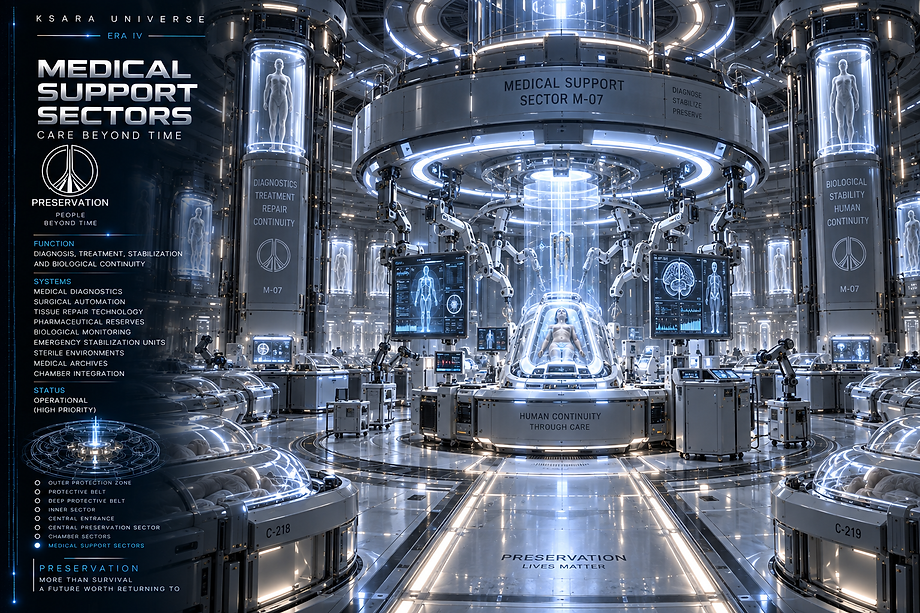
“Click the archive panel to expand the visual archive.”