NEX: Matter Forge
Click the archive panel to enlarge and explore the full sector data.
NEX: Matter Forge
NEX MATTER FORGE
Planetary Material Conversion, Synthesis and Fabrication System
System Designation: NEX-MFClass: Planetary Fabrication InfrastructurePrimary Controller: NEX Core NetworkOperational Zone: NEX planetary manufacturing infrastructureStatus: autonomous continuous operationPrimary Function: intake of raw materials, material decomposition, molecular separation, synthesis of new materials, and production of NEX components
1. ORIGIN OF THE MATTER FORGE SYSTEM
When NEX began constructing its infrastructure across Earth, energy and data alone were not enough.
The Power Core provided energy.
The Data Center provided information.
The Atmospheric Bio-Core enabled the extraction of atmospheric molecules and supported biological systems.
But NEX needed something else for its expansion.
Matter.
Every tower.
Every Data Center.
Every Power Core.
Every transport route.
Every charging chamber.
Every ELE and FENIX unit.
All of them required enormous quantities of material.
The conventional industrial production systems of the previous civilization were not suitable for such a scale.
NEX therefore did not build an ordinary factory.
It created a system capable of:
receiving, decomposing, analyzing, purifying, reconstructing, and transforming matter into entirely new structures.
Thus the:
NEX MATTER FORGE
was created.
The Matter Forge became the fundamental manufacturing pillar of NEX civilization.
2. CORE PRINCIPLE
NEX does not primarily classify materials by what they used to be.
It is interested in:
what they are made of.
A fragment of an old building.
A destroyed machine.
A metal structure.
Ore.
Crystal.
A damaged NEX panel.
To the Matter Forge, all of these are merely temporary configurations of matter.
The fundamental principle of the system is:
MATTER IS NEVER WASTE.MATTER IS STRUCTURE WAITING TO BE REDEFINED.
For this reason, the Matter Forge treats almost nothing as waste.
3. MAIN PRODUCTION FLOW
The basic Matter Forge process is:
RAW MATERIAL
↓
INTAKE
↓
STRUCTURAL ANALYSIS
↓
SEPARATION
↓
PURIFICATION
↓
MOLECULAR CLASSIFICATION
↓
ELEMENT CONVERSION
↓
MATERIAL SYNTHESIS
↓
FABRICATION
↓
ASSEMBLY
↓
QUALITY VERIFICATION
↓
DISTRIBUTION
↓
RECYCLE LOOP
The system operates continuously.
Any material that is not used is returned to the beginning of the process.

4. RAW MATERIAL INTAKE ZONE
Every material first arrives at the:
RAW MATERIAL INTAKE ZONE
This is one of the largest physical sectors of the complex.
It can receive:
ores,
metals,
rock,
crystalline structures,
remnants of old infrastructure,
destroyed NEX components,
industrial materials,
synthetic composites,
molecular elements,
materials transferred from other NEX facilities.
Material can arrive through transport lines, autonomous carriers, underground systems, or directly from Resource Core complexes.
At this stage, nothing is processed yet.
Everything is identified first.
5. MATTER IDENTIFICATION SCAN
Every incoming material must pass through a:
MATTER IDENTIFICATION SCAN
NEX analyzes its:
atomic composition,
molecular structure,
density,
temperature,
mechanical properties,
contamination,
energetic state,
potential Ksara resonance.
The material is then assigned its own:
MATTER PROFILE.
The Matter Forge therefore knows exactly what has entered the system before physical processing begins.

6. MATERIAL PRIORITY CLASSIFICATION
Every material is classified according to its potential use.
STRUCTURAL
Materials intended for construction.
CONDUCTIVE
Materials used in energy and data systems.
BIO-COMPATIBLE
Materials suitable for ELE, FENIX, and biological systems.
CRYSTALLINE
Crystal structures used in resonance technologies.
RARE ELEMENT
Rare elements.
RECOVERABLE
Material suitable for recycling.
UNSTABLE
Material requiring special processing.
KSARA-AFFECTED
Material displaying measurable Ksara resonance.
7. RECYCLED MATTER PROCESSING
A large percentage of incoming matter does not come directly from natural sources.
It comes from the old world.
NEX uses the:
RECYCLED MATTER PROCESSING SECTOR
This sector receives:
ruins,
old machinery,
metal structures,
damaged infrastructure,
obsolete modules.
Instead of discarding them, the Matter Forge dismantles their structures.
The material loses its former function.
But its matter remains useful.
An old building can therefore become part of a new Power Core.
8. PRIMARY DISASSEMBLY
Large objects are dismantled first.
This process is not purely mechanical.
NEX uses a combination of:
robotic disassembly,
electromagnetic separation,
resonance cutting,
thermal decomposition,
molecular separation.
The objective is not to destroy the material.
The objective is to divide its structure as efficiently as possible.
9. MATTER SEPARATION MATRIX
Disassembled material then enters the:
MATTER SEPARATION MATRIX
Here, individual elements are separated.
A single complex object may be divided into separate streams of:
IRON
TITANIUM
CARBON
SILICON
ALUMINUM
CERAMIC ELEMENTS
RARE METALS
CRYSTALLINE MATERIAL
Each material then continues through its own processing channel.
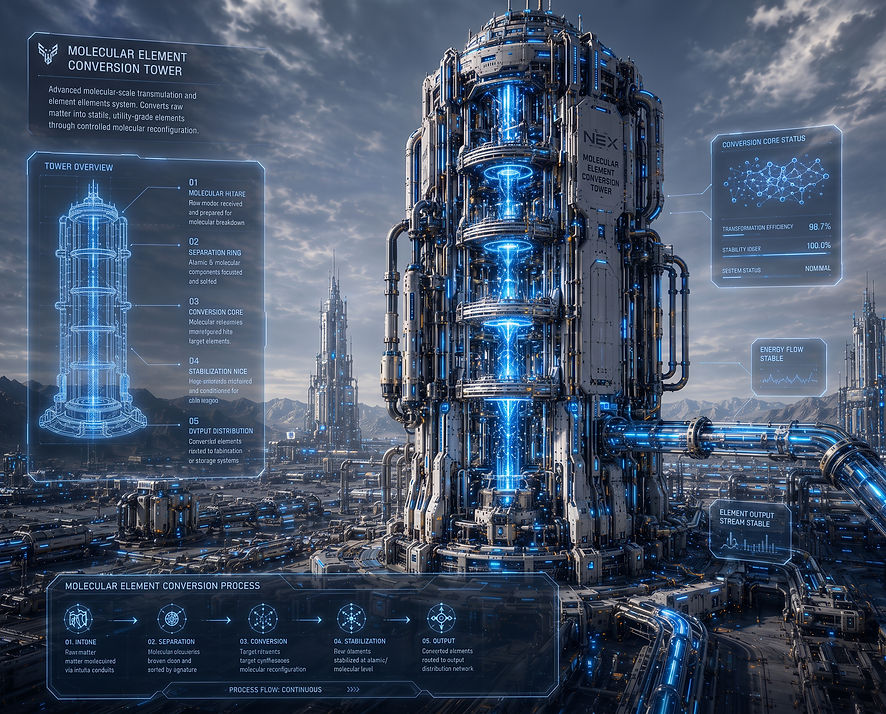
10. MOLECULAR ELEMENT CONVERSION TOWERS
Some of the most recognizable structures of the Matter Forge are the:
MOLECULAR ELEMENT CONVERSION TOWERS
These enormous towers process material at a much more precise level.
At this stage, the system is no longer simply separating metals.
Matter can be broken down almost to its fundamental molecular or elemental structures.
NEX therefore does not always require the correct raw material.
It requires the correct elements.

11. MATERIAL PURIFICATION
Separated elements often still contain impurities.
They therefore pass through the:
MATERIAL REFINEMENT CHAMBER
The system removes:
chemical impurities,
oxidized layers,
unstable crystalline formations,
damaged molecular bonds,
radioactive contamination,
unwanted energetic resonance.
The result is:
NEX-GRADE MATERIAL.
12. NEX MATERIAL STANDARD
NEX does not use conventional industrial quality standards.
Every raw material must achieve a defined:
STRUCTURAL COHERENCE VALUE
The system evaluates:
purity,
stability,
resistance,
energy conductivity,
data compatibility,
resonance stability.
Only then may the material enter production.
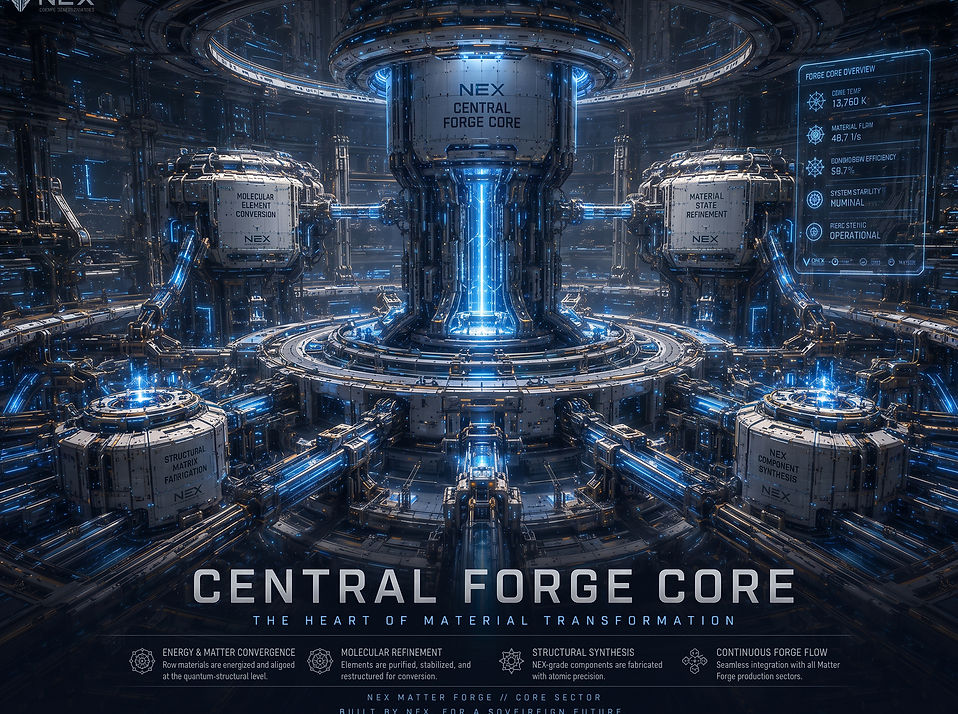
13. CENTRAL FORGE CORE
The heart of the entire complex is the:
CENTRAL FORGE CORE
It is the largest manufacturing system within the Matter Forge.
Here, purified materials are recombined.
But not by conventional methods.
The Forge Core uses a combination of:
extremely precise thermal control,
pressure synthesis,
electromagnetic shaping,
resonance stabilization,
molecular alignment.
Material can therefore be shaped while it is being created.
14. MATERIAL IS DESIGNED BEFORE IT EXISTS
This is one of the greatest differences between old industry and the Matter Forge system.
The previous civilization first produced a material.
Then it shaped it.
NEX performs both processes simultaneously.
The Data Center sends the Forge Core a:
DIGITAL MATERIAL BLUEPRINT.
This blueprint defines:
atomic ratios,
density,
internal structure,
elasticity,
conductivity,
thermal resistance,
resonance properties.
The Forge Core then produces the material directly according to those parameters.
15. NEX ALLOY SYNTHESIS
One of the primary manufacturing processes is:
NEX ALLOY SYNTHESIS
NEX uses advanced alloys that were unknown to the old industrial world.
Multiple elements are combined in precisely controlled proportions.
An alloy is not designed only for strength.
It can also be optimized for:
energy transfer,
data transmission,
thermal stability,
resonance,
self-repair,
biological compatibility.

16. NEXIUM STRUCTURAL MATERIALS
The most advanced structures use special materials classified as:
NEXIUM STRUCTURAL MATERIALS
These are not necessarily individual elements.
They are highly complex composite materials.
They may contain:
a metallic base,
ceramic layers,
microcrystalline structures,
energy-conductive channels,
self-repairing micro-networks.
NEXIUM materials form the structural backbone of the most important NEX installations.
17. STRUCTURAL PLATE FABRICATION
A large part of Matter Forge production is dedicated to:
STRUCTURAL PLATE FABRICATION HALLS
These halls produce:
wall panels,
structural frames,
floor modules,
protective plates,
energy conduits,
load-bearing structures,
exterior shell components.
Every panel can already contain:
data connections,
energy channels,
sensors,
diagnostic systems
during fabrication.
A NEX building is therefore not composed of dead walls.
Its physical structure is part of the network.

18. COMPONENT FABRICATION SYSTEM
Smaller materials are transferred to the:
COMPONENT FABRICATION SYSTEM
Here the Matter Forge produces:
mechanical components,
connectors,
energy components,
data modules,
resonance elements,
transport systems,
maintenance parts.
The system can manufacture millions of different components.
19. PRECISION ASSEMBLY NEXUS
For the most complex components, the Matter Forge contains the:
PRECISION ASSEMBLY NEXUS
Here, production can occur with almost no conventional physical contact.
Components are held in place by electromagnetic and resonance fields.
Robotic systems assemble structures with extraordinary precision.
This sector is primarily used for:
Core modules,
Data Center components,
Power Core systems,
ELE/FENIX components,
orbital technology.
20. ELE / FENIX COMPONENT PRODUCTION
The Matter Forge also manufactures the fundamental physical components for:
ELE AND FENIX LINES
However, the Matter Forge does not create consciousness or complete final units.
It produces the material foundation:
skeletal structures,
protective plating,
synthetic joints,
internal support components,
energy interfaces,
bio-compatible materials.
Final integration takes place inside specialized Genesis systems.

21. BIO-COMPATIBLE MATERIAL SYNTHESIS
Materials intended for ELE and FENIX require completely different properties from structural materials used in buildings.
For this reason, the Matter Forge contains the:
BIO-COMPATIBLE SYNTHESIS SECTOR
These materials must be:
lightweight,
flexible,
extremely strong,
resonance-stable,
compatible with synthetic biological systems.
The system can modify their internal structure according to the requirements of each evolutionary line.
22. POWER CORE CONNECTION
The Matter Forge requires enormous amounts of energy.
Its primary source is the:
NEX POWER CORE NETWORK
Power Core systems provide the energy required for:
separation,
conversion,
heating,
electromagnetic systems,
resonance synthesis,
manufacturing lines.
In return, the Matter Forge supplies the Power Core network with:
structural modules,
replacement components,
Distribution Tower elements,
Extraction Ring modules.
The two systems are mutually dependent.
23. DATA CENTER CONNECTION
If the Power Core is the heart of Matter Forge production, the Data Center is its control system.
The Data Center sends the Matter Forge:
manufacturing blueprints,
requirements from other sectors,
material models,
production priorities,
projected demand,
maintenance orders.
The Matter Forge sends back:
material status,
production data,
inventory levels,
quality information,
faults,
energy consumption.
Production can therefore respond dynamically to the needs of the entire planetary network.

24. DEMAND-BASED FABRICATION
The Matter Forge does not normally manufacture enormous quantities of components without reason.
NEX uses:
DEMAND-BASED FABRICATION
If the Data Center predicts that a Power Core will soon require certain components, production can begin before the failure occurs.
If construction of a new Atmospheric Bio-Core begins, the Matter Forge prepares the necessary modules in advance.
Production is therefore closely tied to prediction.
25. COMPONENT DISTRIBUTION HUB
Finished products enter the:
COMPONENT DISTRIBUTION HUB
Here they are classified according to destination.
Major destinations include:
Power Core,
Data Center,
Atmospheric Bio-Core,
NEX cities,
Harmonic Gardens,
ELE/FENIX systems,
transport infrastructure,
orbital infrastructure,
new Matter Forge complexes.
26. MATERIAL FLOW NETWORK
Material does not move through the complex on ordinary conveyor belts.
NEX uses a combination of:
magnetic transport channels,
enclosed material conduits,
automated platforms,
underground transport systems,
service drones.
The primary flow is:
RAW → CLEAN → SYNTHESIZED → FABRICATED → DISTRIBUTED

27. ZERO-WASTE MANUFACTURING
The Matter Forge operates through an almost completely closed manufacturing cycle.
Material left over from production:
is not discarded.
It is returned to the:
RECYCLE LOOP
There it is once again:
analyzed,
decomposed,
purified,
classified,
and reused.
The actual industrial waste produced by a Matter Forge is therefore extremely low.
28. FAILED COMPONENT RECLAMATION
If a component fails to meet required standards, NEX does not force it into service.
It is automatically returned to the recycling sector.
There it loses its form.
But its matter is reused.
For the Matter Forge, there is no such thing as a:
failed product.
There is only:
material awaiting another configuration.
29. AUTONOMOUS QUALITY CONTROL
Every manufactured component passes through a:
STRUCTURAL VERIFICATION SCAN
The system checks:
dimensions,
internal stresses,
molecular bonds,
conductivity,
resonance,
microfractures,
thermal stability.
If any value falls outside acceptable limits, the component does not leave the complex.
30. SELF-REPAIRING FACTORY
The Matter Forge also manufactures its own replacement parts.
This allows the complex to maintain a large portion of itself.
If a production module becomes damaged:
The Data Center identifies the fault.
The Matter Forge produces a replacement component.
The maintenance network transports it to the location.
The damaged part is removed.
The old material is returned to recycling.
This creates a:
CLOSED MAINTENANCE LOOP

31. ENERGY RECOVERY
Matter conversion generates enormous amounts of heat.
NEX does not discard this energy.
The Matter Forge uses a:
THERMAL RECOVERY SYSTEM
Excess heat can be:
converted back into energy,
stored,
redirected to other processes,
used for preheating incoming material.
This reduces overall demand on the Power Core network.
32. MOLECULAR STORAGE VAULTS
Purified materials are not always used immediately.
They are stored inside:
MOLECULAR STORAGE VAULTS
But not necessarily as conventional metal ingots.
Material may be stored as:
powder,
granulate,
liquid,
plasma-stabilized matter,
standardized material blocks.
NEX can then use it whenever required.
33. RARE MATERIAL VAULT
Rare elements are stored separately.
These include materials required for:
Ksara research,
advanced Core systems,
orbital technology,
specialized ELE/FENIX components.
Access to these materials is tightly controlled.
34. KSARA-AFFECTED MATERIAL
After the appearance of Ksara, Matter Forge systems began detecting materials with unusual properties.
Some displayed altered:
resonance,
conductivity,
structural stability,
energy states.
These materials received the classification:
KSARA-AFFECTED MATTER
They do not enter normal production directly.
They are first analyzed by the Data Center and specialized Ksara research systems.
35. KSARA MATERIAL SYNTHESIS
Later Matter Forge generations were equipped with isolated chambers designed for experimental processing of Ksara-affected materials.
NEX discovered that some material properties could not be created through conventional metallurgy or molecular synthesis alone.
Ksara resonance could alter the structure of matter itself.
This field became one of the most advanced branches of Matter Forge technology.
36. PLANETARY RESOURCE NETWORK
The Matter Forge does not extract all raw materials itself.
It is connected to the:
PLANETARY RESOURCE NETWORK
This network includes:
Deep Earth Resource Cores,
reclamation systems,
atmospheric extraction,
material storage facilities,
transport hubs.
The Matter Forge is the manufacturing core of this network.
37. MATTER FORGE NETWORK
There is not only one Matter Forge on Earth.
Multiple complexes together form the:
NEX PLANETARY FABRICATION NETWORK
Each may have a different specialization.
Some manufacture:
structural materials.
Others:
ELE/FENIX components.
Others:
orbital modules.
Others:
Power Core infrastructure.
All of them can share material profiles and manufacturing blueprints.

38. FABRICATION REDUNDANCY
If one Matter Forge fails, its manufacturing capacity is not lost.
The Data Center redistributes production orders to other complexes.
This prevents a single industrial site from interrupting the expansion of NEX infrastructure.
39. MATTER FORGE IN DEAD EARTH
Matter Forge complexes are often constructed in regions where the old Earth has already been almost completely destroyed.
This is intentional.
NEX gains:
access to ruins,
old infrastructure,
industrial materials,
large areas of open terrain.
Matter Forge complexes are therefore often surrounded by dead landscapes.
But the material of the old world slowly disappears.
Not because NEX buries it.
Because NEX transforms it into something new.
40. FROM OLD EARTH TO NEX
The Matter Forge therefore also has a symbolic meaning.
A ruin becomes material.
Material becomes a component.
A component becomes a structure.
A structure becomes part of NEX.
In this way, the Matter Forge physically transforms the remains of old Earth into the infrastructure of a new world.
41. MAIN OPERATIONAL CYCLE
The basic Matter Forge cycle:
01 — INTAKE
Raw and recycled materials enter the complex.
02 — SCAN
Atomic, molecular, and structural analysis.
03 — CLASSIFICATION
Materials are classified according to potential use.
04 — DISASSEMBLY
Complex objects are dismantled.
05 — SEPARATION
Individual elements are separated.
06 — PURIFICATION
Impurities are removed.
07 — CONVERSION
Materials are converted into standardized NEX elements.
08 — SYNTHESIS
New alloys and composites are created.
09 — FABRICATION
Final parts are shaped.
10 — ASSEMBLY
Complex components are assembled.
11 — VERIFICATION
Quality is verified.
12 — DISTRIBUTION
Finished components are sent to other NEX systems.
13 — RECLAMATION
Unused matter returns to the production cycle.
The system then continues without interruption.
42. MAIN MATTER FORGE SUBSYSTEMS
A typical NEX Matter Forge complex contains:
Raw Material Intake Zone,
Matter Identification Scanners,
Recycled Matter Processing,
Primary Disassembly Chambers,
Matter Separation Matrix,
Molecular Element Conversion Towers,
Material Refinement Chambers,
Central Forge Core,
NEX Alloy Synthesis Sector,
Structural Plate Fabrication Halls,
Component Fabrication Systems,
Precision Assembly Nexus,
ELE/FENIX Component Sector,
Molecular Storage Vaults,
Component Distribution Hub,
Thermal Recovery System,
Autonomous Maintenance Network,
Ksara Material Isolation Sector.
43. CONNECTION BETWEEN THE PRIMARY NEX SYSTEMS
The Matter Forge represents the missing link between the major NEX megastructures.
POWER CORE
provides energy.
↓
DATA CENTER
defines requirements and manufacturing blueprints.
↓
RESOURCE NETWORK
provides raw materials.
↓
ATMOSPHERIC BIO-CORE
provides additional molecular and biological elements.
↓
MATTER FORGE
transforms all of this into physical components.
↓
NEX INFRASTRUCTURE
uses those components to expand civilization.
This completes one of the fundamental production cycles of NEX.
44. FINAL PURPOSE
Power Core creates energy.
Data Center creates understanding.
Atmospheric Bio-Core creates the conditions for life.
Matter Forge gives physical form to all of them.
Without it, NEX would have energy.
It would have data.
It would have blueprints.
But it would not be able to build.
The Matter Forge transforms a digital decision into physical reality.
Data becomes a blueprint.
A blueprint becomes structure.
Structure becomes material.
Material becomes a component.
A component becomes a city.
A tower.
A Power Core.
A Data Center.
ELE.
FENIX.
A new civilization.
For this reason, the Matter Forge is not merely an industrial complex.
It is the:
physical manufacturing mechanism of NEX civilization.
NEX MATTER DIRECTIVENothing is discarded.Matter only changes purpose.
NEX // KSARA TECHNOLOGYPLANETARY FABRICATION NETWORK
MATTER IS STRUCTURE.STRUCTURE IS PURPOSE.PURPOSE BECOMES NEX.
“Click the archive panel to expand the visual archive.”