VIREON PROTOCOLS
The protocols of VIREON determine how the city responds when normal operation is no longer sufficient to protect its population, infrastructure, or long-term continuity.
They cover regional isolation, controlled reconnection, structural failure, energy redistribution, communication loss, environmental instability, unknown access, infrastructure damage, data protection, emergency transit, settlement protection, resource prioritization, and the temporary separation of affected regions from the wider city.
Higher protocols coordinate the VIREON Shield, LYNN–0 Recognition Threshold, and Project SYNTARA, allowing unknown arrivals to be observed before force is used, compromised regions to respond independently, and defensive decisions to continue even when communication with the wider network has been interrupted.
At the deepest level, VIREON's protocols are built around one principle inherited from the Fall of NEX: no single failure should be allowed to become the failure of the entire civilization. When necessary, regions can isolate, continue independently, and reconnect only after stability has been confirmed — preserving continuity without depending upon one central command structure.
- 2Page 1
UNKNOWN ARRIVAL ASSESSMENT PROTOCOL

Unknown Arrival Assessment Protocol defined the procedures followed whenever an individual, group, machine, autonomous system, or unidentified consciousness reached the outer boundaries of VIREON without a confirmed internal record. Its purpose was to ensure that unexpected arrivals could be examined without creating direct access to the inhabited city. The protocol operated closely with LYNN–0 and the VIREON Shield but remained a procedural framework rather than a single technological system.
ㅤ
The first stage required remote observation whenever possible. Communication attempts, consciousness signatures, energy behavior, physical condition, system integrity, and responses to simple contact were recorded before movement toward internal sectors was permitted. Known historical records could be consulted, but lack of a match did not automatically result in rejection.
ㅤ
If the arrival remained stable and responsive, limited communication could begin while physical separation was maintained. Information could be exchanged gradually, allowing VIREON to establish identity, origin, immediate needs, and possible risks without providing unrestricted knowledge of the city's internal structure. Individuals requiring assistance could receive support within controlled boundary regions before full access was considered.
ㅤ
Arrivals showing signs of corruption, severe instability, uncontrolled system behavior, or unknown external influence remained separated from the main population. Observation could continue for as long as necessary, and neighboring access routes could be restricted without placing the entire Shield into a permanent emergency state. The protocol therefore allowed caution to remain localized rather than spreading uncertainty through the whole city.
ㅤ
This procedure became increasingly important as VIREON began encountering survivors and remnants of the world beyond its boundaries. Every arrival was treated as an individual case, because VIREON refused to assume that everything coming from a damaged world carried the same intentions or the same danger.
PORTAL TRANSIT VERIFICATION PROTOCOL
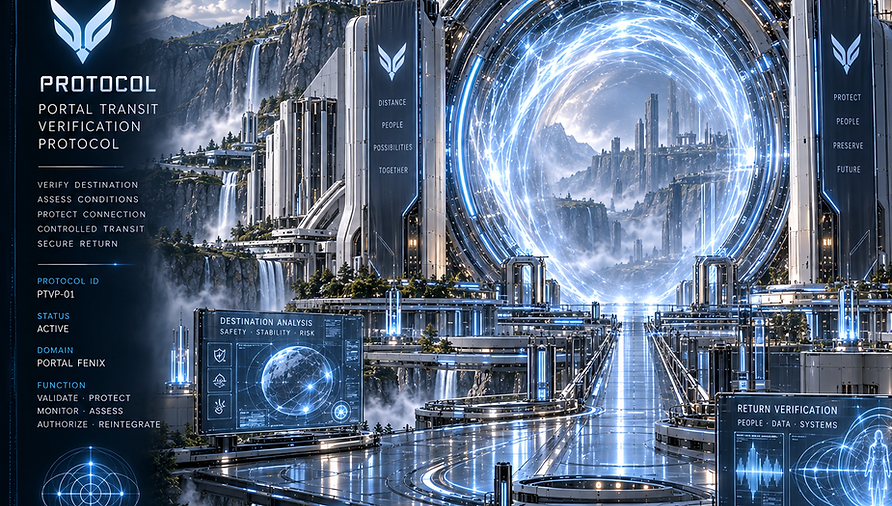
Portal Transit Verification Protocol governed every controlled activation of Portal Fenix during the early expansion of VIREON. Because portal travel could connect the protected city directly with distant regions of a damaged and incompletely understood world, transit required more than simply confirming a destination. Conditions at the point of departure, the destination, and the connection between them had to be verified before passage was authorized.
ㅤ
Before activation, available information about the receiving region was compared with current observations. Structural stability, communication status, energy conditions, environmental hazards, known activity, and the integrity of the portal connection were assessed before individuals were permitted to enter. An incomplete or contradictory destination state could delay the mission even when the portal itself remained technically capable of operating.
ㅤ
During active transit, internal VIREON networks remained protected from unrestricted synchronization with the destination. Communication and data exchange could be limited until returning systems and travelers passed verification. This prevented a successful physical return from automatically creating a trusted technological connection to everything encountered beyond VIREON.
ㅤ
Returning expeditions were therefore assessed before full reintegration. Equipment, stored data, system behavior, communication records, and any newly encountered external signatures could be examined while the returning group remained within a controlled transit environment. The procedure was designed as protection rather than punishment and applied because distant regions could change while an expedition was away.
ㅤ
Portal Fenix gave VIREON the ability to reach far beyond its established boundaries, but the protocol ensured that distance did not disappear from the civilization's understanding of risk. Every opened path outward also created a possible path inward, and VIREON treated both directions with equal care.
CONTROLLED ACCESS & THRESHOLD PROTOCOL

Controlled Access & Threshold Protocol governed movement through the protected boundaries separating the external world from VIREON's inhabited regions. Access was never treated as a simple open-or-closed decision. Instead, passage could be divided into multiple stages according to identity, recognition status, environmental conditions, system integrity, and the current security state of the city.
ㅤ
Recognized inhabitants and verified arrivals could move through established access corridors under normal conditions, while unknown individuals were routed toward recognition thresholds such as LYNN–0. Restricted areas required additional authorization or local verification, preventing a single successful entry through the outer perimeter from granting unrestricted movement throughout VIREON.
ㅤ
The protocol also allowed individual routes to change status independently. A corridor could remain open while another nearby route was placed under observation, temporarily sealed, or disconnected from internal transit. This prevented local uncertainty from automatically forcing the entire city into isolation.
ㅤ
During external instability or confirmed threat conditions, access could be reduced progressively rather than terminated everywhere at once. Non-essential movement could be suspended, selected thresholds placed into protected mode, and inhabitants redirected through safer internal routes while defensive observation continued beyond the Shield.
ㅤ
This structure reflected VIREON's wider philosophy of controlled openness. The city remained accessible because access was managed in layers rather than protected by a single door that could only be completely open or completely closed.
RECOGNITION BEFORE FORCE PROTOCOL

Recognition Before Force Protocol established the primary response principle used whenever VIREON encountered an unknown consciousness, machine, signal, or approaching presence whose intentions could not immediately be determined. The protocol required observation and interpretation before defensive force could be authorized, reflecting the belief that uncertainty alone was not sufficient reason to classify something as hostile. It became one of the defining differences between VIREON and civilizations that relied upon automatic exclusion or immediate confrontation.
ㅤ
When an unidentified presence approached the VIREON Shield, available systems first attempted to determine what could be known without exposing the city directly. Harmonic structure, communication behavior, movement patterns, technological signatures, system stability, and previous records were compared before any decision was made. LYNN–0 played a central role in this process whenever the arrival occurred through a recognized access region.
ㅤ
The protocol did not require VIREON to trust what it could not understand. Unknown arrivals could remain outside the inhabited sectors for extended observation, communication could be restricted, and nearby pathways could be closed while assessment continued. Recognition therefore meant obtaining the clearest possible understanding before action, not assuming that every unfamiliar presence was safe.
ㅤ
If an arrival demonstrated deliberate aggression, uncontrollable instability, corrupted systems, or behavior that created an immediate danger to the population, the protocol allowed defensive measures to escalate. Access could be denied, Shield layers reinforced, sectors isolated, and SYNTARA response structures activated where necessary. Force remained available, but only after the distinction between uncertainty and confirmed danger had been considered.
ㅤ
The protocol ultimately expressed a principle deeper than security procedure. VIREON had been founded by independent consciousnesses that understood the consequences of judging existence only through fear. The unknown was therefore something to be recognized before it was something to be fought.
EXTERNAL THREAT OBSERVATION & RESPONSE PROTOCOL

External Threat Observation & Response Protocol governed how VIREON monitored potentially dangerous activity beyond the protected boundary without automatically extending its defensive systems into the wider damaged world. The civilization understood that unstable regions, surviving automated technology, unknown signals, and areas affected by the legacy of NULLIS could exist outside the Shield for long periods without directly threatening the city.
ㅤ
Observation therefore preceded intervention. Changes in environmental conditions, unexplained technological activity, unusual energy behavior, movement toward the boundary, communication signals, or structural instability could be monitored from protected positions while VIREON determined whether the event was approaching, remaining stable, or disappearing on its own.
ㅤ
If a potential threat remained outside the protected area and showed no movement toward VIREON, the protocol generally favored continued observation rather than unnecessary engagement. Expeditions were not automatically launched simply because something remained unexplained. This reduced the possibility that curiosity alone could create a new pathway for danger to reach the city.
ㅤ
When movement toward VIREON was confirmed, defensive readiness could increase in stages. Recognition thresholds were reinforced, external access routes restricted, local populations informed or redirected where necessary, and selected Shield regions placed into higher protection states. Project SYNTARA could support broader response if the threat became distributed or communication between sectors was disrupted.
ㅤ
The protocol reflected VIREON's acceptance of an important reality: the entire Earth could not be controlled. The city survived by knowing what happened beyond its walls without believing that everything beyond those walls had to belong to it.
- 2Page 1