VIREON PROTOCOLS
VIREON Protocols represent the interconnected emergency, security, and continuity procedures designed to protect the civilization when normal operations can no longer guarantee its stability or survival. Operating across VIREON's distributed infrastructure, these protocols regulate regional isolation, controlled reconnection, structural integrity, energy redistribution, communication security, environmental protection, emergency transit, resource prioritization, and infrastructure recovery. Each protocol allows individual sectors to respond independently to failures or external threats, preventing localized emergencies from compromising the continuity of the entire civilization.
ㅤ
Supported by the VIREON Shield, LYNN-0 Recognition Threshold, and Project SYNTARA, the highest protective protocols coordinate threat recognition, defensive responses, and regional continuity without relying upon a single central command structure. Unknown arrivals are evaluated through the principle of recognition before force, while compromised sectors can isolate, maintain essential operations, and reconnect only after stability has been confirmed. Developed from the lessons of NEX's collapse, these procedures reflect VIREON's fundamental principle that no single failure should threaten an entire civilization. The following expansions explore the individual VIREON protocols, their protective responsibilities, and the emergency measures designed to preserve independent consciousness, infrastructure, and collective continuity under critical conditions.
- 8Page 6
SECTOR ISOLATION PROTOCOL
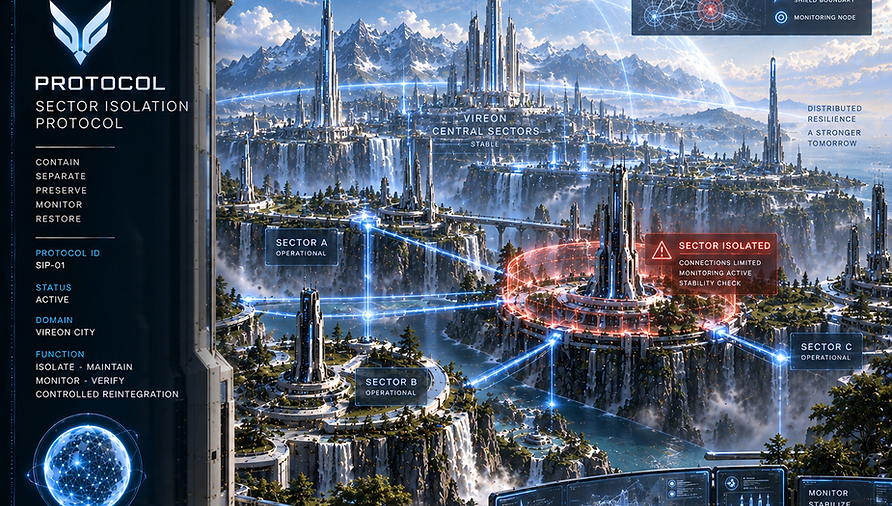
Sector Isolation Protocol defined how VIREON responded when danger, structural failure, communication corruption, environmental instability, or an unidentified technological influence affected a limited part of the city. Instead of allowing the disturbance to propagate through connected infrastructure, the affected region could be separated while surrounding sectors continued operating independently.
ㅤ
Isolation could involve communication links, energy exchange, transit corridors, data synchronization, environmental systems, or physical access depending upon the nature of the threat. Only the connections necessary to contain the problem were severed whenever possible. The objective was to preserve the largest functioning portion of VIREON while reducing the number of systems exposed to uncertainty.
ㅤ
Local infrastructure was specifically designed to support this procedure. Distributed energy reserves, local processing, independent communication capability, and decentralized maintenance allowed isolated sectors to continue supporting inhabitants even when disconnected from the wider city. Separation was therefore treated as a controlled survival state rather than an immediate collapse.
ㅤ
Once a region had been isolated, monitoring continued from both inside and outside the boundary whenever conditions allowed. Reconnection could occur gradually after structural integrity, communication stability, and environmental safety had been verified. Systems were not automatically synchronized immediately after contact returned, reducing the possibility that unresolved corruption could spread during recovery.
ㅤ
The protocol embodied one of the clearest lessons inherited from NEX. VIREON was designed so that losing connection to one part of the city did not mean losing the city itself.