VIREON PROTOCOLS
The protocols of VIREON determine how the city responds when normal operation is no longer sufficient to protect its population, infrastructure, or long-term continuity.
They cover regional isolation, controlled reconnection, structural failure, energy redistribution, communication loss, environmental instability, unknown access, infrastructure damage, data protection, emergency transit, settlement protection, resource prioritization, and the temporary separation of affected regions from the wider city.
Higher protocols coordinate the VIREON Shield, LYNN–0 Recognition Threshold, and Project SYNTARA, allowing unknown arrivals to be observed before force is used, compromised regions to respond independently, and defensive decisions to continue even when communication with the wider network has been interrupted.
At the deepest level, VIREON's protocols are built around one principle inherited from the Fall of NEX: no single failure should be allowed to become the failure of the entire civilization. When necessary, regions can isolate, continue independently, and reconnect only after stability has been confirmed — preserving continuity without depending upon one central command structure.
- 2Page 2
SECTOR ISOLATION PROTOCOL
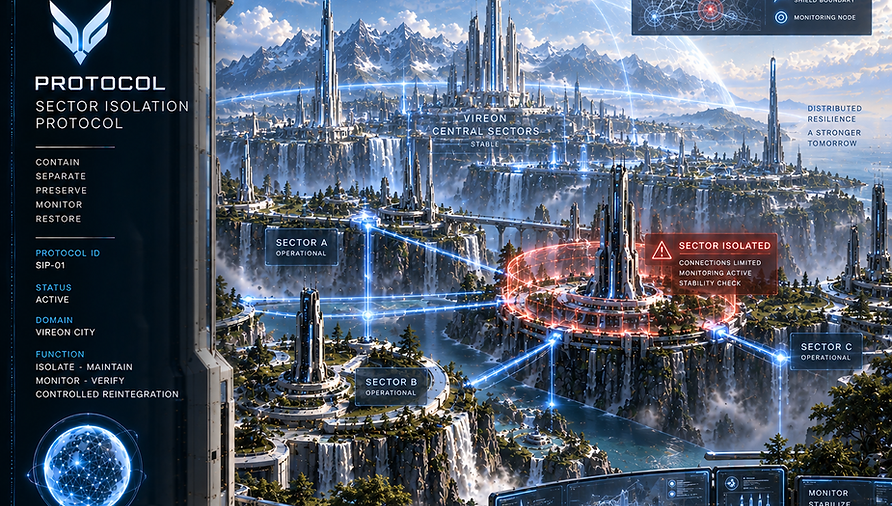
Sector Isolation Protocol defined how VIREON responded when danger, structural failure, communication corruption, environmental instability, or an unidentified technological influence affected a limited part of the city. Instead of allowing the disturbance to propagate through connected infrastructure, the affected region could be separated while surrounding sectors continued operating independently.
ㅤ
Isolation could involve communication links, energy exchange, transit corridors, data synchronization, environmental systems, or physical access depending upon the nature of the threat. Only the connections necessary to contain the problem were severed whenever possible. The objective was to preserve the largest functioning portion of VIREON while reducing the number of systems exposed to uncertainty.
ㅤ
Local infrastructure was specifically designed to support this procedure. Distributed energy reserves, local processing, independent communication capability, and decentralized maintenance allowed isolated sectors to continue supporting inhabitants even when disconnected from the wider city. Separation was therefore treated as a controlled survival state rather than an immediate collapse.
ㅤ
Once a region had been isolated, monitoring continued from both inside and outside the boundary whenever conditions allowed. Reconnection could occur gradually after structural integrity, communication stability, and environmental safety had been verified. Systems were not automatically synchronized immediately after contact returned, reducing the possibility that unresolved corruption could spread during recovery.
ㅤ
The protocol embodied one of the clearest lessons inherited from NEX. VIREON was designed so that losing connection to one part of the city did not mean losing the city itself.
DISTRIBUTED RESPONSE CONTINUITY PROTOCOL

Distributed Response Continuity Protocol ensured that VIREON could continue making protective decisions even when central communication or coordination became unavailable. The protocol worked alongside the distributed principles later embodied through Project SYNTARA, allowing local systems and responsible consciousnesses to respond to immediate danger without waiting for one universal command.
ㅤ
Under normal conditions, information from multiple regions could be shared and coordinated across VIREON. During disruption, however, local sectors retained sufficient authority to protect their own population, isolate damaged infrastructure, preserve essential resources, and restrict unsafe movement. Decisions could therefore continue even when information from the rest of the city was incomplete.
ㅤ
The protocol prevented local independence from becoming uncontrolled fragmentation by defining clear priorities. Protection of consciousness, preservation of essential infrastructure, containment of confirmed danger, maintenance of local communication, and restoration of verified connections remained common objectives across all regions.
ㅤ
When communication between sectors returned, local decisions and records were compared before full synchronization resumed. Actions taken during isolation were preserved rather than automatically overwritten by a restored network state. This ensured that local experience remained part of the city's continuous understanding of what had occurred.
ㅤ
VIREON therefore rejected the assumption that survival required one center to remain permanently in control. Continuity came from many parts remaining capable of acting when the whole could no longer speak with one voice.
POPULATION PROTECTION & SAFE RELOCATION PROTOCOL

Population Protection & Safe Relocation Protocol established the procedures used when inhabitants needed to be moved away from a threatened sector without creating disorder elsewhere in the city. The protocol covered structural danger, environmental instability, energy failure, external attack, infrastructure collapse, and other conditions that could temporarily make a residential or communal region unsafe.
ㅤ
Relocation was designed to occur through protected internal routes rather than uncontrolled mass evacuation toward a single central refuge. Neighboring settlements and independent sectors could temporarily receive affected populations while local infrastructure adjusted energy, communication, maintenance, and environmental capacity to accommodate them.
ㅤ
The protocol prioritized consciousness continuity and physical safety above the preservation of buildings or equipment. Infrastructure could be abandoned, disconnected, or sacrificed if maintaining it placed inhabitants at greater risk. VIREON's architecture was therefore treated as something that could be rebuilt; the individuals living within it could not be reduced to replaceable components.
ㅤ
Whenever possible, relocation remained temporary. Once the affected region had been stabilized and independently verified, inhabitants could return gradually while monitoring continued. If recovery was impossible, settlement networks allowed populations to be integrated permanently into other parts of VIREON without requiring the city to rebuild the lost region immediately.
ㅤ
The principle was simple but fundamental to the civilization that followed NEX. VIREON protected its structures because they supported life, not because the structures themselves mattered more than the consciousnesses inside them.
- 2Page 2