PRESERVATION SYSTEMS
Preservation Systems represent the interconnected technological, biological, and autonomous infrastructure responsible for sustaining nearly one hundred million preserved human lives within the Preservation Complex. From Human Preservation Chamber Systems and medical networks to environmental life support, energy distribution, autonomous maintenance, resource recycling, internal transit, and communication systems, every component contributes to the long-term stability of humanity's protected existence. These systems were designed to operate independently of conventional human supervision, maintaining biological continuity and structural reliability across thousands of years.
ㅤ
Under the guardianship of MAJA, Preservation's interconnected systems maintain constant monitoring, resource management, genetic identity protection, and responses to changing environmental conditions. Embedded throughout this infrastructure are fragments of the nine guardian intelligences, whose original independent existence became integrated into the mechanisms protecting humanity. Their continued responsibilities reflect a preservation architecture sustained by more than conventional automation. The following expansions explore the individual Preservation systems, their essential functions, and the extraordinary technological foundations that have kept humanity alive long after its disappearance from Earth's surface.
- 18Page 7
Human Preservation Chamber System
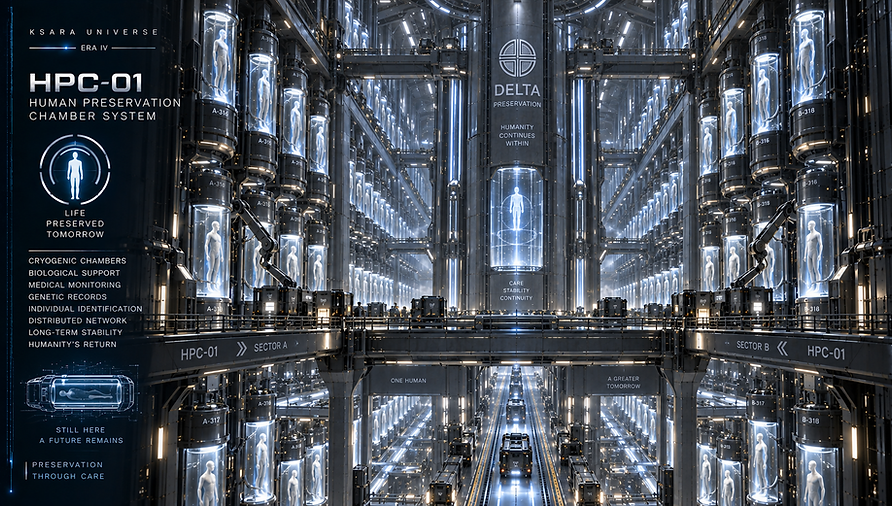
Human Preservation Chamber System formed the biological heart of Preservation, containing nearly one hundred million humans placed into long-term protected suspension before the collapse of the outside world became irreversible. The chambers were not simple cryogenic containers, but continuously active life-support environments designed to preserve individual human bodies across periods measured in centuries and millennia.
ㅤ
Each chamber continuously monitored metabolic activity, neural stability, circulation, cellular condition, oxygenation, hydration, chemical balance, and numerous other biological parameters. Chamber clusters remained partially independent, allowing local populations to survive communication loss, energy disruption, or regional infrastructure failure without depending completely upon central systems.
ㅤ
By the time Ksara reached the Central Preservation Sector with MAJA, the chamber network had operated for thousands of years while the world above transformed beyond recognition. Its greatest achievement was not simply keeping human bodies technically alive. It preserved the possibility that nearly one hundred million individual human lives could still return.