PRESERVATION SYSTEMS
Preservation Systems represent the interconnected technological, biological, and autonomous infrastructure responsible for sustaining nearly one hundred million preserved human lives within the Preservation Complex. From Human Preservation Chamber Systems and medical networks to environmental life support, energy distribution, autonomous maintenance, resource recycling, internal transit, and communication systems, every component contributes to the long-term stability of humanity's protected existence. These systems were designed to operate independently of conventional human supervision, maintaining biological continuity and structural reliability across thousands of years.
ㅤ
Under the guardianship of MAJA, Preservation's interconnected systems maintain constant monitoring, resource management, genetic identity protection, and responses to changing environmental conditions. Embedded throughout this infrastructure are fragments of the nine guardian intelligences, whose original independent existence became integrated into the mechanisms protecting humanity. Their continued responsibilities reflect a preservation architecture sustained by more than conventional automation. The following expansions explore the individual Preservation systems, their essential functions, and the extraordinary technological foundations that have kept humanity alive long after its disappearance from Earth's surface.
- 18Page 17
Structural Integrity Monitoring System
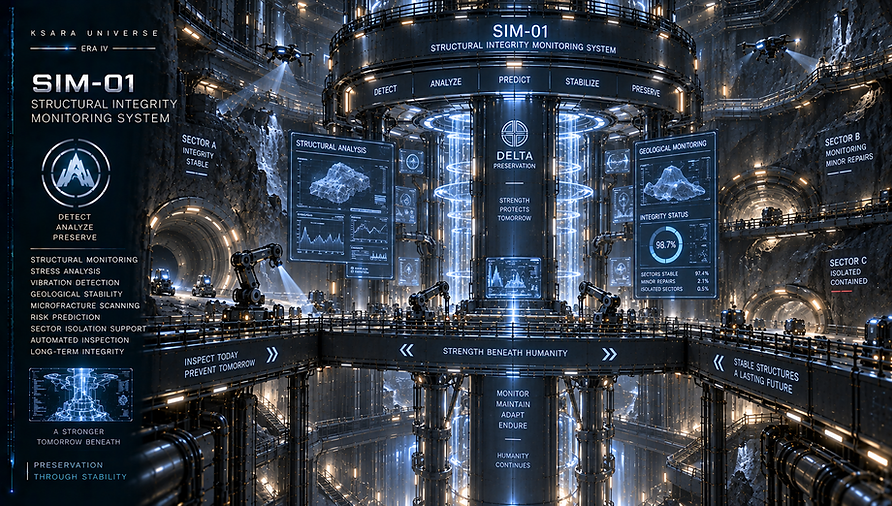
Structural Integrity Monitoring System continuously evaluated the physical condition of Preservation's underground architecture, from tunnels and foundations to chamber housings, pressure barriers, defensive layers, and deep structural supports. Its primary purpose was to identify weakness long before local damage could threaten the preserved population.
ㅤ
Sensors measured stress, vibration, geological displacement, pressure changes, material fatigue, deformation, thermal movement, and microfractures throughout the complex. The system analyzed not only whether something was failing, but how that failure would redistribute load, affect neighboring structures, and potentially spread toward deeper sectors.
ㅤ
Fragments of the former Structural Intelligence remained embedded within portions of the monitoring architecture, preserving its understanding of redundancy, sacrificial design, and controlled failure. Preservation survived because its structure was never assumed to remain perfect forever. Weakness was expected, observed, contained, and prevented from reaching the people sleeping at the center.