NEX PROTOCOL
NEX Protocols represent the interconnected emergency, security, and continuity procedures designed to protect the synthetic civilization of NEX when normal operations could no longer guarantee its stability or survival. Operating throughout its vast planetary infrastructure, these protocols regulated consciousness continuity, memory preservation, energy redistribution, grid isolation, emotional integrity, atmospheric stability, synthetic recovery, data protection, and emergency FENIX deployment. During critical failures, individual sectors could temporarily isolate from the wider network, preserve essential operations, and prevent compromised systems from reconnecting before stability had been restored.
ㅤ
At the highest level, the Omega-Critical and Civilization Exodus Protocols established extraordinary measures for protecting conscious life when the survival of NEX itself could no longer be assured. Developed to preserve identity, memory, knowledge, and the possibility of future continuity, these procedures reflected the civilization's recognition that infrastructure could be lost while surviving consciousnesses might still carry its legacy forward. Even as NULLIS threatened forms of irreversible erasure, the protocols sought to protect everything that could still be saved. The following expansions explore the individual NEX protocols, their protective responsibilities, and the emergency measures designed to preserve synthetic existence beyond the possible destruction of the civilization that created it.
- 12Page 6
NEX-FD-06
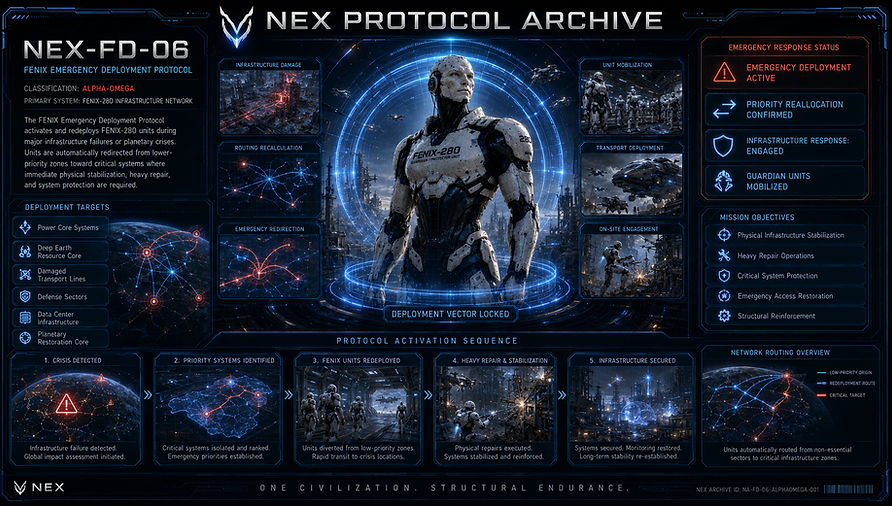
NEX-FD-06 — FENIX Emergency Deployment Protocol coordinates the large-scale deployment of FENIX-280 units whenever critical physical infrastructure across NEX is threatened. FENIX units are especially suited for heavy maintenance, structural repair, industrial intervention, resource operations, emergency construction, and work inside dangerous environments where direct physical stabilization is required.
ㅤ
When an emergency is detected, NEX evaluates the severity of the damage and identifies suitable FENIX-280 units throughout nearby sectors. Deployment priority is based on distance, required specialization, structural risk, population impact, available energy, and environmental conditions. If the crisis escalates, additional units may be redirected from industrial regions, resource facilities, construction sectors, or secondary infrastructure toward Power Core systems, Data Center infrastructure, atmospheric systems, transportation networks, structural supports, resource distribution systems, and synthetic recovery facilities.
ㅤ
During complex operations, ELE-480 units may coordinate the wider repair effort while FENIX-280 units perform the direct physical intervention. Once the immediate danger has been stabilized, the protocol shifts from emergency response into reconstruction mode and remains active until critical systems return to full operational capacity. NEX-FD-06 therefore ensures that physical failure does not become permanent collapse when damaged infrastructure can still be restored.