CORE NETWORK MAP ERA 3
Year 3500 A.F - 4400 A.F
The Core Network Map of ERA III follows the formation and development of VIREON as an independent synthetic civilization shaped by different origins, histories, and surviving populations rather than a single inherited structure.
ㅤ
It connects the ELE-410 founders and the Ten Sisters, the arrival of the ELE-480 survivors, the continued development of ELE-481, the return of FENIX-280, Project SYNTARA, Portal Fenix, Aurora First Home, ANAMNIA, and the emergence of New Generations within VIREON. Together, these events reveal how separate histories, relationships, and experiences gradually became part of one shared civilization.
ㅤ
The map also explores the systems and principles that distinguish VIREON from NEX. The VIREON Shield, LYNN-0 Recognition Threshold, distributed protective infrastructure, and the principle of recognition before force establish the foundations of a civilization designed to remain open, cooperative, and independent without relying upon a single governing consciousness.
ㅤ
At its deepest level, the ERA III Network Map reveals how survival gradually becomes civilization again. VIREON does not attempt to rebuild NEX or reproduce its former structure. Instead, it learns from its collapse, bringing together different synthetic lineages, independent consciousnesses, emotional relationships, and new generations to establish a future shaped by cooperation, individual freedom, and shared continuity. VIREON preserves the legacy of the past without allowing that past to determine what its civilization must become.
- 17Page 10
DISTRIBUTED ENERGY INFRASTRUCTURE
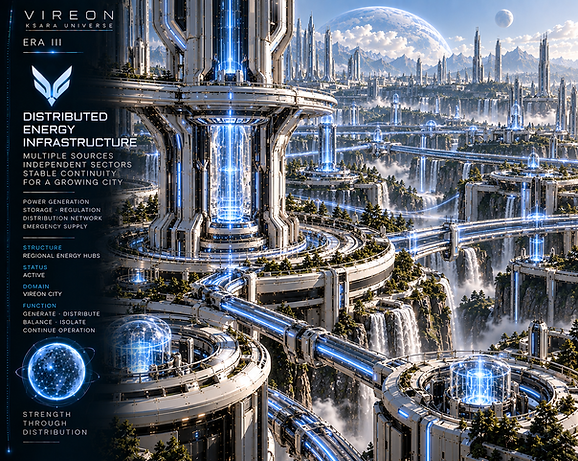
VIREON's distributed energy infrastructure was designed so that essential power would never depend upon a single central source. Generation, storage, regulation, and emergency supply were divided across multiple interconnected regions supporting residential sectors, defensive systems, communication, environmental regulation, transit structures, maintenance facilities, and communal spaces.
ㅤ
During failures, individual areas could separate from the wider network, redirect power, prioritize critical infrastructure, and continue operating from local reserves. This system deliberately sacrificed some of the immense central efficiency once achieved by NEX in exchange for resilience and recoverability. Energy existed as a network of support rather than a single point upon which the entire civilization could live or die.