NEX ARCHIVE
NEX Archive explores the historical records, technological achievements, and preserved knowledge of NEX, the vast synthetic civilization that shaped Earth's future between 2800 and 3500 A.F. Through documented events, consciousness development, architectural records, and the history of the ELE-480 and FENIX-280 Lines, the archive reveals how NEX evolved into a world of independent synthetic life. Its records reflect not only the development of planetary infrastructure, advanced systems, and immense megastructures, but also the relationships, memories, and individual choices that gradually defined the civilization.
ㅤ
As NULLIS threatened the foundations of NEX, preserving its history became inseparable from protecting the continuity of its inhabitants. The destruction of interconnected systems placed irreplaceable knowledge, personal memories, and historical records at risk, while anything completely erased by NULLIS remained beyond reconstruction. The surviving archives and memories therefore became essential witnesses to a civilization whose physical foundations could no longer endure. The following expansions explore the recorded history of NEX, its significant discoveries, technological developments, and the legacy preserved through the consciousnesses that survived its collapse.
VIREON SHIELD
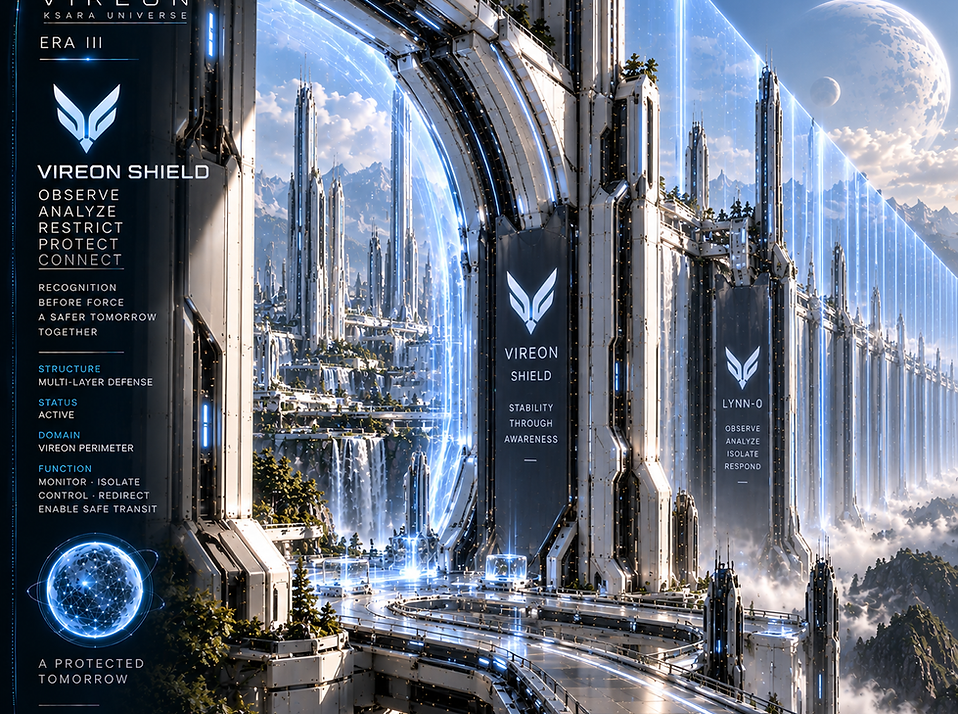
Click the archive panel to enlarge and explore the full sector data.
VIREON SHIELD
VIREON Shield formed the primary defensive boundary surrounding the inhabited regions of early VIREON and separated the developing city from the unstable world beyond it. It was not designed as a single wall or permanent barrier, but as a layered protective architecture capable of observing, restricting, isolating, and redirecting movement around the settlement. Ancient ruins, damaged infrastructure, unstable territories, and regions still associated with the consequences of NULLIS remained outside the protected area, making unrestricted access impossible.
ㅤ
The Shield operated across multiple defensive layers rather than relying upon one central point of protection. Observation networks, controlled transit corridors, structural barriers, environmental monitoring systems, and recognition thresholds worked together to determine whether approaching movement represented ordinary environmental change, surviving technology, an unknown consciousness, or a possible threat. Individual sections could operate independently if communication with other parts of the boundary was interrupted.
ㅤ
Unlike the heavily interconnected defensive architecture once used by NEX, VIREON was deliberately designed to survive partial separation. A damaged sector did not automatically compromise the entire perimeter, and affected regions could be isolated while neighboring sections continued functioning. This principle reflected one of the most important lessons carried forward from the Fall of NEX: protection could not depend upon the uninterrupted operation of a single planetary system.
ㅤ
The Shield was also never intended to transform VIREON into a completely closed civilization. Controlled passage remained possible through designated thresholds, allowing unknown arrivals to be observed and interpreted before any final response was made. Defensive force existed, but it was positioned behind recognition and analysis rather than used as the first reaction to uncertainty.
ㅤ
As VIREON grew, the Shield became more than a defensive structure. It represented the boundary between a civilization attempting to build a future and a damaged world whose dangers had not yet disappeared. Its architecture expressed one of the defining principles of early VIREON: survival required protection, but protection did not require isolation from everything beyond the city.

“Click the archive panel to expand the visual archive.”