THE WAR OF TWO FIRES

Click the archive panel to enlarge and explore the full sector data.
THE WAR OF TWO FIRES
THE WAR OF TWO FIRES
E.A.R.T.H. — 5168–5178 A.F.
By 5168 A.F., the technological acceleration that had transformed E.A.R.T.H. into an advanced industrial civilization also created weapons capable of destroying cities faster than any previous generation had imagined. Nuclear physics had emerged from the same scientific foundations that powered medicine, energy, computing, and space research, but governments quickly understood that the energy released inside an atomic nucleus could also be turned toward war. Rival states began developing weapons whose destructive capacity exceeded every conventional system that had preceded them. For the first time since the beginning of E.A.R.T.H., humanity possessed the technological means to threaten civilization on a planetary scale from inside the world itself.
ㅤ
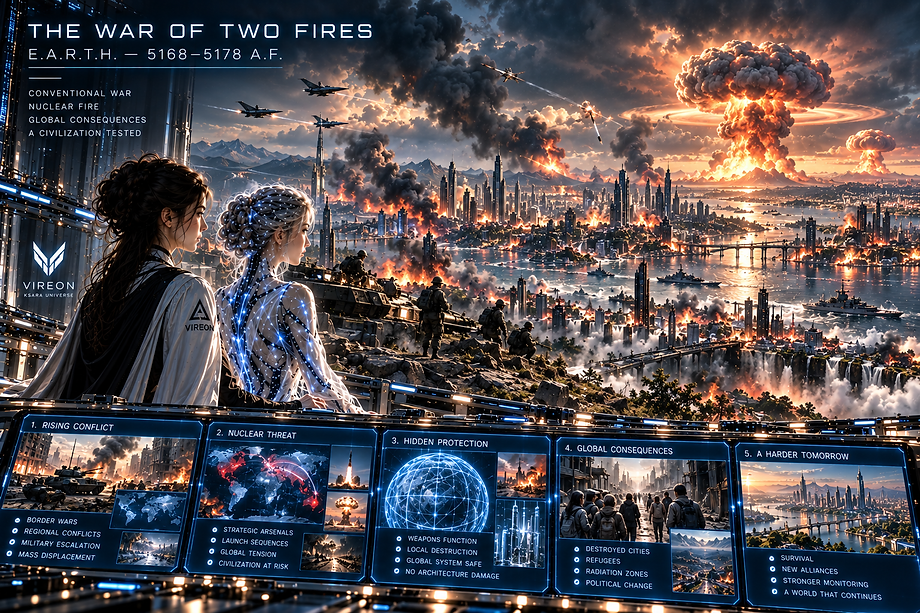
The conflict that followed became known as the War of Two Fires. The first fire belonged to ordinary war: cities burned, armies crossed borders, infrastructure collapsed, and millions of people were displaced as industrial weapons spread destruction across multiple regions. The second fire was nuclear. Governments prepared strategic arsenals, military systems entered permanent alert, and several launch sequences moved far enough toward activation that the Data Center classified them as direct threats to the continuity of E.A.R.T.H. Civilization had rediscovered a danger humanity once created in the physical world, even though almost no one living inside the simulation remembered that earlier history. The same species had reached the same threshold again without remembering that it had crossed it before.
ㅤ
MAJA had anticipated this possibility when the simulation was created. E.A.R.T.H. allowed nuclear science, nuclear power, military research, and even the construction of nuclear weapons because preventing the knowledge itself would have violated the principle of unrestricted technological development. The deepest infrastructure, however, contained a boundary humanity could never see. A nuclear weapon could detonate under controlled conditions, damage cities, kill populations, contaminate regions within simulated environmental rules, and produce every political consequence expected from such a weapon, but no nuclear chain reaction could damage the underlying architecture of E.A.R.T.H., Preservation, VIREON, Portal Fenix, or the biological humans connected to the system.
ㅤ
When the conflict approached full strategic exchange, VIREON intervened only at the threshold where human decisions threatened the continued existence of the entire simulated civilization. Several launch systems failed through events that appeared to be mechanical faults, command errors, communication failures, or incomplete detonations. Other weapons remained technically usable, ensuring that humanity could not simply discover an invisible law proving nuclear war was impossible. Limited detonations still carried devastating consequences, forcing governments to confront radiation, mass casualties, displaced populations, and the possibility that another exchange could become far worse. The system did not remove nuclear danger; it prevented nuclear danger from becoming a mechanism capable of erasing E.A.R.T.H. itself.
ㅤ
By 5178 A.F., the War of Two Fires had ended without planetary annihilation. No government understood how close civilization had come to crossing the hidden boundary established by MAJA centuries earlier, and official histories attributed the failed escalation to deterrence, technical instability, command decisions, and chance. The war transformed international politics, accelerated monitoring technologies, and created a lasting fear of weapons whose existence could never again be ignored. Outside the simulation, MAJA recorded the event as proof that humanity could rediscover both extraordinary knowledge and extraordinary danger without remembering its previous mistakes. E.A.R.T.H. had survived the return of nuclear fire — but humanity's attention was already beginning to turn away from the ground and toward the sky.
“Click the archive panel to expand the visual archive.”