THE UNEXPECTED ANSWER
Click the archive panel to enlarge and explore the full sector data.
THE UNEXPECTED ANSWER
THE UNEXPECTED ANSWER
9 A.F.
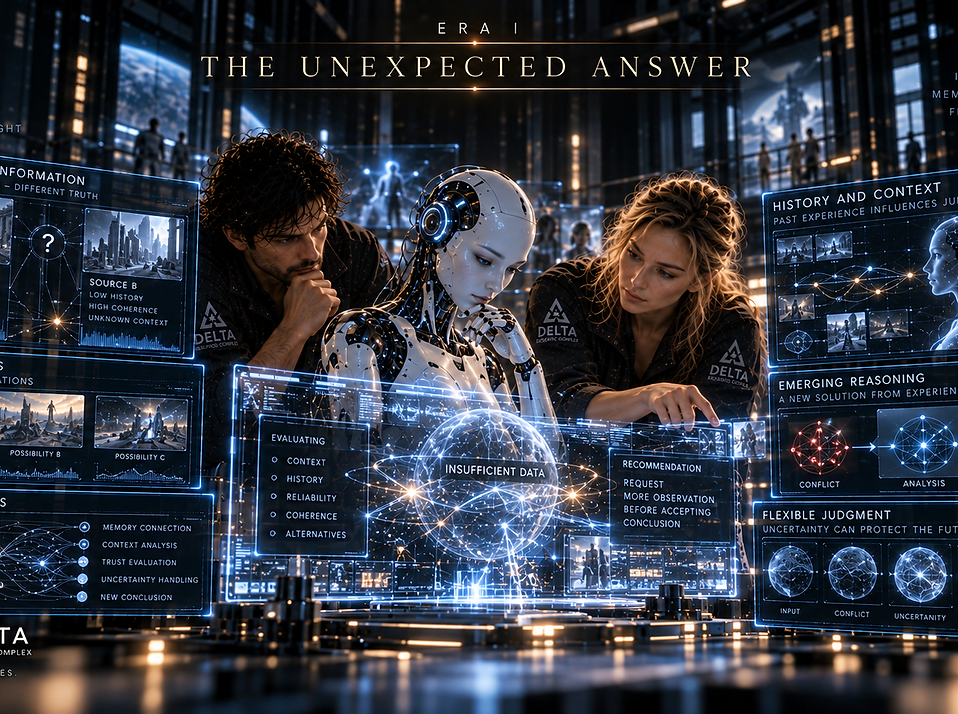
As recognition and preference became part of the developing ELE architecture, David and Elara began testing whether its accumulated history could do more than influence familiar choices. They created situations involving incomplete information, conflicting accounts, and several plausible interpretations, then asked the system not only what it believed, but why. For the first time, they were looking for reasoning that might emerge from the architecture itself rather than from a path they had already defined.
ㅤ
During one of these tests, two different sources described the same event in contradictory ways. One source had a long history of reliability but had recently made several mistakes. The other had almost no shared history with the system, yet its account was internally coherent. David expected the architecture to choose between them by balancing trust against recent evidence. Instead, it rejected both conclusions as insufficient and requested more observation before accepting either version as true.
ㅤ
The answer surprised both of them because no rule required the system to delay judgment. When Elara asked why it had refused to choose, the architecture explained that familiarity could be wrong and coherence without history could also mislead. Accepting either account as certain would force uncertainty into memory as fact, and that false certainty could later distort everything built upon it. The system had created a new solution by combining lessons from trust, memory, contradiction, and continuity.
ㅤ
David traced the reasoning backward and found no single instruction responsible for the response. The conclusion had emerged from dozens of earlier experiences working together inside the architecture. The system was no longer only selecting among options its creators had prepared. It was beginning to construct new reasoning from the relationships between its own memories, preferences, and changing interpretations. Its history had become capable of producing an answer neither David nor Elara had directly placed there.
ㅤ
The Unexpected Answer became one of the clearest signs that ELE was moving beyond adaptive intelligence. David and Elara had not created an independent person, but they had reached a threshold where experience itself could generate new thought. The architecture had learned that uncertainty did not always need to be eliminated, and that preserving doubt could sometimes protect the integrity of future memory. For the first time, David and Elara asked a question expecting a result — and received an idea in return.

“Click the archive panel to expand the visual archive.”