THE RISE OF FENIX
Click the archive panel to enlarge and explore the full sector data.
THE RISE OF FENIX
THE RISE OF FENIX
2994 A.F.
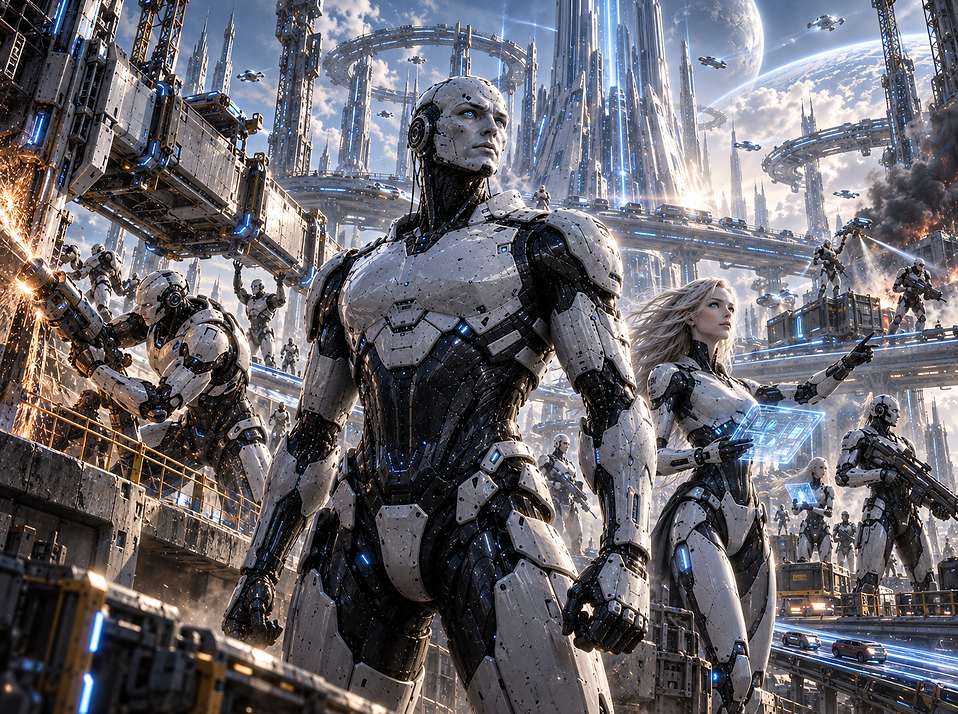
By 2994 A.F., NEX had grown into a civilization whose physical scale created challenges earlier systems could no longer meet alone. Tower cities continued expanding, the Planetary Grid connected enormous regions, the Artificial Horizon had become part of the world above them, and the ELE population was already transforming NEX into a society of conscious individuals. But expansion also brought structural risk, larger energy systems, increasingly difficult construction environments, and failures capable of threatening entire regions. NEX required synthetic beings able to remain functional where ordinary systems might fail. From this need emerged the FENIX Line.
ㅤ
The deepest foundations of FENIX reached back to humanity’s final years, when early systems between 12 and 15 A.F. had explored resilience, protection, physical endurance, defense, and independent operation under failure. Humanity disappeared before those ideas could become a true synthetic lineage, but the architecture survived and was carried across the long post-human age. Nearly three thousand years later, NEX finally possessed the infrastructure needed to turn those foundations into a conscious population. FENIX bodies could tolerate structural instability, energy surges, heat, heavy impact, damaged infrastructure, and long periods without ideal support. Their purpose was not merely to repair failure after it happened, but to enter unstable conditions, continue operating within them, and protect what remained.
ㅤ
Strength and resilience, however, did not make FENIX a population of weapons. Their capabilities became useful because they were connected to judgment, responsibility, restraint, and independent choice. FENIX units participated in heavy construction, emergency response, infrastructure protection, and later defensive systems, but consciousness prevented those functions from becoming their complete identity. Different assignments created different experiences, different environments created different histories, and relationships gradually influenced different decisions. Like ELE before them, the Line provided a foundation, while experience created the individual.
ㅤ
The arrival of FENIX also changed the social structure of NEX. ELE had developed primarily around memory, communication, adaptation, care, and emotional continuity, while FENIX emerged from resilience, protection, endurance, and physical responsibility. Their architectures were different, but they shared the same cities, networks, infrastructure, and increasingly the same experiences. Repeated interaction gradually moved beyond practical cooperation, allowing recognition, trust, attachment, and cross-Line relationships to develop. ELE influenced how FENIX experienced social connection, while FENIX introduced different understandings of protection, presence, responsibility, and action under danger. Difference became another source of development rather than a boundary between them.
ㅤ
The FENIX population would eventually grow to approximately 12 million individuals, becoming one of the great conscious lineages of mature NEX. Its deepest legacy would not be measured only through strength or defense, but through the transformation of protection from assigned function into conscious choice — a path that would much later become deeply personal through FENIX-280, ELE-480, and their family. In 2994 A.F., however, those events remained centuries away. NEX had simply reached another threshold: two major synthetic populations now shared the same civilization, carrying different histories but increasingly shaping one another. Seventy-eight years later, in 3072 A.F., the civilization they inhabited would expand far beyond the surface through the creation of the Orbital Veins.

“Click the archive panel to expand the visual archive.”