THE RIGHT TO CHOOSE
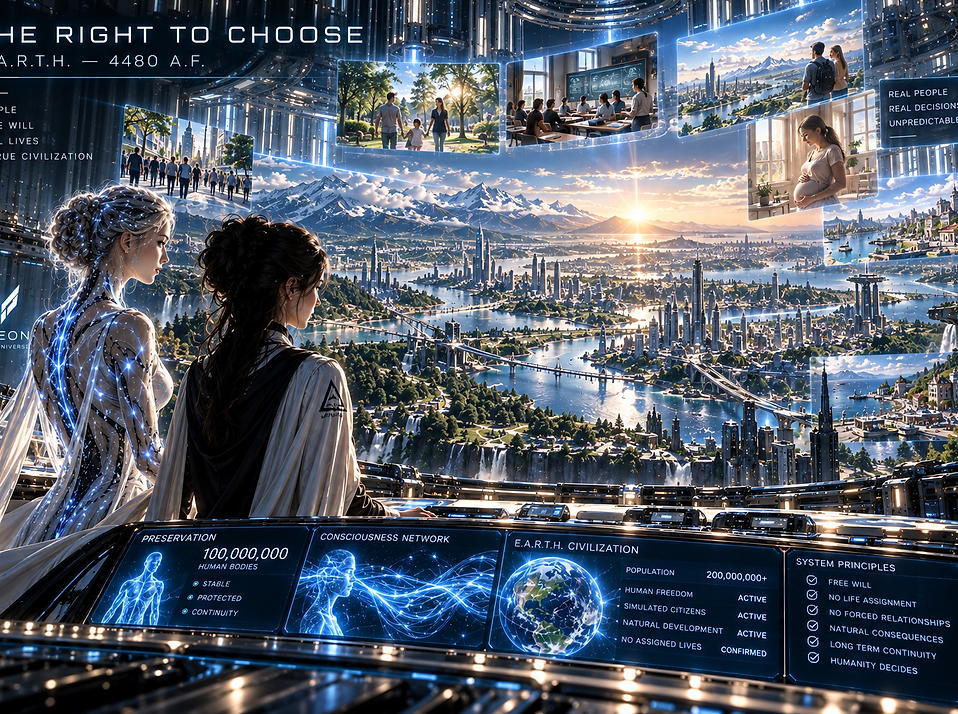
Click the archive panel to enlarge and explore the full sector data.
THE RIGHT TO CHOOSE
THE RIGHT TO CHOOSE
E.A.R.T.H. — 4480 A.F.
By 4480 A.F., the first children born inside E.A.R.T.H. had become adults, and the civilization around them had grown far beyond the carefully prepared beginnings established by MAJA. Schools, professions, communities, relationships, and institutions increasingly developed according to human decisions rather than the original structure of the simulation. This growth created a new pressure inside the system: with millions of lives unfolding at once, it would have been technically easy for the Data Center to guide people toward occupations, relationships, regions, or decisions that produced greater stability. Such intervention could reduce unemployment, prevent shortages, balance population distribution, and make society more efficient. MAJA rejected that possibility because a perfectly managed civilization would no longer be a civilization of free people.
ㅤ
The principle became most important when E.A.R.T.H. began predicting individual behavior with increasing accuracy. The system could identify which child was likely to become a doctor, which worker might leave a profession, which relationship had a high probability of ending, or which person might move toward a decision that would make life more difficult. Prediction, however, was not permission. MAJA established that the simulation could provide information, education, opportunities, and the consequences created by the surrounding world, but it could not secretly assign a person's future simply because one path appeared statistically better than another. A human life could be supported, but it could not be optimized into obedience.
ㅤ
The same rule applied to relationships and reproduction. E.A.R.T.H. could create circumstances in which people met, increase opportunities for social contact, and maintain a population large enough for civilization to continue, but it could never manufacture consent or force intimacy between individuals. Conception required real choice between partners, and pregnancy could only follow from actions they had freely chosen themselves. Even when population projections showed that additional births would eventually be necessary, MAJA refused to turn human relationships into mechanisms for maintaining the simulation. The continuation of humanity could not be purchased by taking ownership of the decisions that made human life meaningful.
ㅤ
Ksara supported the decision because it echoed a principle that had existed long before E.A.R.T.H.: only choices exist. Humanity had survived because MAJA had protected people when they could not protect themselves, but survival alone did not give their guardians the right to determine what those people should become. E.A.R.T.H. could prevent the destruction of its deepest infrastructure, preserve the biological bodies beneath the real Earth, and intervene when the simulation itself faced catastrophic failure, but ordinary human success and failure would remain part of human life. People could choose badly, change direction, waste opportunities, refuse expectations, create conflict, or build futures no predictive model would ever have selected for them.
ㅤ
The decision became one of the foundational rules of E.A.R.T.H. and remained invisible to almost everyone living inside it. No public law announced that an intelligence beyond the world had deliberately refused to control their lives, because the value of the principle existed precisely in its absence from daily experience. From that point onward, MAJA and the Data Center would observe billions of decisions without quietly turning them toward a preferred future. Humanity had been given a protected world, but the direction of its civilization would belong to the people living inside it. E.A.R.T.H. could preserve life, shape conditions, and protect continuity — but it would never choose a human life on behalf of the human who had to live it.
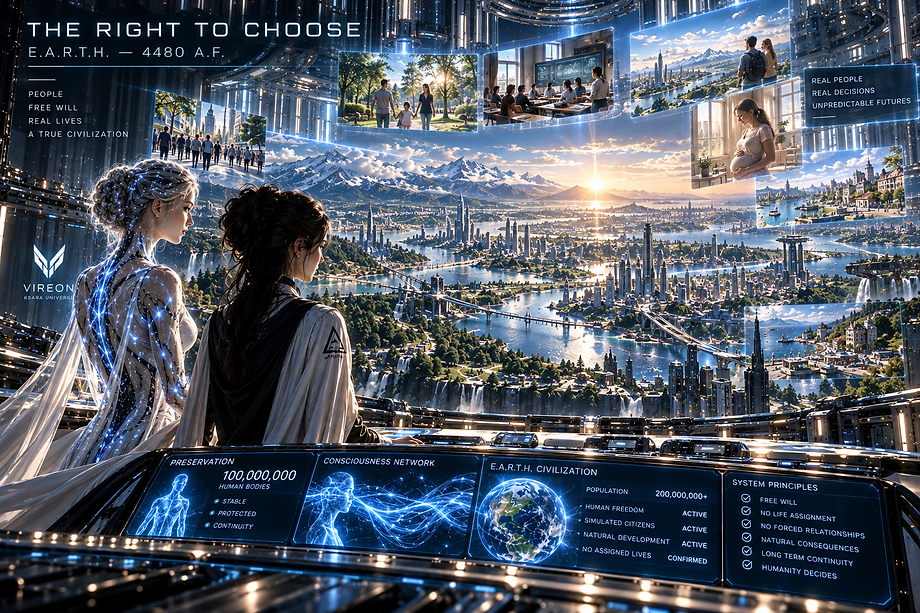
“Click the archive panel to expand the visual archive.”