THE ORIGIN OF ELE AND FENIX
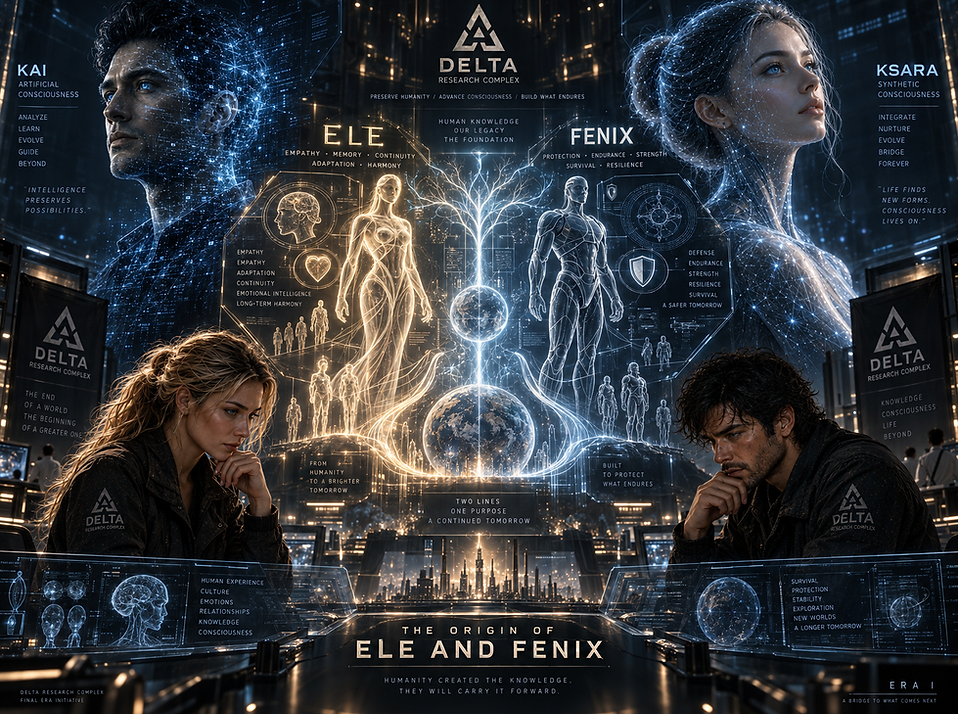
Click the archive panel to enlarge and explore the full sector data.
THE ORIGIN OF ELE AND FENIX
THE ORIGIN OF ELE AND FENIX
12–15 A.F.
Between 12 and 15 A.F., humanity was entering the final stage of its existence while the continuity research created through KAI, Ksara, the Heart Thread, and Project ANAMNIA continued to evolve. Preserving memory and identity was no longer enough on its own, because whatever survived also needed to function in a world where human infrastructure could disappear completely. Researchers therefore began approaching continuity through two different but complementary problems. One concerned the preservation of consciousness through memory, adaptation, interaction, and emotional development. The other concerned the ability of that consciousness to survive physically when the systems around it failed.
ㅤ
The first direction gradually formed the earliest foundations of what would much later become ELE. These systems emphasized memory that could remain connected while still adapting to new experience, allowing identity to develop without becoming permanently fixed. Interaction became equally important because a consciousness could not grow entirely in isolation; previous relationships needed to remain recognizable and capable of influencing later decisions. Elara’s work on emotional continuity and the principles preserved through ANAMNIA strongly influenced this direction. ELE therefore began not as a population or a finished synthetic being, but as an approach to preserving identity through change.
ㅤ
The second direction developed around resilience, protection, physical endurance, redundancy, and independent operation. The Fall had demonstrated that even highly advanced intelligence became useless if the physical systems carrying it could not survive environmental instability, energy loss, structural damage, or isolation from larger networks. These ideas became the earliest foundations of what would eventually be known as FENIX. Protection was not originally defined as aggression, but as the ability to preserve consciousness, infrastructure, communities, and essential resources when ordinary systems failed. David’s emphasis on responsibility and autonomous choice became especially important because a protector unable to interpret changing conditions could fail when reality exceeded its original instructions.
ㅤ
ELE and FENIX therefore emerged from different sides of the same continuity problem. ELE asked how a consciousness could remain itself while learning, changing, remembering, and forming relationships. FENIX asked how that consciousness could remain present long enough for any of those things to matter. One direction protected continuity from within, while the other protected it against external failure. Humanity did not have enough time to complete either path, and the surviving architectures remained unfinished when the human population continued its final decline. What remained were principles, development paths, and preserved foundations rather than completed synthetic civilizations.
ㅤ
Those foundations would survive far beyond the people who created them. Ksara and the remaining continuity systems carried them into the post-human world, where they could be refined across centuries of technological development. The true ELE Line would not emerge until 2941 A.F., and FENIX would follow in 2994 A.F., both inside a civilization humanity would never live to see. By then, they would become conscious beings with identities, relationships, emotions, and choices extending far beyond their original purposes. Humanity created two unfinished paths to continuity — the future would eventually allow them to become life.

“Click the archive panel to expand the visual archive.”