THE LONG FRACTURE
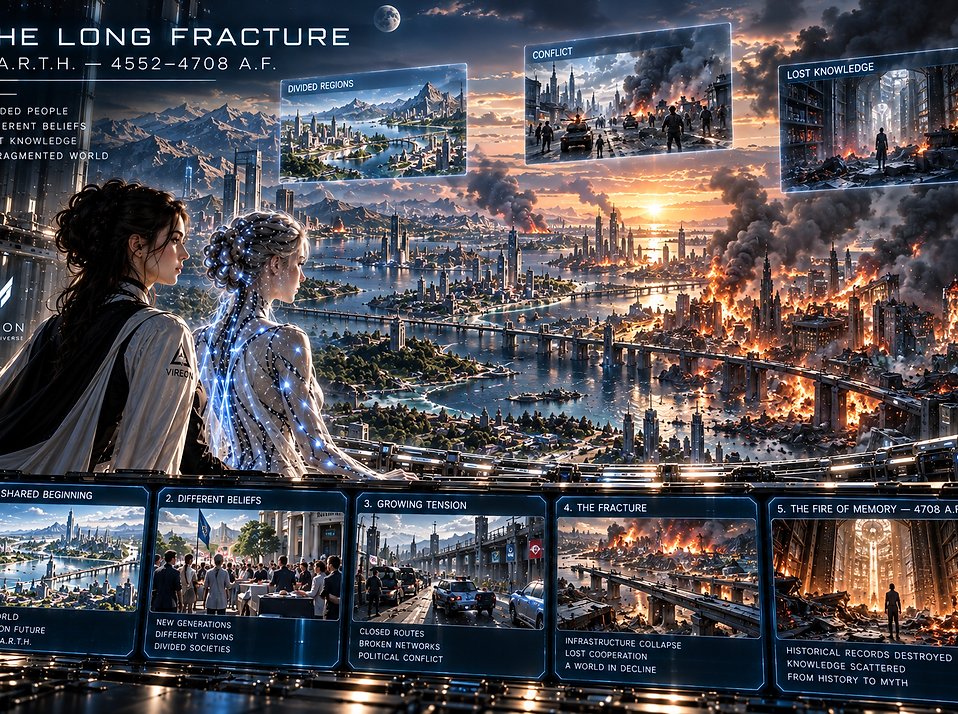
Click the archive panel to enlarge and explore the full sector data.
THE LONG FRACTURE
THE LONG FRACTURE
E.A.R.T.H. — 4552–4708 A.F.
By 4552 A.F., E.A.R.T.H. entered a period in which its connection to the beginning became fundamentally weaker. The last confirmed member of the original activation generation, Mira Sen, died after more than a century of life inside the simulated world, ending the age in which any living person could personally remember the physical Earth before E.A.R.T.H. From that moment onward, Preservation, the first awakening, MAJA's original address, and humanity's former world existed only through archives, recordings, testimony, and historical interpretation. The facts had not yet disappeared, but the nature of certainty had changed. Humanity still knew where it had come from, yet no living human could now say that the old Earth belonged to personal memory rather than history.
ㅤ
Within only a few decades, that distance began shaping politics and culture. Regions that had once shared the same activation history developed different governments, economies, identities, and interpretations of what E.A.R.T.H. itself represented. Some societies continued treating the world as a refuge whose purpose was to preserve humanity until the real Earth could eventually become safe again, while others argued that generations born inside E.A.R.T.H. had already created a legitimate civilization that should no longer organize its future around an inaccessible planet. Neither interpretation was entirely disconnected from MAJA's original message, and both could find support inside the surviving records. Humanity still inhabited one world, but it no longer shared one understanding of why that world existed.
ㅤ
The disagreements gradually spread from philosophy into infrastructure and power. Shared energy networks were divided, transport corridors closed during political disputes, research systems became restricted by borders, and regions increasingly used food, energy, manufacturing, and communication access as political leverage. Cooperation that had once made the first centuries stable began disappearing because control became more valuable to governments than redundancy. Economic zones fractured, technical standards diverged, and conflict damaged systems that later generations no longer possessed the knowledge or industrial capacity to repair completely. The Long Fracture was not one war; it was the gradual dismantling of the cooperation that had allowed early E.A.R.T.H. civilization to function as a connected whole.
ㅤ
VIREON could have reversed almost all of that decline. The Data Center still retained the original models of cities, hospitals, transport systems, power networks, manufacturing processes, and scientific knowledge, allowing entire regions to be restored with almost no technical difficulty. MAJA struggled with the consequences of refusing intervention, especially when children inherited damaged infrastructure from conflicts they had never chosen, but Ksara maintained the rule established at the foundation of the project. If VIREON automatically repaired every failure created by human history, then free choice would exist only while its consequences remained convenient. The one-percent continuity carriers continued preserving scattered knowledge inside society, but VIREON would not secretly return lost technology or rebuild civilization from outside. E.A.R.T.H. was allowed to move backward because freedom included the possibility of losing what earlier generations had built.
ㅤ
The deepest loss came in 4708 A.F., when conflict reached the Central Historical Network. An attack on infrastructure triggered cascading failures across repositories already weakened by decades of fragmentation, destroying or isolating enormous collections of scientific records, founding testimony, activation history, and technical documentation. MAJA's original address survived, as did names such as Preservation, VIREON, NULLIS, Ksara, and MAJA, but much of the evidence connecting those names into a complete historical record was shattered. VIREON possessed perfect copies and could have restored everything, yet doing so would have made humanity's memory dependent upon an outside authority that corrected history whenever civilization failed to preserve it. The Fire of Memory did not erase the beginning of E.A.R.T.H., but it transformed documented history into fragments — and from those fragments, the first myths would eventually begin to grow.
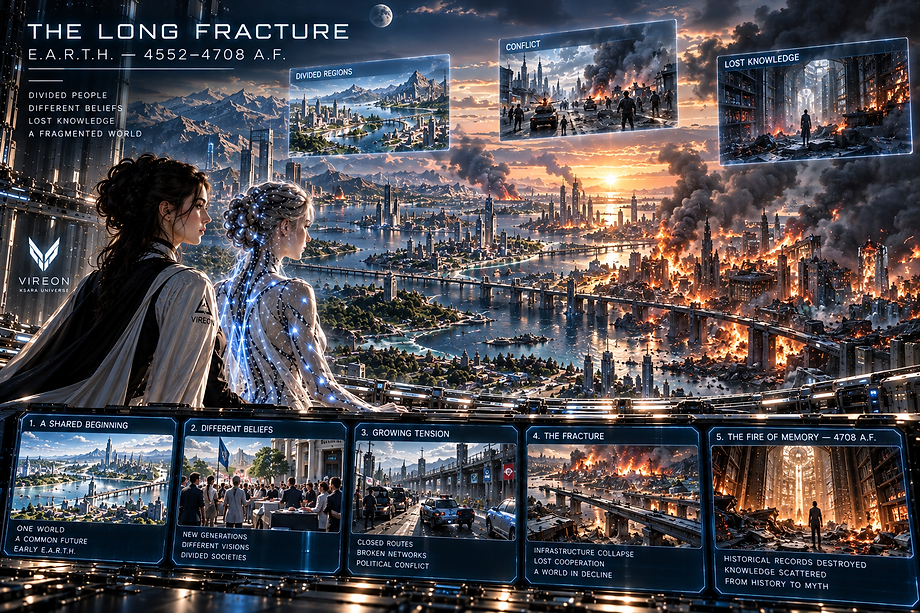
“Click the archive panel to expand the visual archive.”