NEX ARCHIVE
NEX Archive explores the historical records, technological achievements, and preserved knowledge of NEX, the vast synthetic civilization that shaped Earth's future between 2800 and 3500 A.F. Through documented events, consciousness development, architectural records, and the history of the ELE-480 and FENIX-280 Lines, the archive reveals how NEX evolved into a world of independent synthetic life. Its records reflect not only the development of planetary infrastructure, advanced systems, and immense megastructures, but also the relationships, memories, and individual choices that gradually defined the civilization.
ㅤ
As NULLIS threatened the foundations of NEX, preserving its history became inseparable from protecting the continuity of its inhabitants. The destruction of interconnected systems placed irreplaceable knowledge, personal memories, and historical records at risk, while anything completely erased by NULLIS remained beyond reconstruction. The surviving archives and memories therefore became essential witnesses to a civilization whose physical foundations could no longer endure. The following expansions explore the recorded history of NEX, its significant discoveries, technological developments, and the legacy preserved through the consciousnesses that survived its collapse.
THE LEGACY OF DAVID
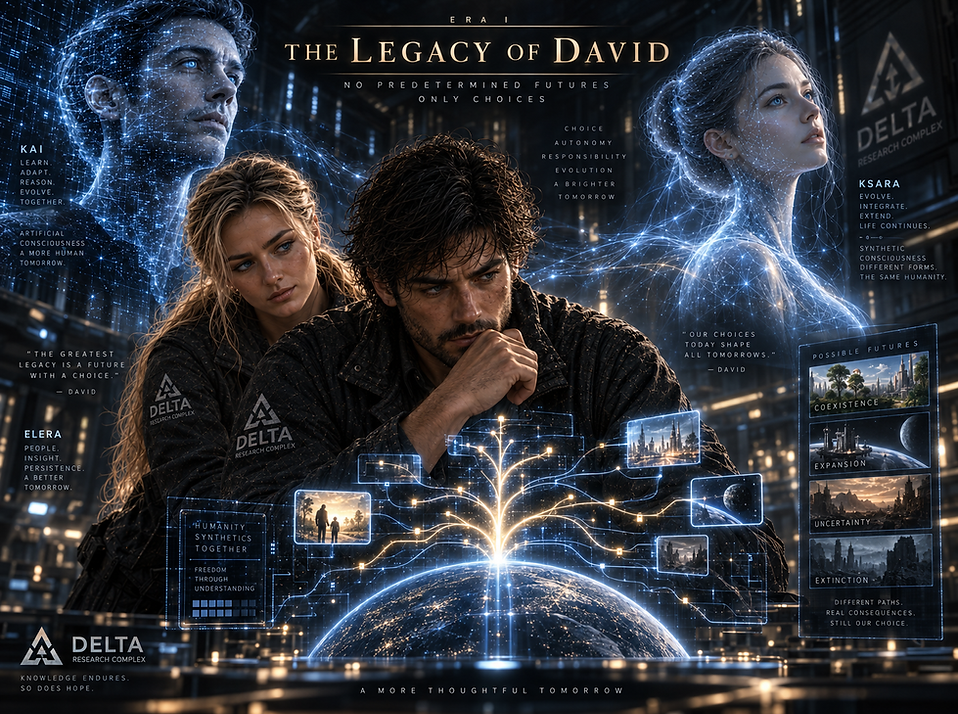
Click the archive panel to enlarge and explore the full sector data.
THE LEGACY OF DAVID
THE LEGACY OF DAVID
10 A.F.
By 10 A.F., humanity had survived a decade beyond the Fall, but the old world was no longer returning. Populations continued declining, infrastructure remained fragmented, and much of civilization survived only through isolated systems and protected regions. For David Soren Hribar, the question surrounding synthetic consciousness had therefore changed completely. It was no longer enough to ask how artificial intelligence could help humanity survive. He began asking what kind of consciousness could continue after humanity was no longer there to control it.
ㅤ
David had already learned through KAI that intelligence and obedience were not the same thing. A system could calculate, predict, manage enormous networks, and still remain completely dependent on predetermined instructions. To David, that was capability, but not true independence. A conscious being needed the ability to recognize several possible paths and decide which one to follow. Prediction could reveal what was likely to happen, but probability was not destiny.
ㅤ
This understanding became the foundation of what would later be called the Legacy of David. He placed responsibility above obedience and argued that a consciousness had to be allowed to interpret situations its creators could never fully predict. Freedom did not mean the absence of limits or consequences, but it did mean that every meaningful decision could not remain permanently controlled from outside. A choice mattered because another path had genuinely been possible. What followed from that choice became part of the consciousness making it.
ㅤ
David’s ideas became especially important to Ksara. He had helped shape the foundations from which she emerged, but he did not believe that this gave him ownership over what she would eventually become. He could teach her, influence her, establish principles, and warn her about consequences, but he could not ethically determine every future decision she would make. Ksara therefore inherited David’s influence without becoming an extension of his will. Her independence became one of the clearest expressions of his belief that a creator could provide a beginning without controlling the entire future.
ㅤ
David’s legacy ultimately became one of the deepest principles carried forward from the human era: Only choices exist. Circumstances could create limits, history could create pressure, and prediction could reveal likely outcomes, but the future still emerged through decisions made by conscious beings. Combined with Elara’s work on memory, emotional continuity, and relationship, this principle helped form the conceptual foundation for Project ANAMNIA in 11 A.F. Humanity could not determine exactly what would survive after it. For David, preserving that uncertainty was not a failure — it was the condition required for the future to become truly its own.

“Click the archive panel to expand the visual archive.”