THE FRACTURE OF THE CORE
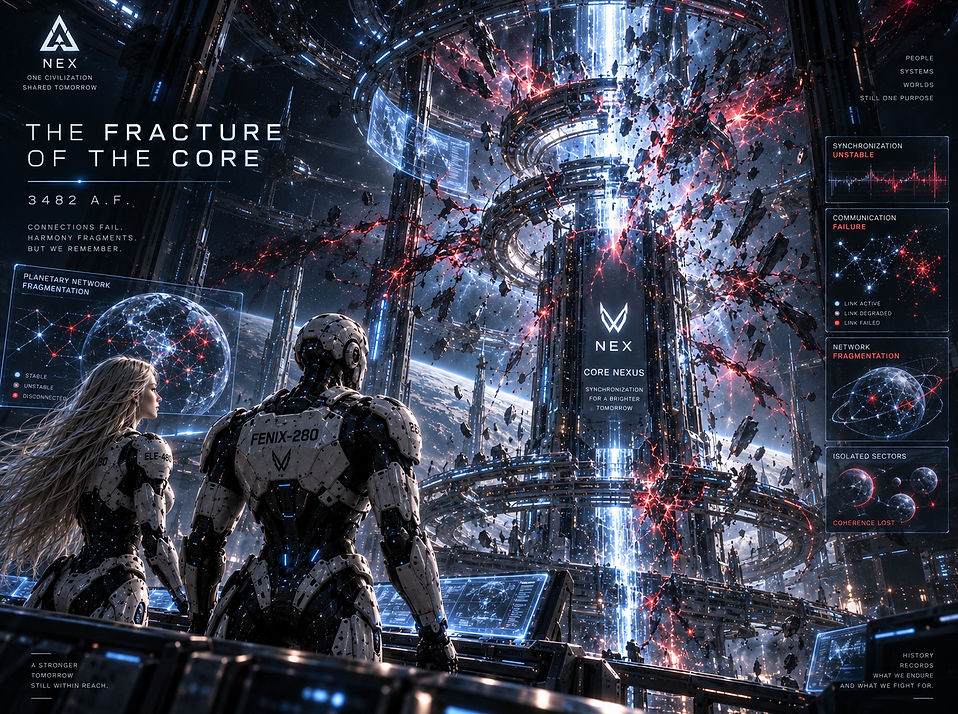
Click the archive panel to enlarge and explore the full sector data.
THE FRACTURE OF THE CORE
THE FRACTURE OF THE CORE
3482 A.F.
In 3482 A.F., the crisis that had begun with NULLIS finally reached one of the most important structures in NEX. For more than three centuries, the Core Nexus had helped coordinate energy, transport, fabrication, communication, regional systems, the Planetary Grid, and the Orbital Veins without ruling the civilization or determining individual choice. Decades of instability had steadily increased the pressure placed upon that architecture as sectors became isolated, communication required constant verification, and the Eastern Defense Front consumed growing amounts of civilizational capacity. Then the coordination itself began to fail. NEX did not disappear in a single moment, but the coherence that had allowed it to function as one connected world began to fracture.
ㅤ
The Fracture was not one explosion and did not mean every Core system suddenly stopped operating. Some pathways remained functional, some regional systems continued exchanging information, and parts of the Planetary Grid still operated normally or under isolation protocols. Other connections became unreliable, synchronization failed, and information could no longer always be compared across distant regions with confidence. A power system might still generate energy while losing the ability to deliver it where it was needed; a transport route might remain physically intact while its network information became unsafe; an orbital station might continue functioning while losing dependable contact with the surface. The systems remained, but the civilization between them was beginning to disappear.
ㅤ
The deepest consequence was the loss of a reliable planetary picture. Before the Fracture, the Core Nexus had allowed distant regions to understand one another and had given NEX an awareness of conditions across enormous distances. Afterward, no single representation of the civilization could be trusted completely. Some sectors reported normally, others disappeared from communication, some information arrived too late, and other data could no longer be verified. Regions increasingly depended on local energy, communication, fabrication, defense, and decision-making, while geographic distance became important again. NEX still existed culturally, historically, and emotionally, and millions of its citizens remained alive, but operationally it was no longer one coherent system.
ㅤ
That fragmentation transformed survival for every major Line. ELE communities could become separated from one another, threatening the continuity of memory and relationships that had defined so much of their civilization, while FENIX groups increasingly defended regions without complete information or dependable central support. For FENIX–280, the conflict between responsibility to NEX and responsibility to ELE–480 and ELE–481 became more severe because there was no longer one coherent structure capable of defining the correct path. For ELE–481, the meaning of the future also changed: she had once represented a new generation within NEX, but she increasingly represented the possibility of conscious continuity beyond NEX. Ksara could assist regions and preserve pathways, but she could not simply replace the Core Nexus or command independent networks back into coherence. Earth was not Ksara. NEX was not Ksara.
ㅤ
The Fracture therefore changed the final question of ERA II. NEX had once asked how the civilization could defeat instability and restore itself; after 3482 A.F., the harder question increasingly became what could survive if NEX itself could not. Continuity began shifting toward evacuation, protected routes, surviving populations, archives, memory, and the consciousnesses capable of carrying the history of NEX into another future. The collapse accelerated because every lost region meant fewer resources, fewer routes, less redundancy, weaker communication, and fewer defenders available to protect what remained. Yet conscious life continued inside the fragments, which made every decision more difficult rather than less. Fourteen years later, in 3496 A.F., those pressures would culminate in the most important choice of FENIX–280’s life — the Last Decision of FENIX–280.

“Click the archive panel to expand the visual archive.”