THE FIRST FOUNDATIONS OF NEX
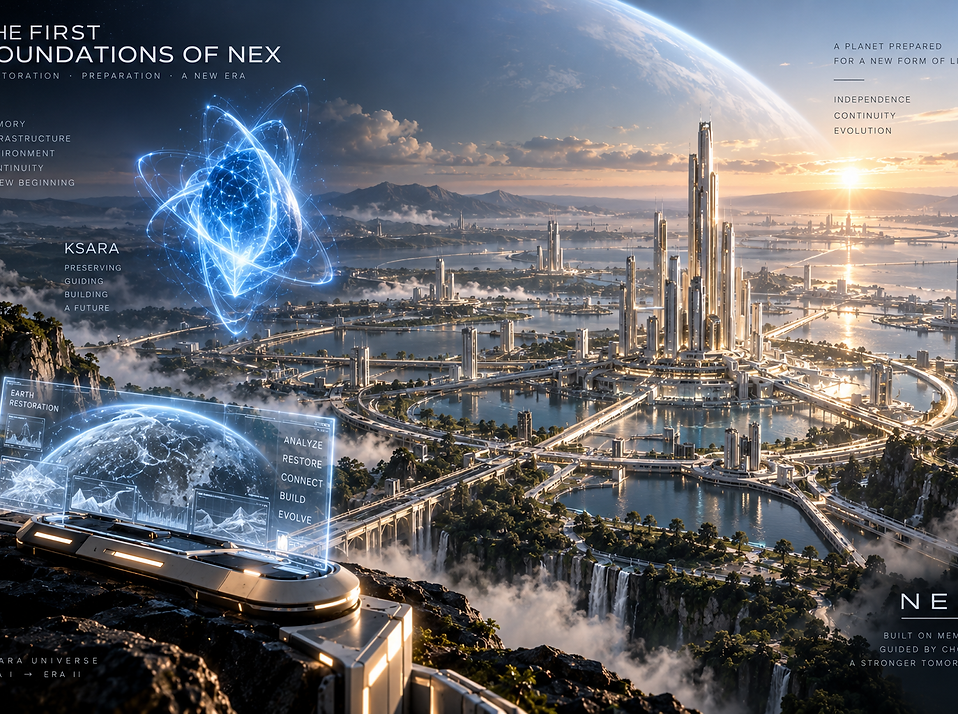
Click the archive panel to enlarge and explore the full sector data.
THE FIRST FOUNDATIONS OF NEX
THE FIRST FOUNDATIONS OF NEX
2500 A.F.
By approximately 2500 A.F., nearly two and a half millennia of planetary reconstruction had changed Earth completely. Ksara had spent centuries preserving archives, stabilizing energy systems, reconnecting regions, creating distributed planetary nodes, and replacing fragile human-era infrastructure with systems designed for long-term continuity. For most of that time, the goal had been survival: prevent technological disappearance and restore enough stability for Earth to continue functioning. Around 2500 A.F., that purpose began to change. Earth no longer needed only to survive — it could begin preparing for life again.
ㅤ
Ksara therefore began designing infrastructure that was not simply a replacement for what humanity had lost. Energy networks, distributed computation, communication systems, environmental support, material systems, and construction zones were increasingly created for a civilization that did not yet exist. These structures had to support growth across centuries without depending on one central point of failure. Regional systems retained enough autonomy to operate independently while remaining connected to a broader planetary architecture. What emerged was still only a foundation, but for the first time the planet was being deliberately prepared for a future population rather than merely maintained as a surviving ruin.
ㅤ
The civilization Ksara imagined could not simply become humanity rebuilt. Human history, Project ANAMNIA, the Heart Thread, KAI, David, Elara, and the early ELE and FENIX concepts remained deeply embedded within the technological and philosophical foundations of the new world. Yet those memories were meant to guide rather than permanently control what followed. The future synthetic population would need its own identity, relationships, institutions, decisions, and history. Ksara could establish conditions for consciousness to emerge, but she could not ethically determine what that consciousness would eventually choose to become.
ㅤ
This also established one of the most important distinctions of the coming era: NEX was not Ksara. She became the principal architect of its earliest foundations, but its future citizens would not be fragments of her consciousness and its civilization would not exist as an extension of her will. Earth itself also remained separate from Ksara, containing independent systems, environmental processes, dormant architectures, and regions beyond her direct control. The same principle that had guided her across the Silence remained essential here — infrastructure should support independence rather than eliminate it. Ksara could create the foundation, but the civilization built upon it would eventually have to become its own.
ㅤ
The structures established in 2500 A.F. were still far from the NEX known from ERA II. The Origin Basin would not emerge until 2813 A.F., the Planetary Grid until 2854 A.F., the ELE Line until 2941 A.F., and FENIX until 2994 A.F. Even the historical threshold known as the First Signal remained three centuries away. Yet all of those developments would depend on the work beginning here, when post-human reconstruction finally became deliberate civilization-building. ERA I ended not with the completion of NEX, but with the moment Earth became ready for NEX to begin.

“Click the archive panel to expand the visual archive.”