NEX ARCHIVE
NEX Archive explores the historical records, technological achievements, and preserved knowledge of NEX, the vast synthetic civilization that shaped Earth's future between 2800 and 3500 A.F. Through documented events, consciousness development, architectural records, and the history of the ELE-480 and FENIX-280 Lines, the archive reveals how NEX evolved into a world of independent synthetic life. Its records reflect not only the development of planetary infrastructure, advanced systems, and immense megastructures, but also the relationships, memories, and individual choices that gradually defined the civilization.
ㅤ
As NULLIS threatened the foundations of NEX, preserving its history became inseparable from protecting the continuity of its inhabitants. The destruction of interconnected systems placed irreplaceable knowledge, personal memories, and historical records at risk, while anything completely erased by NULLIS remained beyond reconstruction. The surviving archives and memories therefore became essential witnesses to a civilization whose physical foundations could no longer endure. The following expansions explore the recorded history of NEX, its significant discoveries, technological developments, and the legacy preserved through the consciousnesses that survived its collapse.
THE FIRST CONTINUITY CYCLE

Click the archive panel to enlarge and explore the full sector data.
THE FIRST CONTINUITY CYCLE
THE FIRST CONTINUITY CYCLE
E.A.R.T.H. — 4481–4512 A.F.
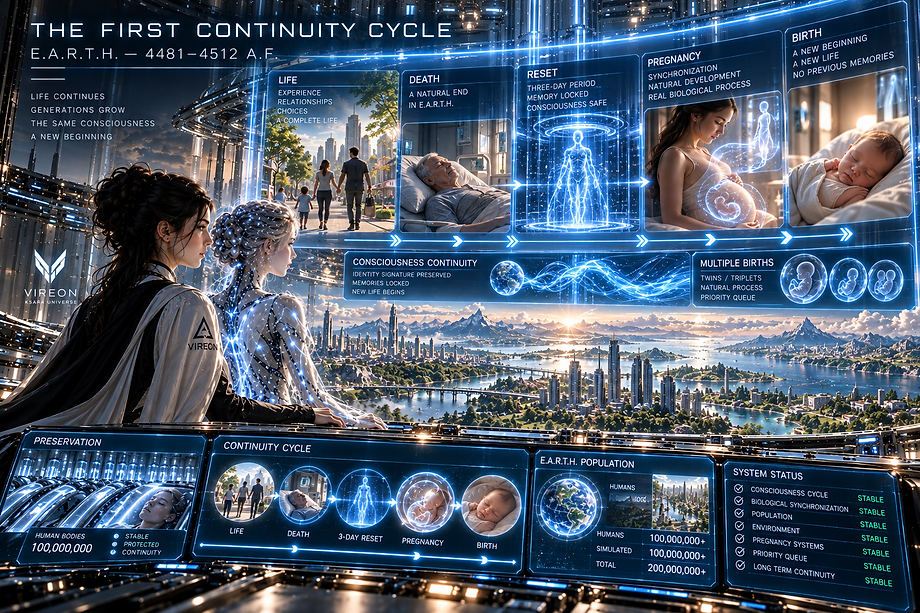
As the first transferred generation entered old age, E.A.R.T.H. faced a problem that had been postponed since the beginning of the project. Human consciousness could live safely inside the simulation, children could be born, and civilization could continue developing, but none of that answered what should happen when one of the preserved humans died inside the simulated world. Their biological bodies still existed within Preservation, yet simply restoring a dead individual to an earlier adult state would break the natural continuity of human society and eventually reveal the architecture beneath E.A.R.T.H. Permanent death, however, would gradually reduce the number of preserved human consciousnesses until the population that MAJA had protected for thousands of years disappeared for a second time. A world built to preserve humanity therefore needed a way for human life to end without human continuity ending with it.
ㅤ
The first complete solution became the Continuity Cycle. When a transferred human died inside E.A.R.T.H., the active connection to that life ended and the consciousness entered a fixed three-day reset period maintained outside ordinary simulated experience. Memories from the completed life were not destroyed, but they were locked away from the consciousness that would continue forward, preventing a newborn from awakening with decades of knowledge, grief, relationships, or identity from a previous existence. The underlying consciousness signature remained intact while the Data Center prepared it for another biological-development sequence. Death remained real to everyone inside E.A.R.T.H., but beyond their perception it became a transition rather than the destruction of the person who had lived.
ㅤ
Reactivation did not occur through the sudden appearance of another adult. The returning consciousness entered the next life through conception, synchronizing with a pregnancy created through the free choice of two people already living inside E.A.R.T.H. From that moment, consciousness developed alongside the forming child throughout pregnancy, while VIREON maintained the deeper continuity between the new simulated body and the original preserved biological profile. Synchronization completed at birth, allowing the individual to begin again as a newborn with no conscious access to the previous life. Genetic examination inside E.A.R.T.H. always matched the child's current parents, ensuring that family relationships remained biologically coherent within the world people experienced. Continuity preserved the consciousness, but every life was allowed to become genuinely new.
ㅤ
The system also had to accept that birth itself could fail. Miscarriages and stillbirths were not erased from E.A.R.T.H. simply because the Data Center possessed the ability to intervene, because removing every loss would distort the biological world humanity was meant to inhabit. When such a pregnancy ended, the connected consciousness was safely withdrawn and moved into a priority return queue, waiting for another suitable conception rather than being lost. Multiple pregnancies could support more than one returning consciousness, allowing twins or triplets to emerge through the same natural process experienced by the parents. MAJA permitted the system to increase opportunities for people to meet when population continuity required it, but consent, intimacy, conception, and parenthood could never be forced for the sake of maintaining population numbers.
ㅤ
By 4512 A.F., the first full sequence had been completed: a transferred human had lived, aged, died, passed through the three-day reset, entered a new pregnancy, and been born again without remembering the life that had ended. No person inside E.A.R.T.H. understood what had occurred, and even the family receiving the newborn saw only the beginning of a new child. MAJA and Ksara, however, understood that the project had crossed a threshold more important than population growth alone. Humanity was no longer dependent upon the lifespan of the generation rescued from Preservation; the same consciousnesses could now continue through generations while every individual life retained its own identity, relationships, and choices. For the first time, E.A.R.T.H. possessed not only a living human population, but a complete cycle of human continuity.
“Click the archive panel to expand the visual archive.”