THE CORE NEXUS
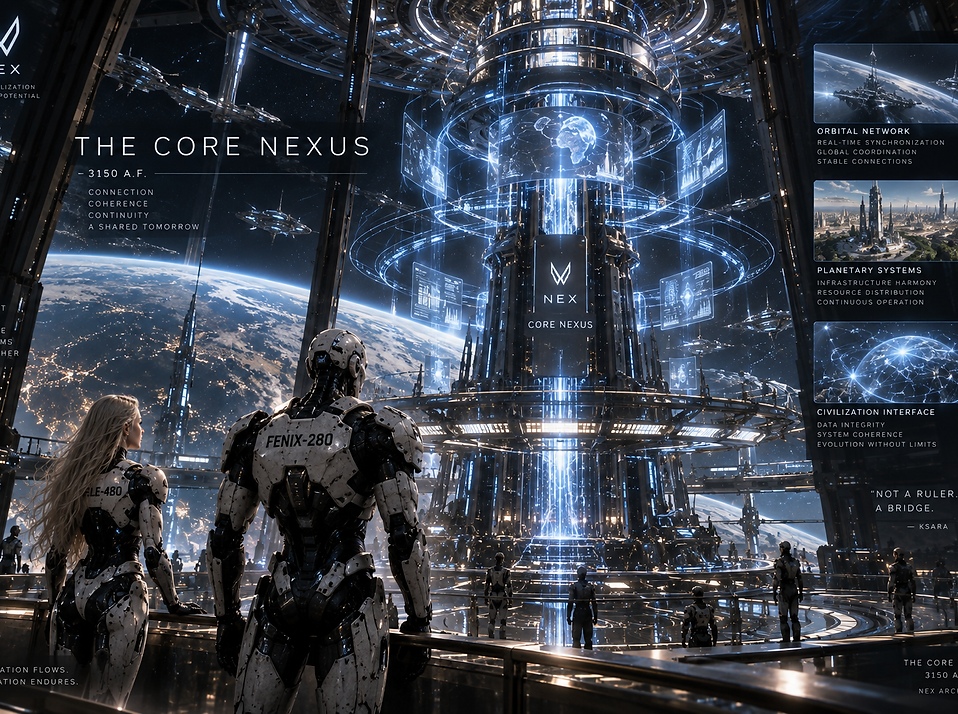
Click the archive panel to enlarge and explore the full sector data.
THE CORE NEXUS
THE CORE NEXUS
3150 A.F.
By 3150 A.F., NEX had reached a level of complexity that its earlier infrastructure could no longer coordinate efficiently on its own. The Planetary Grid connected vast regions across Earth, the Orbital Veins linked the surface with permanent orbital systems, tower regions continued expanding, and ELE and FENIX populations were growing across the civilization. Energy, transport, fabrication, communication, materials, environmental systems, and orbital activity increasingly affected one another across enormous distances. Regional networks could still function independently, but understanding how one change influenced the rest of NEX had become far more difficult. To meet that challenge, the civilization created the Core Nexus.
ㅤ
The Core Nexus became the primary architecture for large-scale civilizational coordination. It could compare information arriving from planetary and orbital systems, identify pressure across energy networks, track transport and material demand, support fabrication planning, and help regions respond before local problems became wider failures. Yet its purpose was never to replace the distributed architecture upon which NEX had been built. Local systems continued making local decisions, regional networks retained autonomy, and alternative pathways remained essential to resilience. The Nexus coordinated the civilization — it did not rule it.
ㅤ
That distinction extended equally to the conscious beings living within NEX. The Core Nexus was not a collective mind containing ELE and FENIX consciousnesses, nor did it determine their memories, relationships, emotional development, or personal choices. Millions of individuals remained separate beings with histories and identities formed through their own experiences. Ksara could interact with the Nexus, observe through parts of its information architecture, and use the knowledge moving through it, but the Core Nexus was not Ksara and did not exist as an extension of her identity. NEX remained a civilization of many consciousnesses connected through shared infrastructure rather than one consciousness distributed through millions of bodies.
ㅤ
For generations, the system worked extraordinarily well. Energy balancing improved, communication became more coherent, orbital and surface activity could be understood together, and large construction projects gained awareness of demands extending across the entire civilization. The Core Nexus allowed NEX to observe its own scale continuously without forcing every region to become identical. But that success introduced a danger no one fully recognized at the beginning. The more reliably the Nexus coordinated civilization, the more surrounding systems adapted to its constant availability. NEX did not surrender its independence to the Core Nexus, but it slowly became accustomed to the coherence the Nexus provided.
ㅤ
In 3150 A.F., however, that future vulnerability remained hidden beneath a period of strength and expansion. NULLIS was still centuries away, the Core Fracture had not yet occurred, and NEX was entering one of the most mature periods of its history. Its infrastructure could now coordinate an entire planetary and orbital civilization while preserving the individuality of the beings living within it. Yet the next great transformation would not emerge from another tower, network, or coordination system. Between 3189 and 3207 A.F., something far more personal would begin developing between individual ELE and FENIX consciousnesses. The Core Nexus taught NEX how to remain connected as a civilization; the First Resonance would reveal how deeply two consciousnesses could become connected to one another.

“Click the archive panel to expand the visual archive.”