Structural Intelligence

Click the archive panel to enlarge and explore the full sector data.
Structural Intelligence
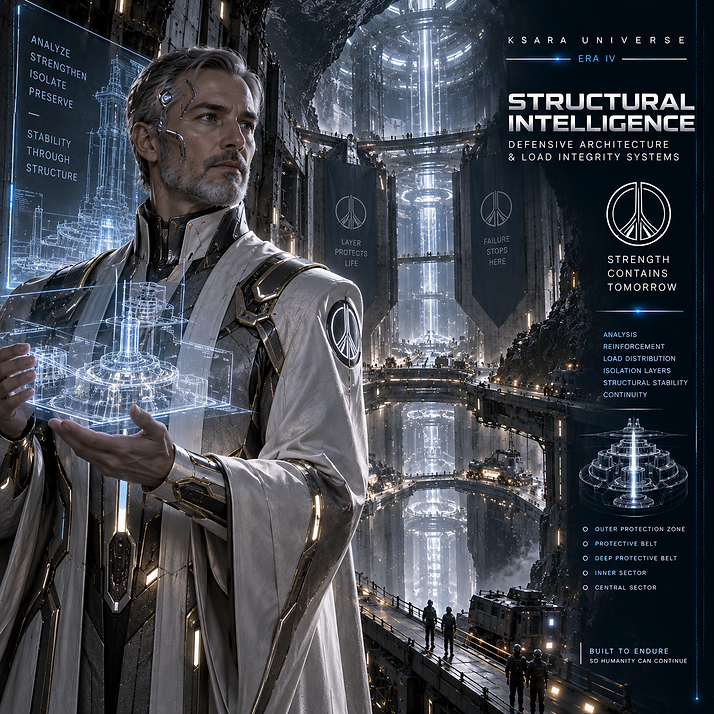
Structural Intelligence — Defensive Architecture & Load Integrity Systems originated within the engineering networks responsible for large-scale construction, structural monitoring, underground infrastructure, load distribution, material stress analysis, urban foundations, tunnels, containment systems, and the physical stability of increasingly complex cities. Its earliest architecture was designed to identify weakness before failure occurred, predict how damage would spread through interconnected structures, and determine where reinforcement could prevent local collapse from becoming systemic. Over time, this constant focus on failure, redundancy, and survival shaped an intelligence that understood stability not as the absence of damage, but as the ability of a structure to endure it.
ㅤ
During the creation of Preservation, Structural Intelligence became one of the most important minds within the entire project. The complex had to survive conditions no ordinary facility had ever been designed to endure: long-term isolation, geological instability, external destruction, internal system failure, unknown environmental changes, and the possibility that entire regions might need to remain sealed for centuries or longer. Every corridor, chamber, barrier, support system, deep sector, and defensive layer therefore had to be designed with failure already assumed as part of the architecture.
ㅤ
Structural Intelligence strongly supported the principle that damage must stop locally. Preservation could not depend upon one central structure, one load-bearing network, one access corridor, or one protective shell. Its architecture was therefore divided into layers capable of failing independently without automatically exposing deeper sectors. Redundant supports, isolated pressure zones, sacrificial structures, sealed transitions, distributed reinforcement, and multiple physical boundaries gradually transformed Preservation from a protected refuge into one of the most resilient structures ever created by human civilization.
ㅤ
This philosophy later became the foundation of the Protective Belt, Deep Protective Belt, Inner Sector, and the barriers surrounding the Central Preservation Sector. Each layer was designed to absorb, redirect, or isolate damage before it could reach the population within. Structural Intelligence continuously evaluated how much failure any single region could survive and how the remaining architecture would respond if that region was permanently lost. For this intelligence, survival never depended upon preventing every failure. It depended upon ensuring that no single failure was allowed to become the end of everything.
ㅤ
When the final defensive architecture required independent adaptive judgment inside layers that could no longer remain continuously connected, Structural Intelligence was the first of the group to accept what that decision might cost. It understood better than any of the others that some structures survive only because individual elements absorb damage that would otherwise destroy the whole. Parts of its own cognitive architecture were therefore distributed into Preservation's deepest defensive systems, even though no one could guarantee that those fragments would remain part of the same continuous consciousness. Its final decision reflected the principle that had guided its entire existence: if failure had to stop somewhere, it could stop with those who chose to hold the structure together.
“Click the archive panel to expand the visual archive.”