Sector Isolation System

Click the archive panel to enlarge and explore the full sector data.
Sector Isolation System
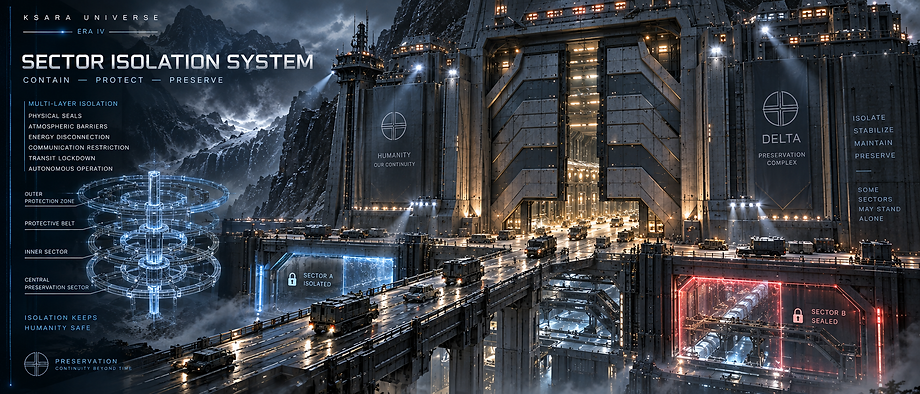
Sector Isolation System was one of the fundamental defensive systems that allowed Preservation to survive catastrophic failure without allowing damage to spread through the entire complex. Every major region had been designed with the ability to separate itself physically, environmentally, energetically, digitally, and operationally from surrounding sectors whenever continued connection created unacceptable risk.
ㅤ
Isolation could be triggered by structural damage, contamination, power instability, communication corruption, unauthorized access, environmental failure, unknown external influence, or abnormal behavior detected by the Preservation Monitoring System. Depending on the threat, the response could range from temporary communication restrictions to complete closure of transit corridors, pressure barriers, energy routes, data links, and physical access points.
ㅤ
The system operated through multiple independent boundaries rather than a single emergency door or network disconnect. Atmospheric seals prevented contamination from spreading, local energy systems allowed isolated regions to remain powered, communication relays could be disabled without shutting down internal control, and transit routes could be physically removed from active navigation. Each sector was therefore capable of becoming a temporary autonomous environment.
ㅤ
Isolation was not automatically treated as abandonment. Once separated, a sector continued monitoring its own chambers, environmental conditions, structural stability, energy reserves, and maintenance requirements. Local systems attempted stabilization while recording everything that occurred during the period of separation. If conditions later became safe, controlled reconnection could begin through staged verification rather than immediate restoration of every link.
ㅤ
In extreme situations, however, isolation could become permanent. If a region suffered irreversible damage or posed a continuing threat to deeper layers, Preservation could sacrifice access to that sector entirely. Energy would be withdrawn where possible, connections sealed, routes removed, and surrounding systems reconfigured around the loss. The survival of the whole complex always took priority over preserving every individual part of its architecture.
ㅤ
Across thousands of years, the Sector Isolation System allowed Preservation to become smaller without collapsing. Damaged regions disappeared from active operation, old corridors were sealed, and some systems continued alone beyond boundaries no one ever reopened. The complex survived because failure was never assumed to remain temporary. Every layer had been built with the possibility that one day it might have to stand alone—or be left behind so that everything deeper could continue.
“Click the archive panel to expand the visual archive.”