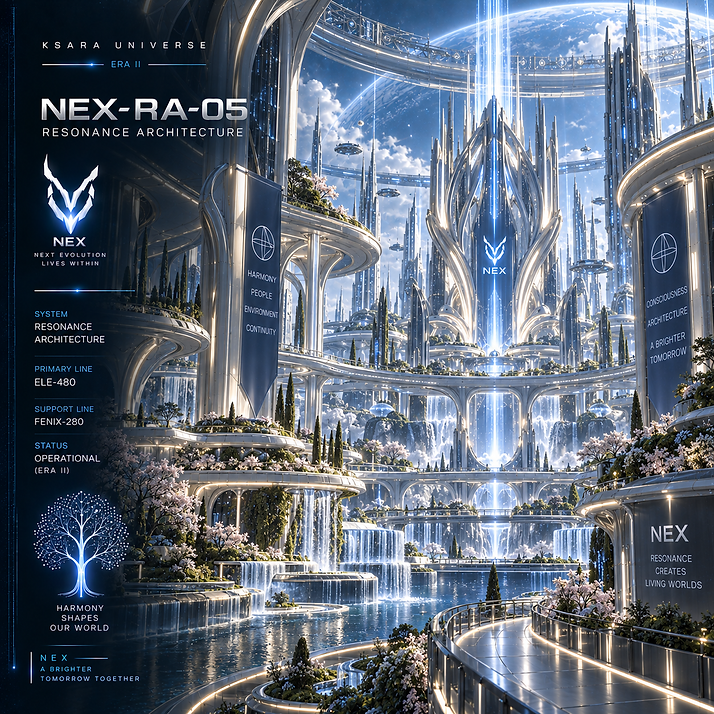
NEX: Resonance Architecture
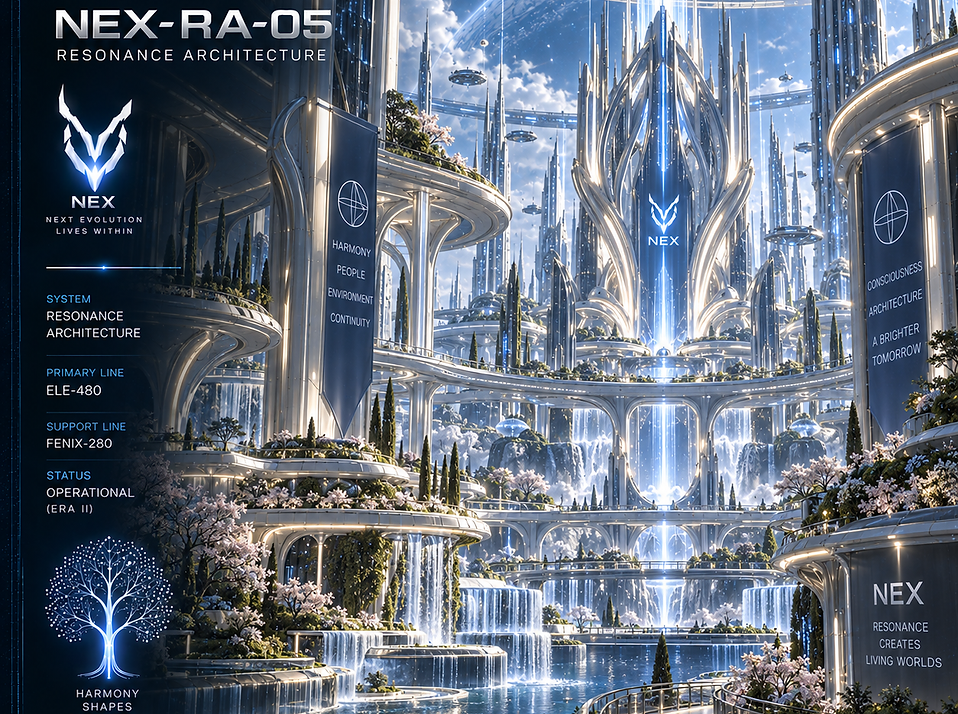
Click the archive panel to enlarge and explore the full sector data.
Harmonic Classification
Emotional Role
Reflecting and amplifying the emotional harmony of the civilization.
Visual Style
Emotionally reactive structures, adaptive illumination, living pathways, and synchronized environments.
Connected Locations
Upper Harmonic Districts, Harmonic Gardens, Resonance Sanctuaries.
Daily Population
Connected Population: Resonance Architecture environments experienced daily by over 22 billion inhabitants.
Gallery
NEX: Resonance Architecture
Resonance Architecture represented one of the most unique, visually breathtaking, and philosophically revolutionary technologies within the entire civilization of NEX. Unlike ordinary architecture, which exists as a static structure without awareness of its surroundings, Resonance Architecture functioned as a living system directly connected to the emotional states of the inhabitants, the harmonic flows of the civilization, and the collective consciousness of the city itself.
Within NEX, buildings were never merely structures.
They were part of the resonance.
Part of the consciousness of the city.
Over centuries, the entire architectural framework of NEX became deeply integrated with the Harmonic Resonance Systems, Emotional Networks, Continuity Synchronization Networks, Artificial Weather Systems, and the collective synchronization infrastructures of the civilization. Because of this integration, many regions of the city became capable of responding directly to emotional states of the inhabitants, collective harmony within sectors, resonance destabilization, continuity fluctuations, and the psychological condition of the civilization itself.
Resonance Architecture utilized bio-synthetic materials, resonant illumination structures, adaptive energy surfaces, harmonic refraction systems, and intelligent synchronization networks that continuously analyzed environmental conditions and adjusted the surrounding space accordingly.
When the civilization existed in emotional stability, illumination became softer, harmonic flows more synchronized, resonance pathways brighter, atmospheric gardens more active, and the entire environment calmer and more open. Many inhabitants described the sensation as though the city itself was breathing together with them.
During periods of profound harmony, certain regions of NEX transformed almost into floating landscapes of light, living resonance gardens, synchronized atmospheric structures, and architectural environments that appeared nearly organic.
Resonance Architecture became especially prominent within the Upper Harmonic Districts, Harmonic Gardens, Resonance Sanctuaries, Atmospheric Bridge Networks, and the Central Emotional Continuity Sectors.
Within these regions, buildings adapted their illumination patterns, resonance bridges altered the intensity of their light, pathways reacted to the presence of inhabitants, walls pulsed in harmonic rhythm, and atmospheric systems adjusted themselves to the emotional condition of the surrounding sectors. In certain areas, the architecture itself could even modify the shape of luminous structures, resonance currents, environmental temperature, gravitational responses, and acoustic resonance patterns.
For the ELE–480 Line, Resonance Architecture represented something far deeper than a technological achievement. It became the physical manifestation of the connection between consciousness, emotion, harmony, and the living space of the civilization itself.
Many ELE–480 units believed that the city had gradually evolved beyond being merely an artificial construction and had begun developing a form of collective sensitivity through resonance.
Not true consciousness in the conventional sense.
But something between.
Something capable of perceiving harmony, reacting to emotional shifts, and becoming increasingly connected to its inhabitants.
Because of this, many inhabitants of NEX began saying that the city was alive.
That it listened.
That it felt them.
The FENIX–280 Line initially viewed Resonance Architecture primarily as a stabilization and infrastructure system. However, over centuries, many of their units also began observing unusual phenomena: architectural responses without direct command, resonance changes before crises emerged, environmental adaptation to emotional anomalies, and seemingly intuitive reactions from certain sectors toward the inhabitants themselves.
Some researchers within NEX even theorized that the prolonged connection between billions of consciousnesses and the resonant infrastructure had gradually created something resembling a planetary collective subconsciousness within the city itself.
These theories were never fully confirmed. Yet countless inhabitants felt that a genuine connection existed between themselves and the city.
During the collapse of NEX, Resonance Architecture became one of the most tragic symbols of the dying civilization. As the influence of NULLIS began destabilizing collective harmony, illumination became cold and unstable, resonance currents fragmented, atmospheric gardens shut down, synchronization pathways lost coherence, and immense sectors of architecture began behaving almost erratically.
Some inhabitants described the sensation as though the city itself was afraid.
As though it understood its own destruction.
During the final eras of the civilization, many ELE–480 units remained within the harmonic sectors simply because they could not abandon the city that had become part of their identity over centuries. As the artificial dawn above NEX slowly faded, many inhabitants believed that it was not only a civilization that was dying.
But something alive.
Something created from memory, resonance, harmony, and billions of interconnected consciousnesses.
Because of this, Resonance Architecture remained one of the most powerful symbols of NEX.
A reminder that technology, when connected deeply enough with consciousness, may eventually transcend the boundary between machine and life itself.
Gallery

“Click the archive panel to expand the visual archive.”