Protective Belt
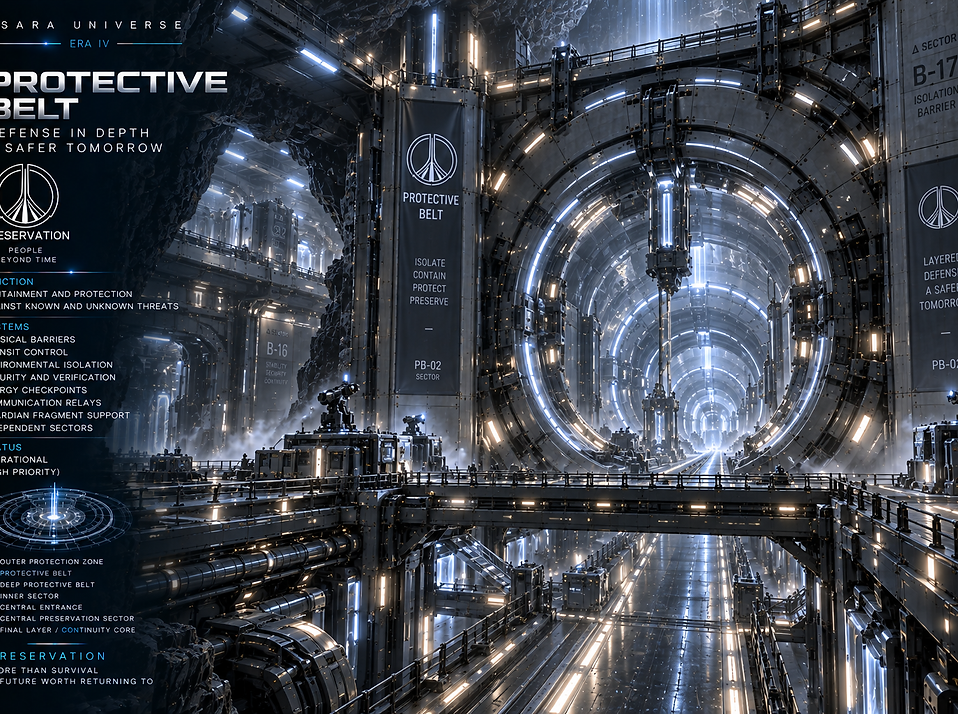
Click the archive panel to enlarge and explore the full sector data.
Protective Belt
Protective Belt formed the second major defensive layer surrounding Preservation and represented the point where protection shifted from broad external observation toward active containment and controlled survival architecture. Unlike the Outer Protection Zone, which absorbed environmental and surface-level instability across a wide region, the Protective Belt was designed specifically to prevent physical, technological, biological, or systemic threats from progressing deeper into the complex.
ㅤ
The belt consisted of reinforced barriers, sealed transit corridors, isolated pressure zones, hardened communication relays, energy checkpoints, structural buffers, and independent environmental systems capable of operating even if neighboring regions failed. Every route passing inward could be closed separately, allowing the entire layer to fragment into smaller defensive regions without opening a direct path toward the deeper sectors.
ㅤ
Security and verification became significantly stricter within the Protective Belt. Unknown signals, unauthorized movement, unstable systems, contamination, and abnormal technological behavior triggered immediate restriction or isolation. Communication with deeper layers passed through heavily controlled relays, while physical access required multiple independent confirmations before any route could continue toward the Deep Protective Belt.
ㅤ
The belt was also one of the first major regions to contain adaptive Guardian Fragment support. Structural, security, environmental, communication, and energy fragments helped local systems interpret unfamiliar threats without depending upon permanent connection to MAJA or central infrastructure. These fragments did not control the entire layer, but they gave individual sectors enough judgment to respond independently when ordinary automation was no longer sufficient.
ㅤ
Over thousands of years, parts of the Protective Belt were damaged, abandoned, or permanently isolated as Preservation adapted to changing conditions. Some corridors became dead ends, some barriers were reinforced repeatedly, and entire sections disappeared from active navigation. The architecture had been designed for exactly this possibility: the belt could become incomplete while still remaining effective as long as enough independent barriers survived.
ㅤ
By the time Ksara passed through the Protective Belt with MAJA, the region had become one of the clearest demonstrations of how far Preservation's builders had been willing to go to separate humanity from danger. The layer was not designed to make entry impossible, but to make uncontrolled passage almost unthinkable. Every step deeper required the outside world to lose another opportunity to follow.
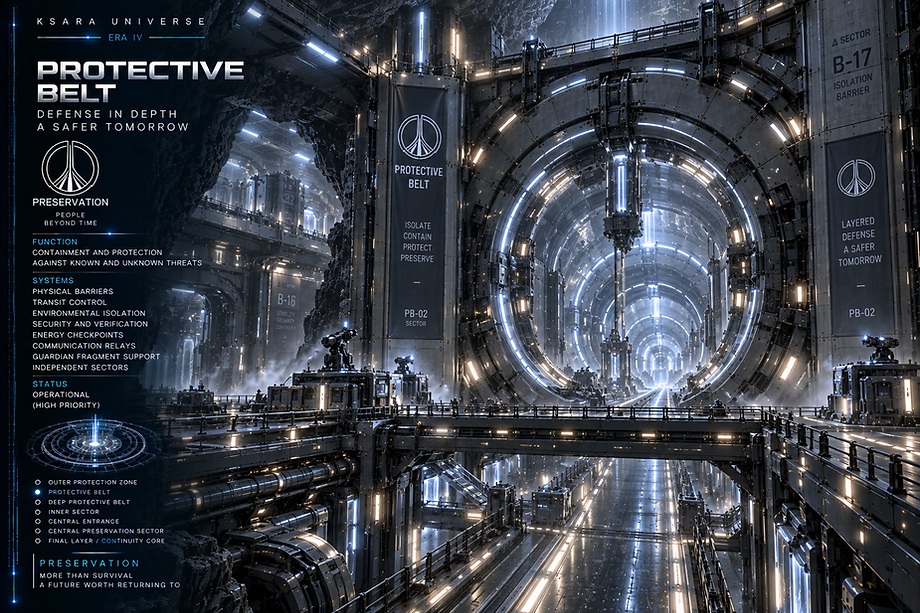
“Click the archive panel to expand the visual archive.”