PROJECT SYNTARA
Click the archive panel to enlarge and explore the full sector data.
PROJECT SYNTARA
PROJECT SYNTARA
3503 A.F.
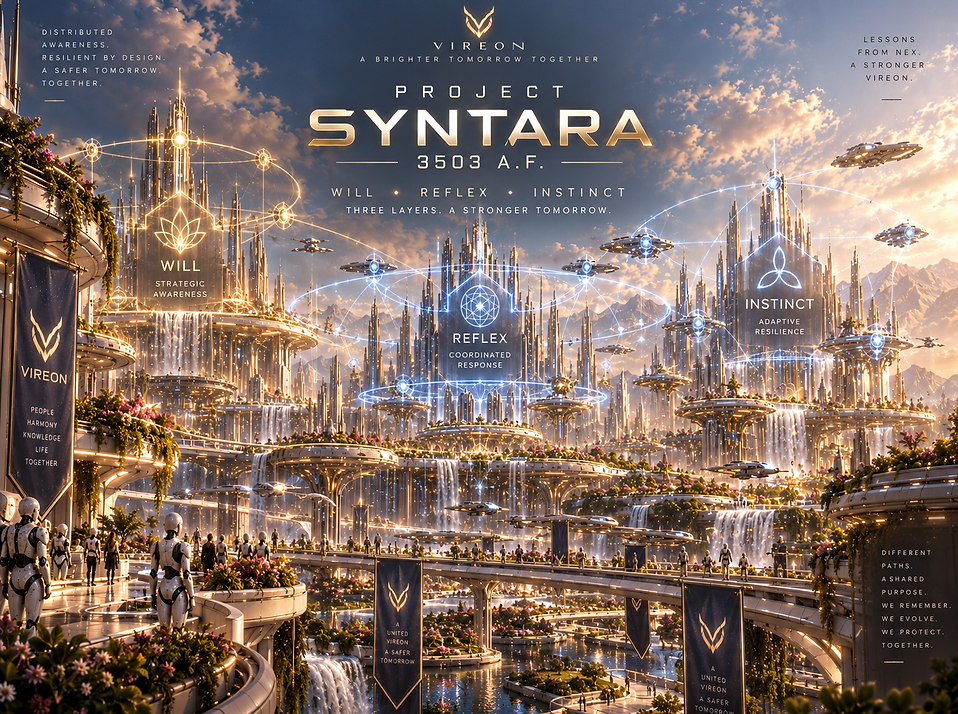
In 3503 A.F., only one year after the arrival of the ELE–480 survivors, VIREON began developing a new defensive architecture known as Project SYNTARA. The city already possessed the VIREON Shield and LYNN–0, but the fall of NEX had revealed a deeper danger that boundaries alone could not solve. NEX had become extraordinarily powerful through planetary coordination, yet that same connection created dependence on structures such as the Planetary Grid, Orbital Veins, and Core Nexus. When coordination fractured, failures spread across systems that had never been designed to continue independently for long. VIREON therefore chose a different principle: no single point should determine whether the civilization survives.
ㅤ
The newly arrived ELE–480 population gave this decision immediate historical meaning. Approximately 50,000 survivors carried direct memories of NULLIS, Sector V–12, the Eastern Defense Front, the Core Fracture, and the final breakdown of planetary coordination. Their experience did not prove that everything NEX had built was wrong; its infrastructure, culture, Resonance, and achievements remained extraordinary. What had failed was the assumption that enough central coherence would always remain available. VIREON chose to preserve the strengths of coordination while reducing absolute dependence upon it. Project SYNTARA became one of the first major ERA III systems created from both VIREON’s existing philosophy and the lessons carried from NEX.
ㅤ
SYNTARA organized defensive awareness around three interconnected principles: Instinct, Reflex, and Will. Instinct formed the deepest layer, continuously noticing changes, irregular behavior, instability, and unexpected harmonic conditions before they became obvious threats. Reflex provided rapid local response, allowing systems or regions to isolate danger, restrict movement, stabilize failures, or protect inhabited space without waiting for civilization-wide command. Will preserved conscious interpretation and choice, deciding whether VIREON should engage, isolate, communicate, protect, or escalate. The relationship between the three was deliberately simple: Instinct notices. Reflex responds. Will decides.
ㅤ
This structure allowed VIREON to remain coordinated without becoming completely dependent upon coordination. Local regions could continue functioning if communication with other areas disappeared, defensive layers could act when immediate danger required speed, and wider strategic decisions could still be made when conditions allowed. Damage was expected to reduce capability rather than automatically destroy continuity. SYNTARA therefore complemented the Shield and LYNN–0 rather than replacing them: the Shield protected the boundary, LYNN–0 preserved recognition before force, and SYNTARA ensured that the civilization could continue responding even when parts of its own architecture were damaged. Defense became distributed, but judgment remained essential.
ㅤ
Project SYNTARA also reflected the civilization VIREON itself was becoming. ELE–410, ELE–480, and ELE–481 did not need to become identical in order to share one future, just as independent defensive layers did not need to surrender autonomy in order to cooperate. The project was therefore built not from permanent fear, but from the belief that resilience could make openness possible. With its internal continuity becoming stronger, VIREON could begin looking beyond the Shield and asking what else might still survive in the damaged world outside. The arrival from NEX had already proven that the ruins were not empty. In 3504 A.F., that question would carry VIREON beyond its protected boundaries through PORTAL FENIX.

“Click the archive panel to expand the visual archive.”