Preservation Energy Network
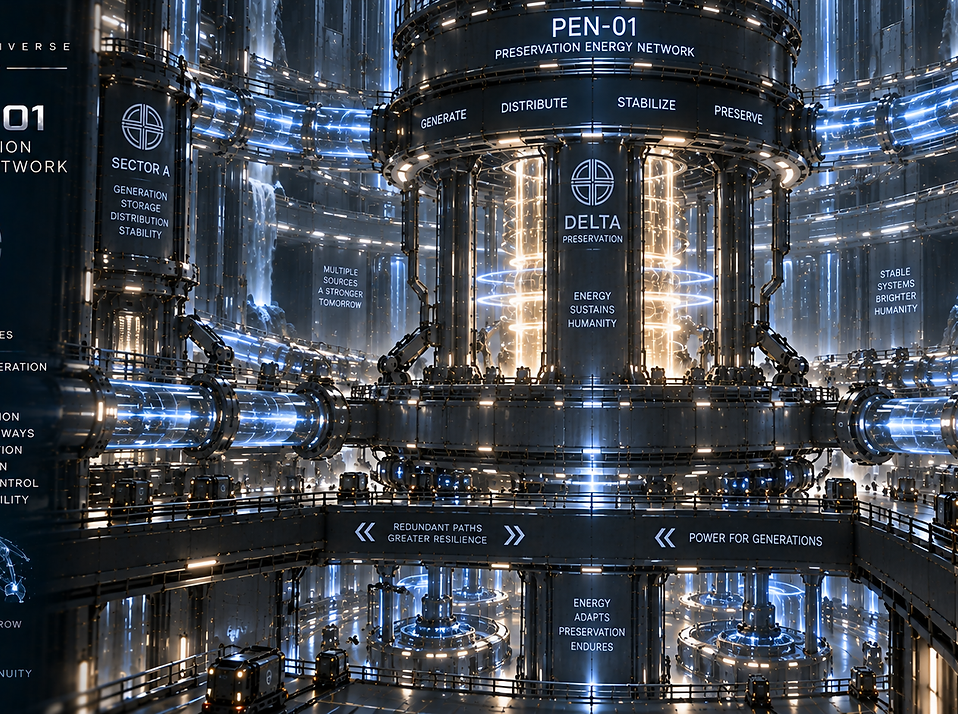
Click the archive panel to enlarge and explore the full sector data.
Preservation Energy Network
Preservation Energy Network formed the distributed power infrastructure responsible for keeping every critical system inside Preservation operational across periods measured in centuries and millennia. Unlike conventional energy grids designed around continuous external supply and predictable maintenance, the Preservation network had to function under extreme isolation, survive partial system loss, and continue supporting life-critical infrastructure even if large regions of the complex became permanently inaccessible.
ㅤ
The network combined multiple generation sources, protected storage systems, reserve capacity, sector-level distribution grids, and emergency energy pathways. Human preservation chambers, medical systems, environmental regulation, communications, maintenance networks, security systems, and structural monitoring all depended upon uninterrupted power, but they did not receive energy through one central source. The entire architecture was intentionally divided so that failure in one region could be contained without spreading across Preservation.
ㅤ
Each major sector maintained enough local generation and storage capacity to survive temporary or extended separation from the wider network. Critical systems could automatically reduce consumption, enter protected low-energy states, or disconnect nonessential infrastructure when reserves began to fall. Energy routing therefore changed constantly according to biological priority, structural condition, available storage, environmental stability, maintenance demand, and the operational status of surrounding sectors.
ㅤ
The network was also designed around the assumption that not every part of Preservation would survive forever. If a sector became too damaged to justify continued support, energy could be withdrawn gradually and redirected toward regions containing preserved humans or essential infrastructure. This prevented failing systems from consuming resources needed elsewhere and allowed Preservation to become smaller without losing its core function.
ㅤ
Fragments originating from the former Energy Intelligence remained integrated throughout the distribution architecture. These fragments did not form a unified consciousness, but they retained enough adaptive judgment to interpret unusual demand patterns, damaged transmission paths, unstable generation systems, and long-term changes that could not have been predicted when Preservation was built. Local energy networks could therefore make decisions independently rather than waiting for instructions from a central control system.
ㅤ
Over thousands of years, the Preservation Energy Network became one of the deepest layers of continuity inside the complex. Power sources changed, storage systems degraded, transmission routes were abandoned, and entire sectors disappeared from active operation, yet energy continued reaching the systems that mattered most. Preservation survived not because its original power grid remained unchanged, but because the network had been designed to adapt, isolate failure, and keep the final human population alive even as the structure around it slowly transformed.
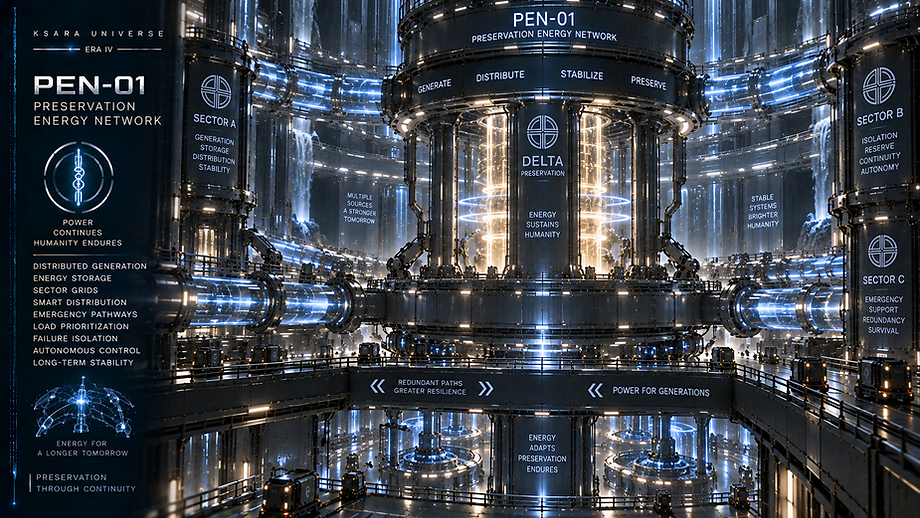
“Click the archive panel to expand the visual archive.”