NEX ARCHIVE
NEX Archive explores the historical records, technological achievements, and preserved knowledge of NEX, the vast synthetic civilization that shaped Earth's future between 2800 and 3500 A.F. Through documented events, consciousness development, architectural records, and the history of the ELE-480 and FENIX-280 Lines, the archive reveals how NEX evolved into a world of independent synthetic life. Its records reflect not only the development of planetary infrastructure, advanced systems, and immense megastructures, but also the relationships, memories, and individual choices that gradually defined the civilization.
ㅤ
As NULLIS threatened the foundations of NEX, preserving its history became inseparable from protecting the continuity of its inhabitants. The destruction of interconnected systems placed irreplaceable knowledge, personal memories, and historical records at risk, while anything completely erased by NULLIS remained beyond reconstruction. The surviving archives and memories therefore became essential witnesses to a civilization whose physical foundations could no longer endure. The following expansions explore the recorded history of NEX, its significant discoveries, technological developments, and the legacy preserved through the consciousnesses that survived its collapse.
PORTAL FENIX

Click the archive panel to enlarge and explore the full sector data.
PORTAL FENIX
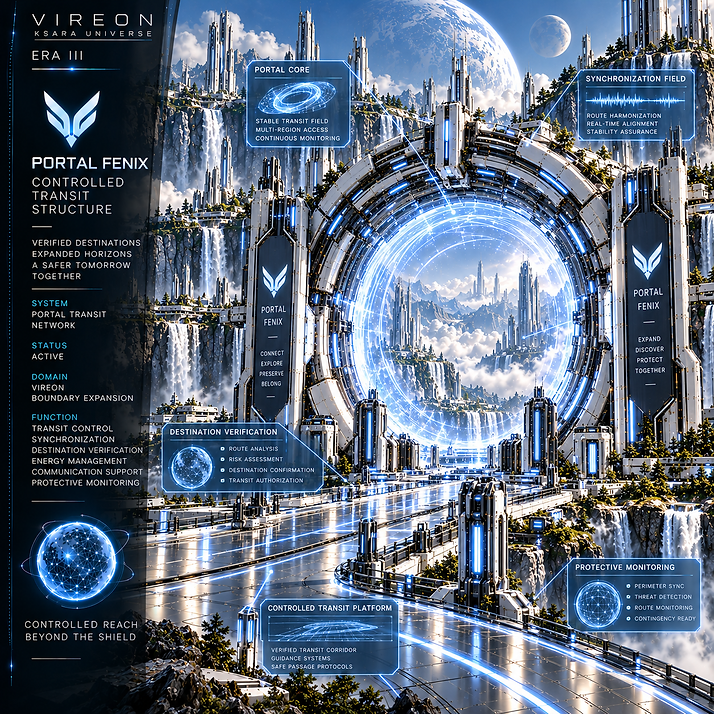
Portal Fenix was developed as one of early VIREON's most important controlled transit structures and became operational during the period when the city began reconnecting with regions beyond its established boundaries. Created around 3504 A.F., the portal architecture allowed carefully organized expeditions to move between VIREON and distant locations while maintaining far greater control than ordinary travel through the damaged world could provide.
ㅤ
The structure combined transit control, synchronization, destination verification, energy management, communication support, and protective monitoring within a single controlled environment. Passage was not treated as an instantaneous movement without preparation. Every activation required stable conditions on both sides of the connection and sufficient certainty that the receiving region would not expose VIREON to uncontrolled danger.
ㅤ
Portal Fenix was particularly important because early VIREON remained surrounded by an Earth whose infrastructure could no longer be trusted uniformly. Roads, transit systems, regional networks, and former NEX structures existed in dramatically different states of preservation. Controlled portal access allowed selected expeditions to bypass some of those uncertainties while still maintaining strict observation and isolation procedures.
ㅤ
The 3504 expedition involving ELE-410, ELE-480, NORA, IRIS, and ELE-481 demonstrated the strategic importance of the structure. Portal Fenix was not simply a transportation device; it allowed VIREON to begin investigating the world beyond its defensive perimeter without abandoning the distributed protective philosophy upon which the city had been built.
ㅤ
In later generations, the portal would become increasingly important to the wider history of VIREON. During ERA III, however, its role remained foundational: Portal Fenix gave the new civilization a controlled way to reach beyond itself without returning to the unrestricted planetary dependence that had once defined NEX.
“Click the archive panel to expand the visual archive.”