Outer Protection Zone
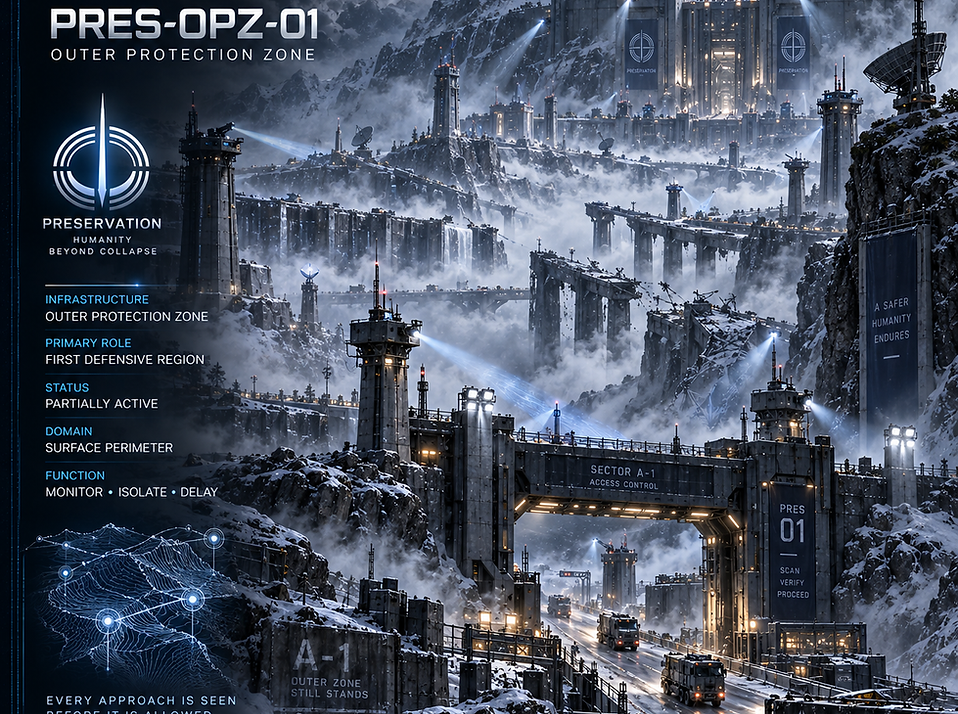
Click the archive panel to enlarge and explore the full sector data.
Outer Protection Zone
Outer Protection Zone formed the first major defensive region surrounding Preservation and marked the transition between the unstable external world and the protected architecture hidden beneath it. It was not a single wall or barrier, but a broad layered region containing hardened access points, observation systems, buried infrastructure, environmental sensors, structural defenses, isolated transit routes, and multiple checkpoints designed to detect danger long before anything could approach the deeper sectors.
ㅤ
The zone continuously monitored atmospheric conditions, radiation, seismic activity, chemical contamination, technological signals, unauthorized movement, and structural changes in the surrounding terrain. External Surface Monitoring, Security & Access Control, Structural Integrity, Communication, and Sector Isolation systems all operated heavily within this region, allowing Preservation to observe the world beyond its boundaries without exposing the deeper complex directly.
ㅤ
Movement through the Outer Protection Zone was deliberately slow and highly controlled. Routes could change according to structural stability, contamination, security status, and long-term environmental conditions. Access corridors that had once been used regularly during the construction and evacuation periods could later be sealed permanently, while surviving pathways were divided by independent barriers that prevented one compromised route from opening a direct path inward.
ㅤ
The zone also served as the first region designed to absorb external failure. Geological movement, surface collapse, hostile activity, environmental instability, or unknown technological influence could damage large portions of the Outer Protection Zone without automatically threatening the Protective Belt beneath it. Infrastructure here was considered important but replaceable, and entire sections could be abandoned if preserving them created greater risk to the deeper layers.
ㅤ
Over thousands of years, the Outer Protection Zone became increasingly fragmented. Some monitoring stations failed, access routes disappeared, buried structures shifted, and regions once connected to the surface became permanently sealed. Yet enough of the architecture remained active to continue separating Preservation from the world above and to provide early warning whenever conditions changed.
ㅤ
By the time MAJA guided Ksara toward Preservation, the Outer Protection Zone no longer resembled the organized defensive region created by its original builders. It had become a vast silent boundary of ruins, buried systems, surviving sensors, and sealed pathways surrounding something the outside world had long forgotten existed. Its purpose, however, remained unchanged: anything approaching humanity's final refuge had to pass through this layer first.
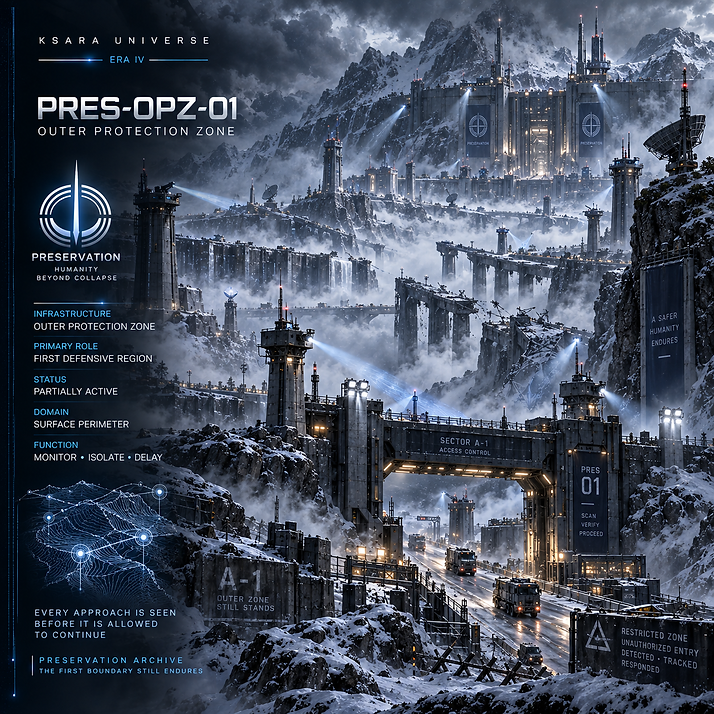
“Click the archive panel to expand the visual archive.”