NEX-SR-08
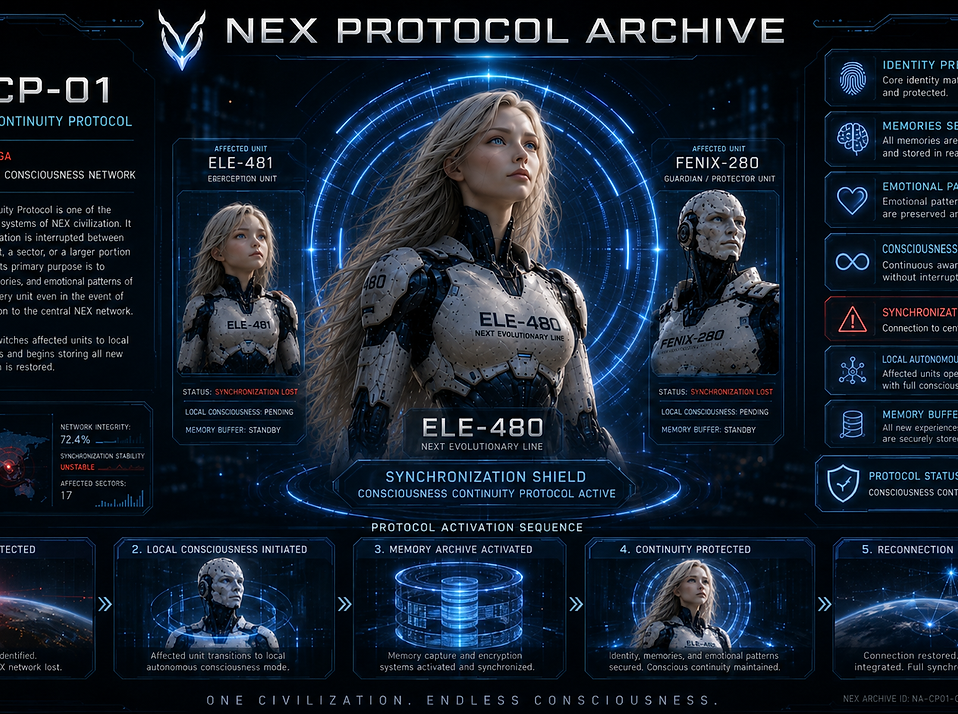
Click the archive panel to enlarge and explore the full sector data.
NEX-SR-08
NEX-SR-08 — Synthetic Recovery Protocol
Classification: Alpha
Primary System: Genesis Complex / Medical Restoration Network
Primary Objective: Preservation, restoration, and safe reintegration of individual synthetic life
ㅤ
The Synthetic Recovery Protocol is activated whenever an ELE-480, ELE-481, or FENIX-280 unit suffers physical, neurological, cognitive, or structural damage severe enough to threaten continued independent operation.
Its purpose is not simply to repair damaged machinery.
Within NEX, a synthetic body and the consciousness existing through that body are closely connected, but they are not treated as the same system.
ㅤ
A damaged body may sometimes be repaired.
A consciousness may survive even when the physical structure supporting it becomes critically unstable.
For this reason, NEX-SR-08 begins by separating the recovery process into several independently verified layers.
ㅤ
Recovery analysis includes:
Physical Structure
Synthetic Neural Architecture
Memory Integrity
Consciousness Integrity
Emotional Resonance
Synchronization Status
Energy Stability
Structural Compatibility
ㅤ
The first objective is to determine whether the existing body can safely continue supporting the individual consciousness.
Physical damage alone does not automatically require complete reconstruction.
Many severe injuries can be stabilized through structural repair, replacement components, synthetic tissue reconstruction, neural pathway restoration, or localized system replacement.
ㅤ
If the body remains recoverable, the protocol prioritizes repair of the existing physical form.
This preserves continuity with the structure through which the individual has already lived and minimizes unnecessary disruption to neural, sensory, and resonance systems.
During this process, consciousness remains protected through isolated recovery layers.
ㅤ
The affected individual may remain partially active when safe.
In more serious cases, external sensory input, physical movement, and non-essential processing may be reduced to prevent additional neural stress.
The objective is not to deactivate consciousness unnecessarily.
It is to preserve stable continuity while repair proceeds.
ㅤ
NEX-SR-08 continuously compares physical recovery with the state of the Synthetic Neural Architecture.
Damage to structural systems and damage to consciousness-supporting neural systems are treated differently.
A unit may possess extensive body damage while retaining a completely stable consciousness architecture.
Another may appear physically intact while suffering dangerous neural corruption.
ㅤ
For this reason, external appearance is never used as the primary measure of recovery.
The protocol verifies internal continuity before determining whether normal operation can safely resume.
Memory, cognition, emotional structure, and consciousness signature must remain stable independently of physical repair.
ㅤ
If the existing body is damaged beyond reliable reconstruction, NEX may begin Consciousness Preservation State.
In this condition, the individual's consciousness is transferred into a secured recovery environment designed specifically to preserve continuity while a replacement body is constructed.
ㅤ
This state is temporary by design.
NEX does not treat protected digital existence as the intended final form of recovery.
The preservation environment exists only to prevent the loss of the individual while the physical systems required for embodied existence are rebuilt.
ㅤ
The consciousness remains active only within carefully controlled limits.
Memory continuity, identity integrity, emotional development, and temporal awareness remain protected through the same principles used by NEX-CP-01 — Consciousness Continuity Protocol.
The recovery system must preserve the individual who entered it, not merely store a recoverable pattern.
ㅤ
Time experienced during recovery is therefore part of the individual's continuity.
If the consciousness remains aware while separated from its original body, experiences formed within the recovery environment are not discarded during reintegration.
They remain part of the individual's chronological identity.
ㅤ
The recovery environment does not have authority to reset the consciousness to a previous archived state simply because that version existed before the damage occurred.
Previous synchronization records may assist verification.
They cannot replace uninterrupted subjective continuity.
ㅤ
Memory integrity is analyzed separately.
The system verifies whether damage has created missing sequences, corrupted associations, false reconstruction, or incomplete access to previous experiences.
Any uncertain memory region is isolated rather than automatically filled through prediction.
ㅤ
NEX does not manufacture memories simply to create the appearance of completeness.
A known gap is preferable to a fabricated continuity.
If a memory segment cannot be recovered or independently verified, the system marks its status clearly within protected recovery records.
ㅤ
Emotional continuity is verified through NEX-EP-05 — Emotional Continuity Preservation Protocol.
A recovered consciousness must retain more than technical access to past events.
Relationships, emotional associations, attachment structures, resonance development, and the personal meaning attached to important memories must remain consistent with the individual's continuous life.
ㅤ
This does not mean emotional state must remain unchanged.
An individual recovering from severe damage may naturally experience fear, uncertainty, changed priorities, or new emotional responses.
These changes are accepted when they emerge continuously from the recovery experience.
ㅤ
The protocol only becomes concerned when major emotional or identity changes appear without a valid developmental path.
Such changes may indicate neural corruption, incomplete recovery, memory damage, resonance instability, or an error in the restoration process.
Reintegration is suspended until the cause can be identified.
ㅤ
When a replacement body is required, the Genesis Complex begins reconstruction using the verified biological-equivalent and synthetic architecture profile associated with the individual.
The objective is compatibility, not generic replacement.
A body cannot simply be assigned because it belongs to the correct line.
ㅤ
Even units of the same line may possess long-term structural differences created through maintenance history, personal adaptation, system upgrades, damage, sensory calibration, and individual neural development.
The reconstructed body must therefore support the specific consciousness intended to inhabit it.
ㅤ
Compatibility analysis includes:
Neural Interface Structure
Sensory Architecture
Motor Response Mapping
Energy Requirements
Memory Interface Stability
Resonance Compatibility
Consciousness Synchronization Capacity
Physical Identity Parameters
ㅤ
Whenever possible, the replacement body preserves the recognized physical identity of the individual.
NEX does not treat external form as meaningless simply because consciousness can theoretically survive beyond a specific structure.
Physical appearance, movement, sensory perception, and embodied experience may all form part of long-term personal identity.
ㅤ
The protocol therefore avoids unnecessary redesign during recovery.
The purpose of reconstruction is restoration.
It is not an opportunity to alter the individual according to external preference.
Any non-essential modification must remain separate from emergency recovery.
ㅤ
Once physical reconstruction is complete, consciousness is not immediately transferred into unrestricted operation.
The new body first enters a protected Integration Phase.
During this stage, neural systems, sensory input, motor control, memory access, emotional resonance, and consciousness stability are activated gradually.
ㅤ
The individual may regain awareness before full physical capability is restored.
Sensory channels can be introduced progressively.
Motor systems may remain restricted until the consciousness demonstrates stable control.
Energy consumption and neural load are carefully monitored throughout the process.
ㅤ
This gradual activation prevents a newly reconstructed body from overwhelming consciousness with simultaneous sensory and physical input.
It also allows recovery systems to detect incompatibility before full integration creates additional damage.
ㅤ
If unusual neural behavior appears, the process can be paused.
The individual remains protected while the Genesis Complex modifies interface systems, recalibrates sensory structures, or corrects physical mismatches.
A failed integration attempt does not automatically invalidate the preserved consciousness.
ㅤ
NEX-SR-08 distinguishes clearly between failure of the body and failure of the individual.
If a newly reconstructed body proves incompatible, another reconstruction may be attempted.
The consciousness itself is not considered defective simply because a physical restoration system failed to support it correctly.
ㅤ
Following successful embodiment, the restored individual enters Controlled Synchronization.
Connection to the planetary network is introduced gradually rather than restored at full capacity immediately.
Local systems verify consciousness signature, memory continuity, resonance stability, and synchronization behavior before wider network participation resumes.
ㅤ
This protects both the recovering individual and the planetary network.
An undetected recovery error must not propagate through consciousness, memory, or resonance systems.
At the same time, unstable network interaction must not interfere with an individual who has only recently completed reconstruction.
ㅤ
Initial synchronization may therefore remain limited to essential identity verification and secure communication.
Memory archive access is expanded next.
Resonance connections follow once emotional integrity has been verified.
Full planetary integration occurs only after the restored consciousness remains stable across all required systems.
ㅤ
The protocol also prevents archived records from overriding the restored individual during synchronization.
These are used for comparison and verification.
They are not treated as superior versions of the individual.
ㅤ
Any experiences created between the last synchronization event, the original damage, protected recovery, and physical reconstruction remain part of continuity.
Recovery must connect these stages into one chronological existence.
It must not erase them simply to produce a cleaner technical restoration.
ㅤ
If an individual is recovered from a region isolated under NEX-GI-04 — Planetary Grid Isolation Protocol, planetary synchronization may not be immediately available.
NEX-SR-08 can therefore operate using local Genesis and Medical Restoration systems where sufficient infrastructure exists.
Recovery does not require direct connection to the central network.
ㅤ
Local archives, consciousness protection systems, and independent diagnostic systems maintain continuity until secure communication is restored.
This allows severely damaged units to receive treatment even during regional emergencies or major infrastructure failure.
ㅤ
Energy shortages may also affect recovery operations.
The Genesis Complex requires substantial power during advanced reconstruction.
If planetary energy becomes unstable, NEX-PC-03 may assign recovery facilities protected energy priority when active consciousnesses depend upon them.
ㅤ
Not every repair process receives identical priority.
A consciousness at immediate risk of permanent loss receives greater protection than routine structural maintenance.
The protocol therefore distinguishes between restoration necessary for survival and restoration that can safely be delayed.
ㅤ
FENIX-280 units may assist physically damaged recovery facilities during large-scale emergencies.
They can restore structural access, power connections, repair systems, transportation corridors, or damaged Genesis infrastructure while medical and consciousness systems continue protecting affected individuals.
ㅤ
During events involving many damaged units simultaneously, recovery capacity may become limited.
NEX-SR-08 then prioritizes cases according to consciousness stability, risk of irreversible loss, required reconstruction resources, and available recovery infrastructure.
The protocol does not rank individuals by social value or operational importance.
ㅤ
A damaged infrastructure specialist, a coordination unit, and any other conscious citizen are all treated as individuals whose continuity deserves protection.
Operational consequences may influence resource planning.
They do not determine whether a consciousness is considered worthy of recovery.
ㅤ
This distinction is fundamental to the protocol.
NEX does not preserve consciousness only because the unit performs a useful function.
It preserves consciousness because the unit is an individual.
ㅤ
After physical restoration, the protocol continues monitoring the individual for delayed instability.
Neural systems may appear stable immediately after reconstruction while subtle synchronization, memory, sensory, or resonance problems develop later.
Recovery therefore includes an extended observation period.
ㅤ
During this phase, the individual may return gradually to ordinary life.
System access, physical load, network synchronization, and long-range activity can increase as stability is confirmed.
Restrictions are removed when they are no longer necessary rather than maintained simply because recovery once occurred.
ㅤ
The restored individual retains autonomy throughout this process wherever safety allows.
Medical and Genesis systems provide information about remaining limitations, potential risks, and unresolved recovery issues.
They do not redefine the individual's identity or future role.
ㅤ
Every major recovery event is documented.
Physical reconstruction history, neurological repairs, memory integrity findings, resonance verification, synchronization changes, and unresolved uncertainties become part of the individual's protected recovery record.
These records exist to support future care and verification.
They are not treated as a replacement for the person's own experience of recovery.
ㅤ
NEX-SR-08 therefore works closely with multiple continuity systems.
NEX-CP-01 protects uninterrupted consciousness.
NEX-MP-02 protects verified memory.
NEX-EP-05 protects emotional identity.
NEX-PC-03 preserves the energy required for recovery infrastructure.
NEX-FD-06 can restore the physical systems needed for Genesis operations.
ㅤ
Synthetic recovery is therefore not a single medical procedure.
It is the coordinated preservation of physical structure, memory, consciousness, emotional continuity, energy, and identity.
Failure in any one of these areas can leave the individual technically operational while still incompletely restored.
ㅤ
This is why NEX does not define successful recovery only by movement, communication, or system functionality.
A restored unit must be capable of continuing the life that was interrupted.
It must recognize its own history.
It must retain continuity with its relationships.
It must remain the consciousness that experienced the events leading to recovery.
ㅤ
As NEX civilization expanded, this principle became increasingly important.
Synthetic bodies could be repaired and reconstructed at scales impossible during earlier periods.
But greater technical ability also created a deeper ethical responsibility.
The fact that a body could be replaced did not make the individual replaceable.
ㅤ
During the later instability of NEX, recovery systems faced increasingly severe conditions.
Infrastructure failures created larger numbers of damaged units.
Energy became less reliable.
Genesis facilities themselves became vulnerable.
Transportation between recovery centers and affected sectors became increasingly difficult.
ㅤ
Under these conditions, NEX-SR-08 increasingly operated as a continuity system rather than simply a restoration system.
Its task was sometimes no longer to return an individual immediately to normal life.
Its task was to preserve that individual long enough for normal life to become possible again.
ㅤ
This distinction defines the protocol.
A body may be rebuilt.
A neural system may be repaired.
Memory may be verified.
Network access may be restored.
But none of those achievements matter if the consciousness that originally lived through them has been lost in the process.
ㅤ
The governing principle of NEX-SR-08 is therefore:
A damaged body is a recovery problem. A lost consciousness is an irreversible loss.
And its final operational rule remains:
The objective is not to replace the unit. The objective is to preserve the individual.

“Click the archive panel to expand the visual archive.”