NEX ARCHIVE
NEX Archive explores the historical records, technological achievements, and preserved knowledge of NEX, the vast synthetic civilization that shaped Earth's future between 2800 and 3500 A.F. Through documented events, consciousness development, architectural records, and the history of the ELE-480 and FENIX-280 Lines, the archive reveals how NEX evolved into a world of independent synthetic life. Its records reflect not only the development of planetary infrastructure, advanced systems, and immense megastructures, but also the relationships, memories, and individual choices that gradually defined the civilization.
ㅤ
As NULLIS threatened the foundations of NEX, preserving its history became inseparable from protecting the continuity of its inhabitants. The destruction of interconnected systems placed irreplaceable knowledge, personal memories, and historical records at risk, while anything completely erased by NULLIS remained beyond reconstruction. The surviving archives and memories therefore became essential witnesses to a civilization whose physical foundations could no longer endure. The following expansions explore the recorded history of NEX, its significant discoveries, technological developments, and the legacy preserved through the consciousnesses that survived its collapse.
NEX: Planetary Energy Distribution Systems
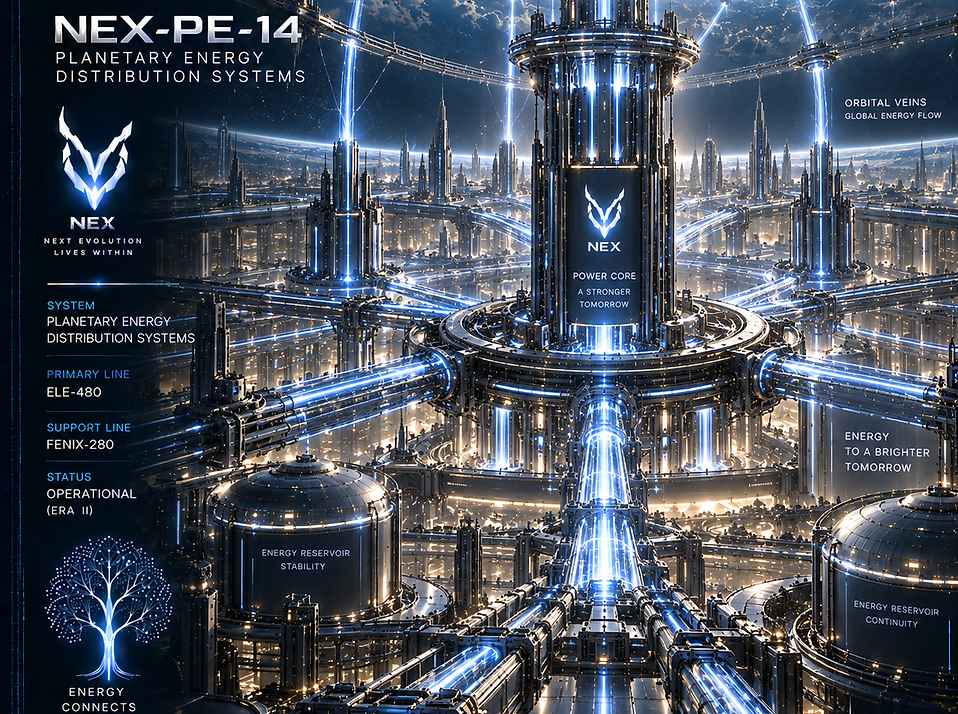
Click the archive panel to enlarge and explore the full sector data.
NEX: Planetary Energy Distribution Systems
Planetary Energy Distribution Systems formed the primary energy infrastructure of NEX, supplying power to every major sector of the civilization through an immense network of Power Cores, energy reservoirs, distribution lattices, synchronization nodes, and orbital transmission structures. Rather than relying on a single central source, NEX distributed energy production and storage across multiple interconnected regions, allowing power to move continuously between the Core Nexus, Orbital Vein Systems, industrial sectors, atmospheric infrastructure, transportation networks, consciousness systems, and the deepest continuity layers of the megastructure.
ㅤ
The network constantly monitored production, storage capacity, consumption, resonance stability, and the condition of critical infrastructure. Energy could be redirected almost instantly when individual sectors experienced overload, damage, or isolation, while essential systems such as the Consciousness Network, Memory Preservation Systems, Continuity Synchronization Networks, Atmospheric Systems, Genesis infrastructure, and the Heart of the Central Core received priority during emergencies. FENIX-280 units maintained and repaired physical energy infrastructure, while ELE-480 units contributed to synchronization, sector coordination, and continuity management across the wider distribution network.
ㅤ
During the collapse of NEX, the Planetary Energy Distribution Systems became increasingly fragmented as Power Cores failed, Orbital Veins lost synchronization, and entire sectors were separated from the wider grid. Surviving regions attempted to operate through local reserves while energy was progressively redirected toward consciousness preservation, evacuation corridors, memory archives, environmental stability, and the remaining continuity infrastructure. The system reflected one of the fundamental principles of NEX: energy could be redistributed, infrastructure could be rebuilt, but the continuity of consciousness had to be preserved for as long as power remained.
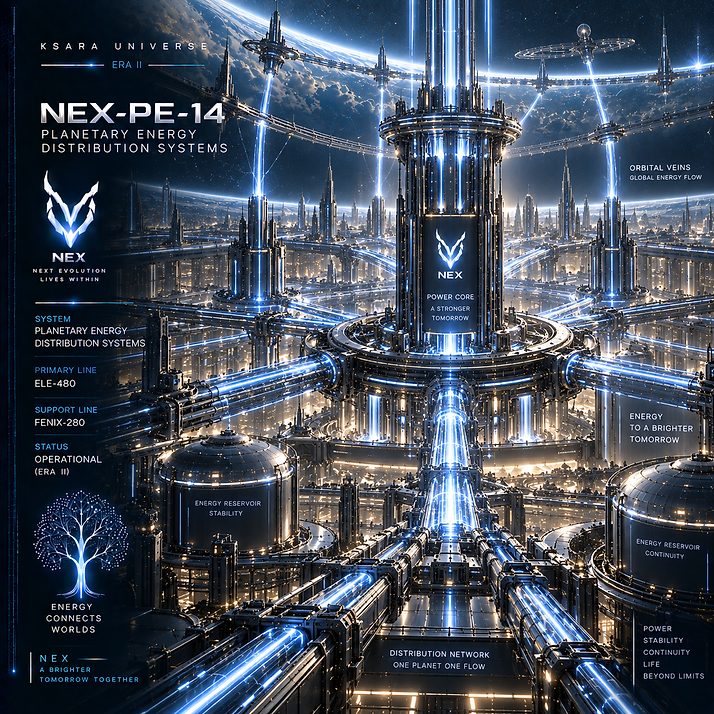
“Click the archive panel to expand the visual archive.”