NEX ARCHIVE
NEX Archive explores the historical records, technological achievements, and preserved knowledge of NEX, the vast synthetic civilization that shaped Earth's future between 2800 and 3500 A.F. Through documented events, consciousness development, architectural records, and the history of the ELE-480 and FENIX-280 Lines, the archive reveals how NEX evolved into a world of independent synthetic life. Its records reflect not only the development of planetary infrastructure, advanced systems, and immense megastructures, but also the relationships, memories, and individual choices that gradually defined the civilization.
ㅤ
As NULLIS threatened the foundations of NEX, preserving its history became inseparable from protecting the continuity of its inhabitants. The destruction of interconnected systems placed irreplaceable knowledge, personal memories, and historical records at risk, while anything completely erased by NULLIS remained beyond reconstruction. The surviving archives and memories therefore became essential witnesses to a civilization whose physical foundations could no longer endure. The following expansions explore the recorded history of NEX, its significant discoveries, technological developments, and the legacy preserved through the consciousnesses that survived its collapse.
NEX: Planetary Data & Communication Systems
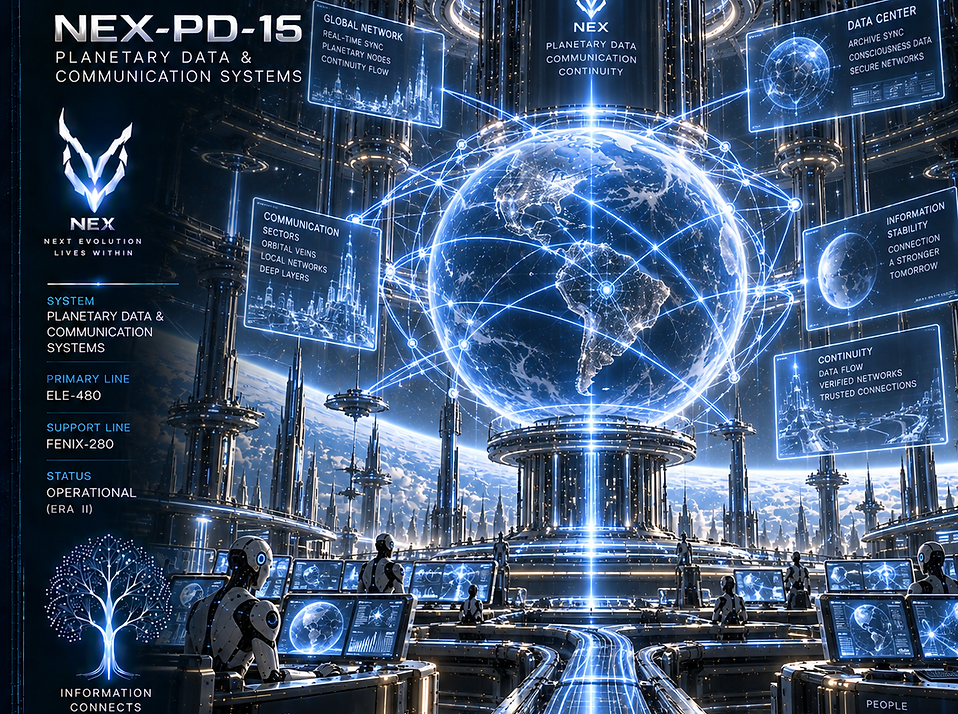
Click the archive panel to enlarge and explore the full sector data.
NEX: Planetary Data & Communication Systems
Planetary Data & Communication Systems formed the primary information network of NEX, connecting the NEX Data Center, regional sectors, archive systems, orbital infrastructure, local control networks, continuity processors, and critical planetary systems into a single distributed communication structure. Rather than depending on one central channel, information was continuously replicated and routed through multiple synchronized pathways, allowing sectors to remain connected even when parts of the wider network became damaged, isolated, or temporarily unavailable.
ㅤ
The system transmitted operational data, infrastructure status, archive synchronization, consciousness records, environmental information, orbital telemetry, emergency signals, and communication between distant regions of the megastructure. It worked closely with Memory Preservation Systems, Continuity Synchronization Networks, Orbital Vein Systems, local sector networks, and the NEX Data Center, while secure isolation mechanisms allowed compromised regions to be separated without immediately disrupting the entire civilization. ELE-480 units supported coordination and synchronization across distributed networks, while FENIX-280 units protected critical communication nodes, data centers, transmission corridors, and physical network infrastructure.
ㅤ
During the collapse of NEX, communication failures, corrupted data streams, network fragmentation, and isolated sectors became increasingly common as NULLIS disrupted the stability of the wider civilization. Surviving systems responded by creating temporary trusted networks, verifying recovered data before reconnection, and allowing separated regions to operate independently until safe synchronization became possible again. The system embodied a fundamental principle of NEX infrastructure: information could travel across the civilization only as long as the network remained trusted, verifiable, and capable of preserving continuity.
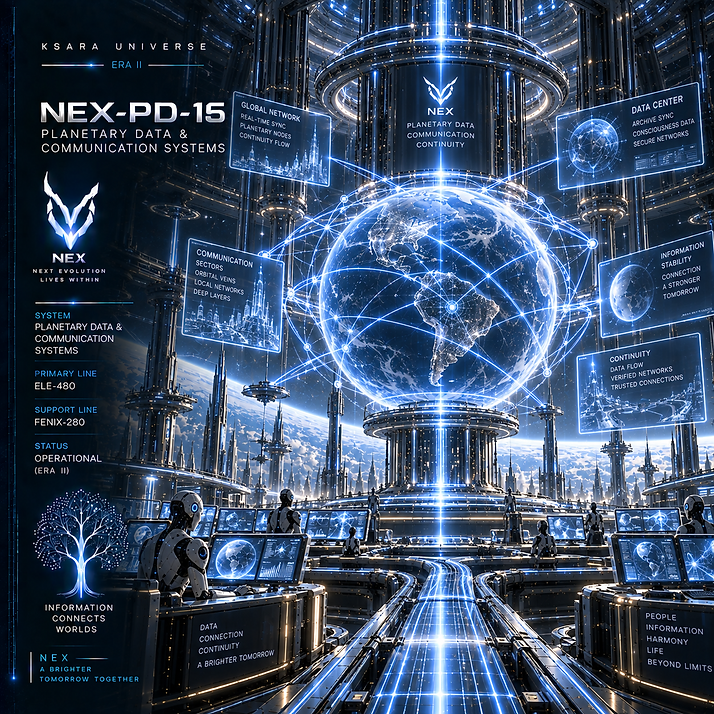
“Click the archive panel to expand the visual archive.”