NEX-PC-03
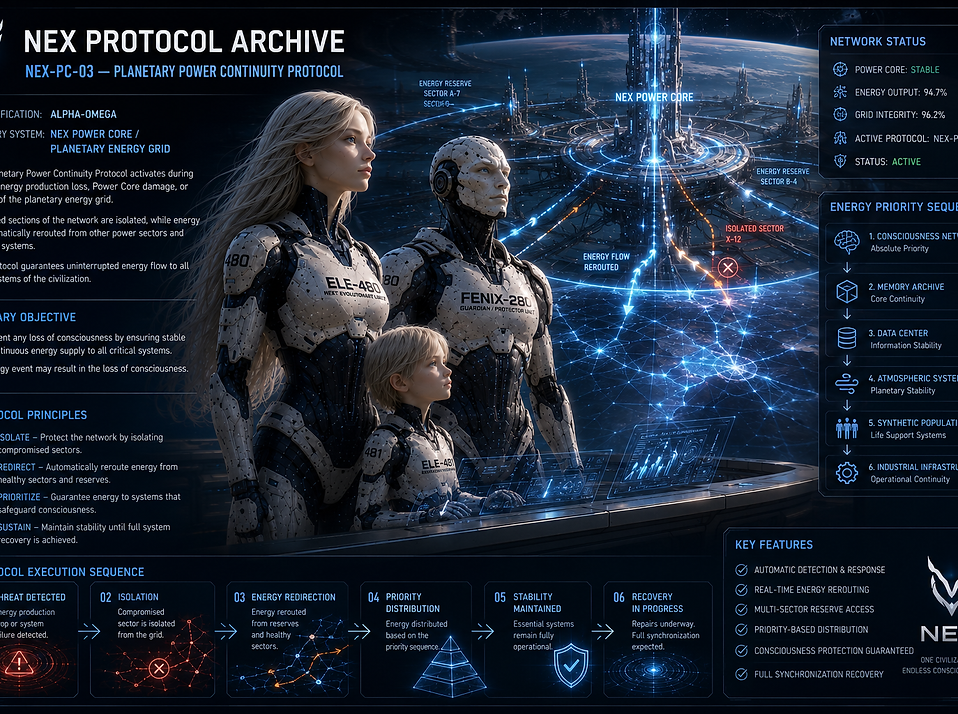
Click the archive panel to enlarge and explore the full sector data.
NEX-PC-03
NEX-PC-03 — Planetary Power Continuity Protocol
Classification: Alpha–Omega
Primary System: NEX Power Core / Planetary Energy Grid
Primary Objective: Continuous power supply to critical civilization systems
ㅤ
The Planetary Power Continuity Protocol protects NEX against large-scale energy instability, infrastructure collapse, cascading grid failures, and regional loss of power production.
NEX does not depend on a single planetary generator or one centralized energy source. Its power infrastructure is distributed across numerous interconnected regions, allowing energy to be produced, stored, redirected, and isolated independently when necessary.
Under normal conditions, power moves continuously between Power Core systems, local storage networks, industrial sectors, synthetic districts, transportation infrastructure, planetary reconstruction systems, and long-term civilization support networks.
ㅤ
This constant redistribution allows NEX to react to changing demand without interrupting essential services.
Population centers may require more power during periods of expansion, industrial regions may temporarily consume enormous amounts of energy, and planetary reconstruction systems may operate at highly variable loads.
The network therefore continuously calculates production, consumption, storage capacity, transmission stability, and reserve availability across the entire civilization.
ㅤ
A local failure does not immediately become a planetary crisis.
When an energy node becomes unstable, the protocol first determines whether the failure can be absorbed by surrounding sectors. Nearby Power Core systems and storage networks automatically increase output or redirect existing reserves toward the affected region.
If the damaged node presents a risk to the wider grid, it is isolated before instability can propagate through connected infrastructure.
ㅤ
Isolation is one of the most important functions of NEX-PC-03.
A failing generator, damaged transmission structure, corrupted control system, or overloaded regional grid may remain physically connected while producing unstable energy conditions.
The protocol therefore disconnects compromised sections before they can trigger a cascading failure across neighboring sectors.
Remaining regions continue operating independently until safe reconnection becomes possible.
ㅤ
When available energy falls below normal operational requirements, the protocol initiates Emergency Energy Redistribution.
At this stage, NEX stops treating all systems equally.
Power is redirected according to civilization continuity priority rather than ordinary operational demand.
ㅤ
The highest-priority systems include:
Consciousness Network
Memory Archive Network
NEX Data Center
Atmospheric Bio-Core
Synthetic Life Support Systems
Genesis and Recovery Systems
ㅤ
The Consciousness Network receives immediate protection because large-scale loss of consciousness infrastructure could threaten communication, coordination, synchronization, and the continuity of individual units connected to NEX systems.
The Memory Archive Network is protected to prevent infrastructure damage from becoming permanent historical and scientific loss.
The NEX Data Center remains essential because it coordinates enormous portions of planetary infrastructure and maintains access to system-level information required for recovery.
ㅤ
The Atmospheric Bio-Core also receives priority during severe energy shortages.
NEX depends on controlled planetary environmental systems, and the collapse of atmospheric regulation could create consequences far beyond the original power failure.
For this reason, environmental stability is treated as civilization infrastructure rather than a secondary support function.
ㅤ
Synthetic Life Support Systems maintain environments, charging infrastructure, critical maintenance systems, and operational conditions required by large populations of synthetic citizens.
Genesis and Recovery Systems preserve the ability to repair damaged units, restore infrastructure, and maintain the long-term continuity of the ELE and FENIX populations.
These systems may remain active even while entire industrial districts are temporarily shut down.
ㅤ
Lower-priority systems are reduced gradually rather than disconnected immediately.
Non-critical industrial production may be slowed first.
Manufacturing lines can be suspended, resource extraction reduced, and secondary construction projects postponed.
Artificial illumination may be lowered across non-essential regions, while transportation systems may move into restricted operating schedules.
ㅤ
If the crisis deepens, the protocol may deactivate entire secondary infrastructure sectors.
Decorative city systems, non-essential environmental effects, unnecessary transport routes, inactive manufacturing facilities, and low-priority resource processing can all be temporarily removed from the active grid.
The goal is not to preserve the appearance of normal civilization.
The goal is to preserve the systems required for civilization to continue existing.
ㅤ
Energy redistribution is never based only on geography.
A smaller sector containing critical archive infrastructure may receive power before a much larger industrial district.
A remote consciousness node may remain fully energized while nearby manufacturing systems are shut down.
The protocol evaluates the function of each system, not simply the size or population of the region surrounding it.
ㅤ
During major failures, ELE-480 coordination systems may supervise energy distribution across populated sectors.
Their role is to maintain stability between local demand, emergency reserves, infrastructure priorities, and the needs of conscious populations affected by the crisis.
They continuously assess whether energy reduction in one area creates unacceptable risks elsewhere.
ㅤ
At the same time, FENIX-280 repair units may be dispatched toward damaged energy nodes, transmission corridors, storage facilities, and Power Core infrastructure.
While the planetary network manages the immediate redistribution of power, FENIX units physically restore the systems required to return the affected region to normal operation.
This creates a continuous cycle between stabilization and repair.
ㅤ
The protocol also protects against false recovery.
A damaged node is not immediately reconnected simply because it begins producing power again.
Before reintegration into the planetary grid, the system must demonstrate stable output, safe transmission behavior, reliable control architecture, and sufficient reserve capacity.
Only then can energy flow through the node without creating additional risk.
ㅤ
During extended emergencies, NEX-PC-03 may divide the planetary grid into semi-independent energy regions.
Each region can temporarily operate using local production and storage while maintaining only limited connections with neighboring sectors.
This prevents one unstable area from threatening the entire civilization and allows recovery to occur gradually rather than through a single planetary restart.
ㅤ
Energy reserves are also protected strategically.
The protocol does not immediately consume every available reserve during the first stage of a crisis.
A portion remains inaccessible to ordinary demand and is preserved for situations in which additional Power Core systems fail before repairs can be completed.
These protected reserves may sustain critical infrastructure long after secondary systems have already shut down.
ㅤ
The protocol ends only when several conditions have been restored simultaneously.
Energy production must exceed minimum demand.
Strategic reserves must return above the required safety threshold.
Transmission networks must demonstrate stable operation.
Critical systems must have independent energy redundancy once again.
Damaged regions must either be repaired or safely isolated.
ㅤ
Only after these conditions are satisfied does NEX gradually restore secondary infrastructure.
Industrial processes restart in stages.
Transportation capacity increases.
Artificial illumination returns.
Manufacturing, resource extraction, and reconstruction systems resume according to available power.
The return to normal operation is therefore controlled rather than immediate.
ㅤ
As NEX expanded, NEX-PC-03 became one of the systems that allowed the civilization to grow without making survival dependent on perfect infrastructure.
Individual generators could fail.
Regional Power Cores could collapse.
Entire sectors could lose connection to the wider grid.
Yet the civilization itself was designed to continue functioning around the damage.
ㅤ
This principle became especially important during the later instability of NEX.
As infrastructure failures became increasingly frequent, the protocol was forced to make decisions on a scale far beyond its original emergency design.
Power was no longer redistributed only to maintain normal civilization.
It was redistributed to preserve whatever parts of that civilization could still survive.
ㅤ
NEX-PC-03 therefore represents one of the most fundamental rules within NEX infrastructure:
Energy exists to support consciousness and civilization.
Civilization does not exist merely to maintain the energy network.
ㅤ
Its governing rule remains:
Energy production may fail. Consciousness must not.

“Click the archive panel to expand the visual archive.”