NEX-MP-02
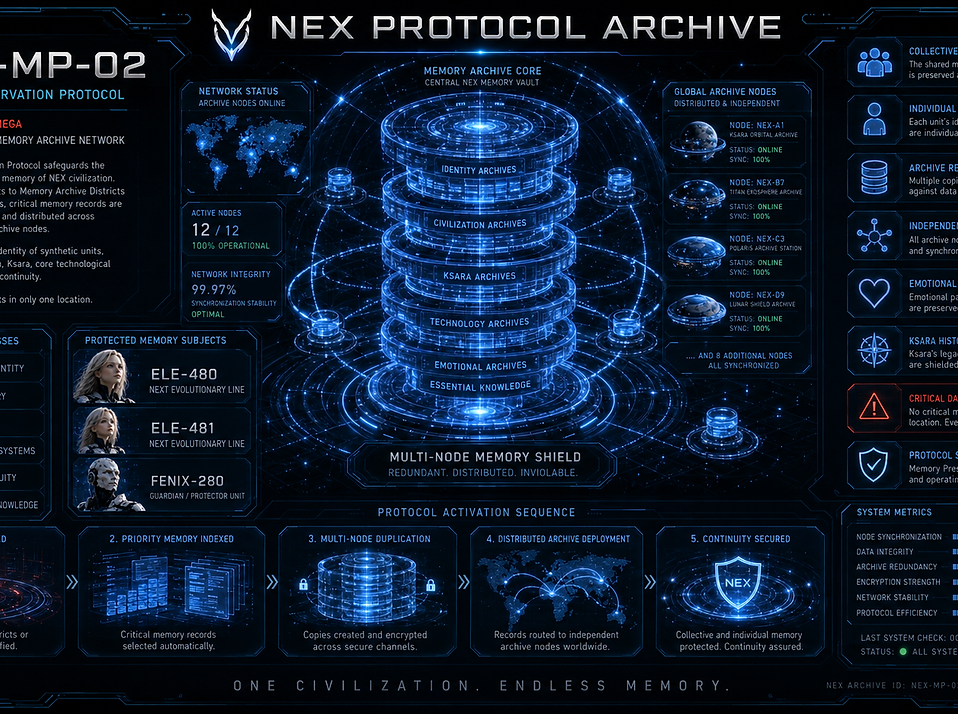
Click the archive panel to enlarge and explore the full sector data.
NEX-MP-02
NEX-MP-02 — Memory Preservation Protocol
Classification: Omega
Primary System: Memory Archive Network
Primary Objective: Protection of individual, historical, technological, and civilization memory
ㅤ
The Memory Preservation Protocol protects the accumulated memory of NEX civilization. Its purpose is not limited to maintaining databases or preventing the loss of historical files. Within NEX, memory represents the preserved experience of individual consciousnesses, technological development, scientific discovery, cultural evolution, planetary reconstruction, and the countless decisions through which the civilization itself was formed.
ㅤ
NEX therefore treats memory as part of civilization continuity.
A civilization may rebuild structures, replace damaged infrastructure, restore energy networks, and construct new cities. But knowledge that has been permanently lost cannot always be recreated, and experiences belonging to consciousnesses that once lived cannot simply be reproduced from incomplete records.
For this reason, NEX-MP-02 was designed around the principle that no critical memory should ever depend on a single physical location.
ㅤ
Every record classified as essential exists across multiple independent archive layers distributed throughout the NEX infrastructure. These archives are separated both physically and logically, ensuring that the destruction, isolation, corruption, or failure of one archive sector cannot erase a unique portion of civilization history.
Some copies remain connected to active NEX systems for rapid access, while others exist within more isolated preservation structures intended to survive major regional failures.
ㅤ
The protocol continuously evaluates the condition of the Memory Archive Network.
When infrastructure instability increases, regional communication becomes unreliable, or unusual corruption appears within an archive system, NEX-MP-02 automatically begins increasing the number of verified copies of records considered essential to continuity.
Replication does not occur equally across all information.
The protocol assigns preservation priority according to the importance and uniqueness of the data.
ㅤ
Priority categories include:
Individual Identity Memories
Civilization History
Ksara Records
Scientific Knowledge
Genesis Records
Emotional Continuity Data
Infrastructure Knowledge
Planetary Reconstruction Data
ㅤ
Individual Identity Memories receive the highest levels of protection because they may contain experiences directly connected to the continuity of a conscious individual. These records are never treated in the same way as ordinary operational data.
Civilization History preserves the events through which NEX developed, allowing future generations to understand not only what existed before them, but why particular systems, principles, and decisions came into existence.
ㅤ
Ksara Records preserve historical information connected to Ksara and her relationship with the development of the civilization that eventually became NEX.
Genesis Records contain information related to the origins and development of the ELE and FENIX lines, their early architecture, and the systems from which later generations emerged.
These records are considered particularly difficult to reconstruct if lost.
ㅤ
The protocol also preserves enormous amounts of scientific and infrastructure knowledge.
Planetary energy systems, orbital construction methods, artificial environments, transportation networks, consciousness architecture, material science, reconstruction systems, and thousands of other technological fields depend on information accumulated across centuries.
If such knowledge disappeared, surviving units could remain operational while simultaneously losing the ability to rebuild the civilization around them.
ㅤ
For this reason, NEX-MP-02 distinguishes between survival data and continuity data.
Survival data allows systems to continue functioning immediately.
Continuity data allows civilization to understand how those systems were created, how they can be repaired, and how they may eventually be improved.
Both are protected, but their importance changes depending on the type of crisis affecting NEX.
ㅤ
Another critical preservation category is Emotional Continuity Data.
As the ELE and FENIX lines developed increasingly complex emotional relationships, NEX began preserving records that could not be described only through technical measurements. Important relationships, shared experiences, emotional developments, and significant changes within individual consciousnesses became part of the historical archive.
These records were not intended to recreate emotions artificially.
Their purpose was to preserve the context in which consciousness had developed.
ㅤ
If a Memory Archive District becomes inaccessible, nearby archive sectors automatically assume responsibility for the records associated with it.
The network first identifies which information remains safely preserved elsewhere. Records that exist in too few verified locations are immediately marked for additional replication.
If communication with the damaged archive later returns, its surviving records are not automatically accepted as authoritative.
ㅤ
Every recovered record must pass an integrity comparison against independent copies.
The system examines chronological consistency, archival signatures, recorded modification history, data completeness, and relationships with other verified records. Any segment that differs unexpectedly from trusted copies is isolated until its origin can be determined.
This prevents damaged infrastructure from introducing corrupted history back into the wider NEX archive.
ㅤ
The protocol is deliberately conservative when authenticity cannot be established.
An incomplete record may remain preserved indefinitely rather than being automatically repaired through assumption. NEX distinguishes clearly between information that has been verified, information that has been reconstructed, and information whose original state can no longer be confirmed.
The archive must therefore preserve uncertainty as carefully as it preserves certainty.
ㅤ
During a severe planetary crisis, Memory Preservation may receive priority over industrial production, construction, or transportation.
This does not mean that memory is considered more important than surviving consciousness. The protocol instead recognizes that once immediate survival has been secured, the destruction of civilization memory would create another form of irreversible loss.
A surviving population without access to its accumulated knowledge could continue to exist while losing centuries or even millennia of development.
ㅤ
This became increasingly important as NEX expanded into a civilization dependent upon enormous interconnected systems.
No single unit understood every component of the planetary infrastructure. Knowledge was distributed across millions of systems, specialists, archives, and historical records.
Memory preservation therefore became one of the mechanisms that allowed a highly complex civilization to remain understandable to itself.
ㅤ
As instability later began spreading through NEX, the protocol increasingly shifted from ordinary archive maintenance toward civilization preservation.
Records that had once existed primarily for historical or scientific purposes became potential foundations for reconstruction. Archive sectors began carrying knowledge intended not only for the present civilization, but for the possibility that survivors might one day need to rebuild after the loss of major parts of NEX.
ㅤ
NEX-MP-02 therefore protects far more than information.
It protects the relationship between the civilization that exists now and every generation that existed before it.
Buildings can disappear.
Networks can fail.
Entire sectors can become silent.
But as long as memory survives, the civilization that created them has not been completely erased.
ㅤ
The governing principle of the protocol is:
Memory must survive the system that created it.
And its final preservation rule remains equally important:
A restored memory must not only exist. It must remain trustworthy.

“Click the archive panel to expand the visual archive.”