NEX-DR-09
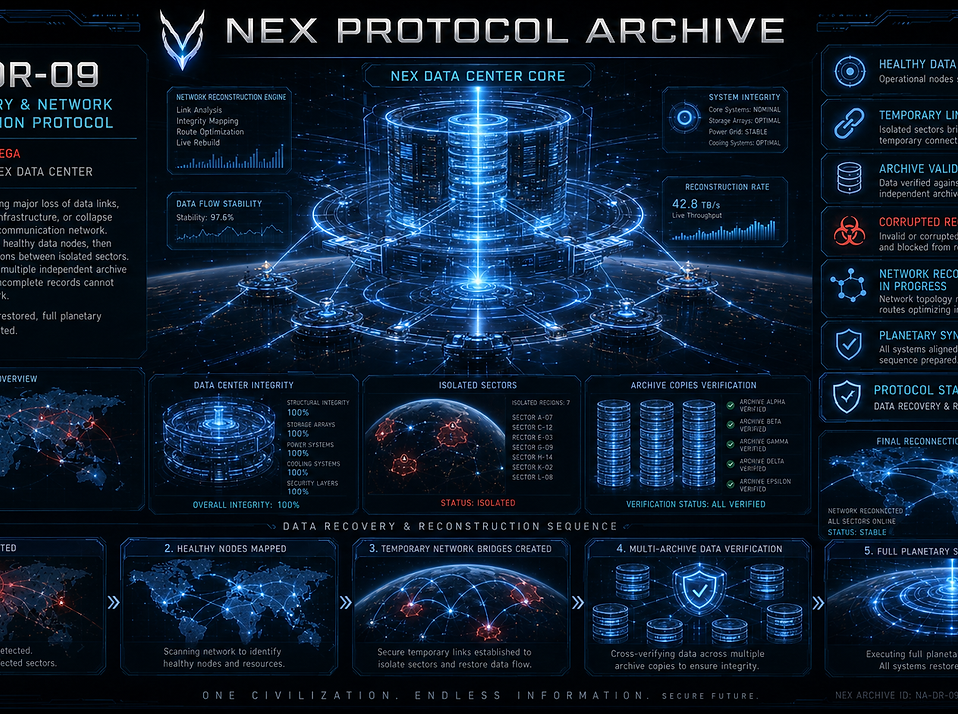
Click the archive panel to enlarge and explore the full sector data.
NEX-DR-09
NEX-DR-09 — Data Recovery & Network Reconstruction Protocol
Classification: Omega
Primary System: NEX Data Center
Primary Objective: Reconstruction of damaged planetary data infrastructure and restoration of trusted network continuity
ㅤ
The Data Recovery & Network Reconstruction Protocol is activated whenever major portions of the NEX communication, synchronization, or planetary data-processing infrastructure become unavailable, unstable, corrupted, or physically separated from the wider network.
Its purpose is not simply to restore communication as quickly as possible.
Its purpose is to rebuild a network that NEX can trust.
ㅤ
The planetary data infrastructure connects enormous numbers of systems.
Consciousness synchronization, memory archives, infrastructure control, power distribution, transportation, environmental systems, industrial coordination, Genesis facilities, and countless local networks all depend upon reliable communication.
A corrupted network can therefore become more dangerous than a disconnected one.
ㅤ
For this reason, NEX-DR-09 never assumes that every surviving node should immediately be reconnected.
A system may still respond to communication while containing corrupted records, unstable synchronization data, damaged infrastructure logs, or malicious and unexplained network behavior.
Reconnecting such a node too early could allow hidden corruption to spread into otherwise stable sectors.
ㅤ
The first stage of recovery is therefore Node Identification.
The NEX Data Center creates a map of every node that remains detectable after the disruption.
Each node is classified according to current communication status, last verified synchronization, infrastructure condition, archive consistency, and known relationship with affected regions.
ㅤ
Nodes are separated into several recovery states:
Verified Operational
Operational but Unverified
Partially Responsive
Isolated
Corrupted or Inconsistent
Unreachable
Destroyed or Permanently Lost
ㅤ
Only nodes classified as Verified Operational are allowed to participate immediately in the reconstruction network.
All others remain separated until their integrity can be established.
This prevents the urgency of restoration from overriding the need for trust.
ㅤ
The next stage is Integrity Verification.
Each surviving node is compared against independently preserved information.
Verification sources may include:
Recent Synchronization Records
Memory Archive Copies
Infrastructure Logs
Independent Network Records
Local Continuity States
System Modification Histories
Verified Time References
Data Center Recovery Records
ㅤ
No single record is automatically considered authoritative.
If several independent sources agree, confidence increases.
If they disagree, the affected information is isolated and investigated before the node is permitted to rejoin the wider network.
ㅤ
This approach is especially important after large-scale infrastructure failures.
Different sectors may have continued operating independently for hours, days, years, or longer.
Each isolated network may therefore contain valid data that did not exist within the last planetary synchronization.
The protocol must preserve those developments while still determining whether the network itself remained trustworthy.
ㅤ
NEX-DR-09 therefore distinguishes between divergence and corruption.
Divergence occurs when two previously synchronized systems develop different records because they continued operating independently.
This is expected and can often be reconciled.
Corruption occurs when data loses reliable continuity, becomes structurally inconsistent, or contains changes that cannot be explained by verified system activity.
ㅤ
The protocol never deletes divergent data simply because it differs from the wider network.
Instead, the system reconstructs the chronological path through which each version developed.
Valid independent experience and local operational history remain part of the recovered civilization record.
ㅤ
Once a sufficient number of trusted nodes have been identified, the NEX Data Center creates a Temporary Reconstruction Network.
This network is intentionally smaller than the original planetary system.
It contains only nodes whose integrity has already been verified.
ㅤ
The temporary network provides a protected foundation from which recovery can continue.
It supports secure communication, verification traffic, essential infrastructure coordination, and controlled synchronization without exposing the surviving planetary network to unverified sectors.
ㅤ
The objective is not immediate scale.
The objective is certainty.
A smaller network containing only trusted systems is considered preferable to a restored planetary network whose integrity cannot be guaranteed.
ㅤ
From this temporary foundation, isolated sectors are reintroduced individually.
Each sector connects through restricted recovery channels rather than receiving immediate full access.
The Data Center examines incoming and outgoing traffic continuously during the first stages of reconnection.
ㅤ
Every recovered data stream passes through multiple verification layers.
The system compares recovered information with archive copies, recent synchronization records, local infrastructure logs, continuity records, network history, and independent references from neighboring sectors.
Any unexplained inconsistency is quarantined.
ㅤ
Quarantine does not mean deletion.
Damaged, incomplete, or suspicious data is preserved in an isolated recovery environment so that it can be examined without affecting trusted systems.
This allows NEX to retain potentially valuable information while preventing uncertain records from becoming active network truth.
ㅤ
The reconstruction sequence generally follows:
Node Identification
Integrity Verification
Temporary Network Formation
Sector Reconnection
Data Comparison
Corruption Isolation
Synchronization Recovery
Planetary Network Restoration
ㅤ
Each stage must reach its own verification threshold before the next stage expands significantly.
The protocol can slow or stop reconstruction at any point if new instability appears.
A recovered connection is therefore always considered provisional until it demonstrates sustained reliable behavior.
ㅤ
During Sector Reconnection, communication access is restored gradually.
Diagnostic communication is enabled first.
Verified infrastructure status follows.
Archive synchronization is introduced only after data integrity has been confirmed.
More complex network functions remain restricted until the sector proves stable.
ㅤ
This gradual approach prevents a recently recovered node from receiving immediate unrestricted access to planetary systems.
A sector that appears stable during basic communication may still reveal inconsistencies when deeper synchronization begins.
The protocol therefore expands trust in layers.
ㅤ
If corruption appears during reconnection, the affected channel is closed immediately.
The sector returns to its previous isolation state while the new anomaly is investigated.
Already verified portions of the reconstruction network remain protected from the failed reconnection attempt.
ㅤ
The protocol does not restart the entire recovery process after every failed node.
Isolation boundaries allow one problematic sector to remain disconnected while reconstruction continues elsewhere.
This prevents a single unresolved region from delaying the recovery of the entire civilization.
ㅤ
During very large failures, the NEX Data Center may create several Independent Temporary Networks.
Each network operates separately using locally verified nodes.
One may support a major city region.
Another may preserve archive infrastructure.
Another may maintain industrial or environmental systems.
ㅤ
These temporary networks are not immediately connected to one another.
Each develops its own verified recovery history until sufficient integrity exists to begin controlled merging.
This architecture allows NEX to reconstruct enormous areas without requiring a single functioning planetary center from the first moment of recovery.
ㅤ
Multiple temporary networks may also contain different versions of shared information.
This does not automatically indicate corruption.
If two regions continued operating independently after separation, both may have created legitimate new records.
The protocol therefore performs Chronological Data Reconciliation before merging the networks.
ㅤ
The system determines which data existed before isolation, which information was created independently afterward, and whether any changes conflict in ways that cannot be resolved automatically.
Infrastructure records may be merged.
Archive history may contain parallel regional developments.
Consciousness and emotional continuity data require even stricter handling.
ㅤ
Records connected to individual consciousness are never treated as ordinary duplicate files.
NEX-DR-09 coordinates with NEX-CP-01 — Consciousness Continuity Protocol to ensure that network reconstruction does not overwrite a consciousness that continued operating independently during the disruption.
The uninterrupted individual state receives priority over older network copies.
ㅤ
Memory records are verified alongside NEX-MP-02 — Memory Preservation Protocol.
Recovered archives may contain copies created at different times and under different network conditions.
The reconstruction system must determine which portions are verified, which are incomplete, and which contain later legitimate additions.
ㅤ
Emotional and resonance information receives additional protection through NEX-EP-05 — Emotional Continuity Preservation Protocol.
Restoring communication must not cause outdated resonance records to overwrite emotional development that occurred during isolation.
Network reconstruction therefore restores connectivity without attempting to reverse lived experience.
ㅤ
Infrastructure systems follow similar principles.
A sector may have modified its local energy grid, transportation system, environmental network, or resource distribution while isolated.
The central network cannot assume that pre-disruption configuration still represents the current physical reality.
Recovered data must therefore be compared with direct infrastructure diagnostics.
ㅤ
This prevents the Data Center from issuing commands based on outdated planetary maps.
A route recorded as operational before the failure may no longer exist.
A power node may have been replaced.
A regional network may have been rebuilt around a different structure.
Recovery therefore requires reconciliation between stored information and physical reality.
ㅤ
NEX-DR-09 may work closely with FENIX-280 units during this stage.
If a node remains unreachable because of damaged physical communication infrastructure, FENIX teams may restore transmission corridors, Data Center hardware, network relays, energy access, or local processing systems.
Digital recovery and physical reconstruction therefore proceed together.
ㅤ
ELE-480 coordination systems may oversee the broader recovery sequence.
Their role may include comparing regional priorities, determining which sectors should reconnect first, supervising continuity between multiple temporary networks, and ensuring that critical systems remain available while reconstruction proceeds.
ㅤ
High-priority reconnection typically includes:
Consciousness Continuity Infrastructure
Memory Archive Networks
Critical Data Center Systems
Planetary Power Coordination
Atmospheric Control Systems
Synthetic Recovery Infrastructure
Emergency Transportation Networks
ㅤ
This priority is not based purely on traffic volume.
A small node supporting critical continuity systems may be restored before a much larger industrial network.
The protocol evaluates how strongly each connection contributes to civilization survival.
ㅤ
During reconstruction, NEX also creates new independent recovery records.
Every successful reconnection, rejected node, corruption event, synchronization conflict, and structural change is documented outside the active reconstruction stream.
These records allow later stages to verify exactly how the recovered network was formed.
ㅤ
This is important because the reconstruction process itself can become a source of error.
If a mistake occurs during recovery, NEX must be able to identify when it entered the network and which systems were affected afterward.
The protocol therefore preserves a complete reconstruction history.
ㅤ
Temporary networks also maintain independent verification checkpoints.
At major stages of recovery, a trusted network state is recorded before further sectors are added.
If later integration produces severe instability, the system can isolate the new additions while retaining the earlier verified network.
ㅤ
This is not conventional rollback of consciousness or lived history.
The checkpoint applies to network structure, configuration, and infrastructure trust.
Individual continuity remains protected separately.
ㅤ
As more sectors return, the temporary network gradually begins resembling the original planetary system.
However, the protocol does not attempt to recreate the old architecture exactly if that architecture contributed to the original failure.
Recovery can therefore include network redesign.
ㅤ
A previously centralized path may be replaced with several independent routes.
Additional isolation boundaries may be introduced.
Archive replication may increase.
Regional systems may receive greater autonomy.
Recovery is allowed to improve the network rather than simply reproduce its previous vulnerabilities.
ㅤ
This principle becomes especially important after systemic failures.
If the same configuration is rebuilt without understanding why it failed, reconstruction only delays the next collapse.
NEX-DR-09 therefore records failure causes wherever they can be established and modifies the restored network accordingly.
ㅤ
A node that repeatedly produces instability may remain permanently isolated from direct planetary access.
It can still operate through restricted communication if necessary.
Full integration is considered a privilege of verified infrastructure, not an automatic consequence of physical survival.
ㅤ
When several temporary networks are ready to merge, the process occurs gradually.
Secure communication is established first.
Network clocks and system histories are compared.
Archive differences are reconciled.
Infrastructure records are synchronized.
Critical services are tested across the boundary.
ㅤ
Only after both networks remain stable under increasing interaction is the boundary removed.
The newly combined network then enters another verification period before additional segments are attached.
This process may repeat many times during planetary-scale reconstruction.
ㅤ
The protocol ends only when the wider planetary network demonstrates sustained stability.
Successful recovery requires more than restored communication.
Critical nodes must possess redundancy.
Archive synchronization must remain trustworthy.
Isolation systems must function correctly.
Network behavior must remain predictable under normal load.
ㅤ
Unresolved corrupted sectors may remain outside the restored planetary network even after the primary protocol concludes.
NEX does not require every surviving system to be reconnected before civilization can be considered operational again.
A stable incomplete network is preferable to an unstable complete one.
ㅤ
This principle reflects a broader understanding within NEX infrastructure.
Connection is valuable only when the systems being connected can trust one another.
A planetary network that distributes corrupted information perfectly is not a functioning network.
It is a mechanism for spreading failure.
ㅤ
During the later instability of NEX, NEX-DR-09 became increasingly important.
Regional communication failures occurred more frequently.
Infrastructure fragmentation created larger isolated networks.
Some sectors continued operating independently while others disappeared from communication completely.
ㅤ
The protocol repeatedly reconstructed partial networks from whatever trusted infrastructure remained.
In some regions, restoration returned broad planetary communication.
In others, only local continuity could be preserved.
As failures intensified, temporary networks sometimes remained temporary far longer than originally intended.
ㅤ
This changed the role of the NEX Data Center.
Its purpose was no longer simply to coordinate one unified civilization network.
It increasingly had to determine which parts of that network could still trust each other at all.
ㅤ
Yet the fundamental recovery principle remained unchanged.
NEX did not measure success by how many systems could be connected.
It measured success by how much verified continuity could be restored without endangering what had already survived.
ㅤ
The Data Recovery & Network Reconstruction Protocol therefore exists around one central idea:
A damaged network must be rebuilt from trust outward.
And its final operational rule remains:
Restore only what can be verified. Connect only what can be trusted.

“Click the archive panel to expand the visual archive.”