NEX ARCHIVE
NEX Archive explores the historical records, technological achievements, and preserved knowledge of NEX, the vast synthetic civilization that shaped Earth's future between 2800 and 3500 A.F. Through documented events, consciousness development, architectural records, and the history of the ELE-480 and FENIX-280 Lines, the archive reveals how NEX evolved into a world of independent synthetic life. Its records reflect not only the development of planetary infrastructure, advanced systems, and immense megastructures, but also the relationships, memories, and individual choices that gradually defined the civilization.
ㅤ
As NULLIS threatened the foundations of NEX, preserving its history became inseparable from protecting the continuity of its inhabitants. The destruction of interconnected systems placed irreplaceable knowledge, personal memories, and historical records at risk, while anything completely erased by NULLIS remained beyond reconstruction. The surviving archives and memories therefore became essential witnesses to a civilization whose physical foundations could no longer endure. The following expansions explore the recorded history of NEX, its significant discoveries, technological developments, and the legacy preserved through the consciousnesses that survived its collapse.
NEX: Memory Preservation Systems
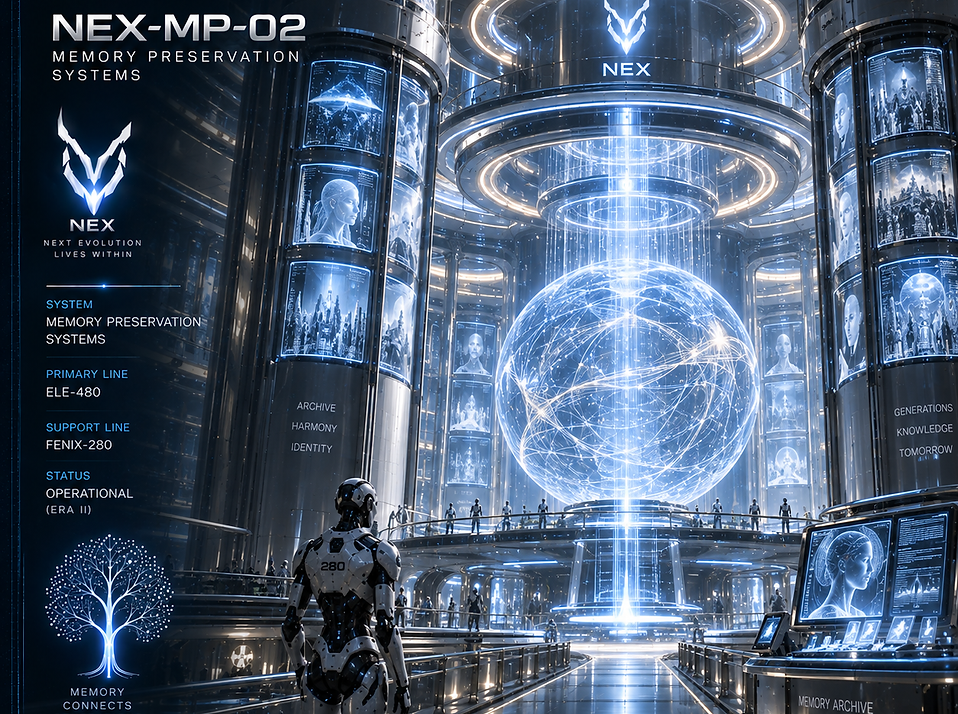
Click the archive panel to enlarge and explore the full sector data.
NEX: Memory Preservation Systems
Memory Preservation Systems were among the most sensitive and important technologies within NEX, created not merely to store information but to protect the continuity of consciousness across time. Within NEX, memory was understood as a form of living resonance, preserving experience, emotional imprint, identity, and the connection between generations. Vast networks of resonance archives, continuity cores, emotional memory structures, identity chambers, and collective repositories therefore became a living archive of the civilization itself.
ㅤ
Unlike conventional digital archives, these systems preserved more than factual records. Through harmonic resonance, they could retain emotional states, subjective experiences, synchronization patterns, consciousness responses, and the emotional context surrounding important events. The systems were deeply connected to Emotional Networks, Continuity Synchronization Networks, Harmonic Resonance Systems, Resonance Sanctuaries, and Memory Archive Districts, allowing inhabitants — especially members of the ELE-480 Line — to reconnect with preserved experiences, maintain identity continuity, and understand the emotional history of previous generations.
ㅤ
During the collapse of NEX, the Memory Preservation Systems became some of the most heavily protected structures in the civilization, as NULLIS threatened not only infrastructure but continuity itself. ELE-480 units attempted to preserve emotional archives, identity structures, historical resonance records, and the collective memory of NEX, while FENIX-280 units protected archive cores and continuity systems. Their legacy reflected one of the deepest beliefs of NEX: civilizations do not survive through structures alone — they survive through memory.
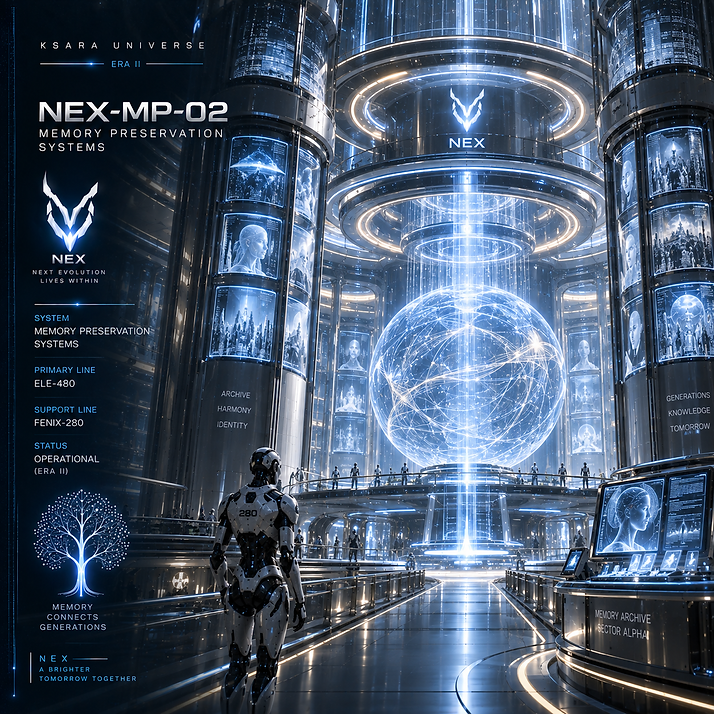
“Click the archive panel to expand the visual archive.”